

Audio player docked to bottom

Listen to this article
Key takeaway Insulating-fluid standards publish limits for three lifecycle states, not one. The number you quote is usually correct; the state you quote it in is what goes wrong. And the error is not reliably conservative — for water on a Category A transformer, the delivery spec for unused oil is looser than the in-service limit.
One sample, five verdicts
A transformer. The lab reports water at 25 mg/kg. Is that acceptable?
The honest answer is that the question is incomplete, and the ways of finishing it do not agree.
| Judged against | Limit | Verdict at 25 mg/kg |
|---|---|---|
| ASTM D3487-25 Table 1 — as received | max 35 mg/kg | within spec |
| IEC 60422:2024 Table 3 — new equipment, > 170 kV | max 10 mg/kg | exceeds limit |
| IEC 60422:2024 Table 5 — in service, Cat A | good < 15, fair 15–20 | poor |
| IEC 60422:2024 Table 5 — in service, Cat B | good < 20, fair 20–30 | fair |
| IEC 60422:2024 Table 5 — in service, Cat C | good < 30, fair 30–40 | good |
Water as mg/kg at transformer operating temperature. ASTM D3487-25 Table 1, p. 3; IEC 60422:2024 Table 3, p. 29, and Table 5, p. 36.
Run each row in the classifier
Each button opens the Oil Condition Classifier with that row already filled in — mineral oil, the standard, the lifecycle state, the highest voltage for equipment (Um) and water at 25 mg/kg. The tool derives the equipment category and produces the verdict itself; nothing is computed in this article.
Nothing about the oil changed. Read the first three rows as one unit: the same transformer above 170 kV at three points in its life — 35 mg/kg as delivered, 10 mg/kg after filling, below 15 mg/kg in service, Category A being the band above 170 kV (Table 1, p. 13). The last two rows change only the category, and move the same result from poor to good.
Notice which state is the most forgiving. ASTM D3487-25 is an acceptance specification for unused mineral oil as delivered, and against a Category A transformer it is looser than the in-service table by 20 mg/kg at the Good edge — 15 mg/kg against the top of the Fair band. The intuition that an acceptance limit is stricter, and that applying it to service oil is therefore at worst over-cautious, is false here: it is permissive, and it would let a genuinely wet transformer read as compliant.
Two conditions attach. Table 5 references water to transformer operating temperature, so a result reported at another temperature is not the number the band was written for, and the same table's Notes require that water "shall be always assessed together with the values for breakdown voltage". Water in ppm is also not the same statement as water as relative saturation — see why the two differ.
Why there are three states, not two
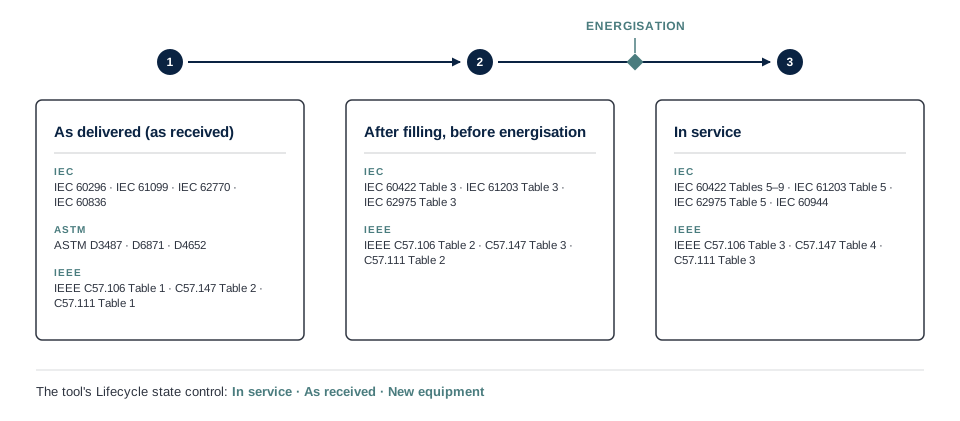
Split the lifecycle the way the standards actually split it.
As received. A commercial handover: did the supplier deliver what was ordered? The limits are manufacturing tolerances on a product that has never seen a winding.
New equipment (after filling, before energisation). The fluid is in the tank, has picked up whatever the tank and the solid insulation had to give, and has to be fit to energise. IEC 60422:2024 gives this its own table — Table 3, Recommended limits for mineral insulating oils after filling in new electrical equipment prior to first energization at site (p. 29), with Clause 8 (p. 28) drawing the boundary. Neither the delivery spec nor the service scale.
In service. A condition judgment on a fluid that is expected to degrade. The IEC bands for mineral oil and the esters are graded — good, fair, poor — because the question is no longer pass/fail but how far along, and how fast. IEC 60944 for silicone keeps a two-group split: satisfactory for continued use, or in need of treatment.
Different questions produce differently shaped answers, so the numbers do not track each other in one direction. Water on a Category A unit is stricter in service than on delivery, and stricter again in between. Acidity runs the other way: ASTM D3487-25 caps unused oil at 0.03 mg KOH/g (Table 1, p. 3), IEC 60422:2024 Table 3 holds the same 0,03 after filling (p. 29), and Table 5 treats a Category A oil in service as good below 0,10, fair from 0,10 to 0,15 (p. 36) — more than three times looser, because acid is an expected product of ageing rather than a manufacturing defect. Footnote d qualifies that row: "Acidity values are typical for uninhibited oils. Inhibited oils with 'Good' inhibitor content would have lower acidity values which are not expected to reach the 'Poor' condition" (p. 40). On an inhibited fleet the gap is narrower than the printed numbers suggest.
One legitimate practice looks like this error and is not: an operator may deliberately hold service oil to receipt limits as an internal standard. But "a stricter house rule" describes only one direction. On acidity the receipt number is genuinely the tighter one; on water it sits above the Good edge of every in-service category, so adopting it wholesale relaxes the water criterion rather than tightening it. A house rule is a defensible policy decision — it becomes an error only when it is applied in the belief that the standard requires it.
Which standard is which — as received, new equipment, in service
| Fluid | As received | New equipment | In service |
|---|---|---|---|
| Mineral | IEC 60296:2020 · ASTM D3487-25 · IEEE C57.166-2026 Table 2 | IEC 60422:2024 Table 3 · IEEE C57.166-2026 Table 3 | IEC 60422:2024 Tables 5–9 · IEEE C57.166-2026 Tables 4 and 8 |
| Synthetic ester | IEC 61099:2010 · ASTM D8240-22 · IEEE C57.166-2026 Table 2 | IEC 61203:2025 Table 3 · IEEE C57.166-2026 Table 3 | IEC 61203:2025 Table 5 · IEEE C57.166-2026 Tables 4 and 8 |
| Natural ester | IEC 62770:2024 · ASTM D6871-26 · IEEE C57.166-2026 Table 2 | IEC 62975:2021 Table 3 · IEEE C57.166-2026 Table 3 | IEC 62975:2021 Table 5 · IEEE C57.166-2026 Tables 4 and 8 |
| Silicone | IEC 60836:2015 · ASTM D4652-20 · IEEE C57.166-2026 Table 2 | IEEE C57.166-2026 Table 3 | IEC 60944:1988 · IEEE C57.166-2026 Tables 4 and 8 |
Two things about that table are easy to misread.
The IEEE guide spans columns on purpose. IEEE C57.166-2026 is titled a guide for acceptance and maintenance of insulating liquids, and it means it. Table 2 covers unused liquid as received from the supplier (printed pp. 42–44). Table 3 covers liquid in new equipment or after filling, prior to energization (pp. 46–47). Table 4 covers continued use in service (pp. 50–51), and Table 8 covers on-load tap-changer liquid in service (pp. 69–70). The guide combines the fluid-specific IEEE guides, among them C57.106 (mineral oil), C57.147 (natural ester) and C57.111 (silicone), into one document, and they are superseded by it (Introduction, p. 9). Citing "C57.166" without naming the table is the same ambiguity this article is about — and so is forgetting that IEC 60422:2024 publishes five in-service tables, of which Table 5 covers transformers and reactors.
ASTM appears only in the first column, and that is not an omission. ASTM's contribution here is unused-fluid specifications and test methods. We cite no ASTM graded condition scale for these fluids alongside the IEC bands, and an acceptance specification does not become one by being applied to oil in service.
Where the envelope closes further
Lifecycle state is the coarsest cut. Three finer ones decide the number just as firmly.
Equipment category. IEC 60422:2024 Table 1 (p. 13) sorts equipment into categories and Table 5 publishes the in-service limits per category — which is what produced three different verdicts from one water result above. The category is keyed on Um, the highest voltage for equipment (Table 1, NOTE 4), together with equipment type. It is derived, not chosen. IEEE C57.166-2026 draws the same kind of line for silicone liquid: in Table 4 its breakdown-voltage, dissipation-factor, acidity and water limits apply only at ≤ 69 kV, and the cells above that read N/A (printed pp. 50–51).
Tap-changer compartments. Oil in a tap-changer compartment is a different population from main-tank oil, and all three IEC in-service standards say so: each carries a Category F for the diverter tanks of on-load tap-changers. They differ in how much they publish for it. IEC 60422:2024 goes furthest — a table of its own (Table 6, p. 41) and construction guidance covering vacuum and non-vacuum types (Clause 9.4.3, p. 32). IEC 61203:2025 §7.4 states that "For Category F (tap-changers), only breakdown voltage and water content are specified", and that "the values specified are valid for both vacuum and non-vacuum type tap-changers" (p. 14); IEC 62975:2021 likewise specifies breakdown voltage and water content for Category F (Table 1, NOTE 4, p. 10; Table 5, p. 15) and adds an informative annex on use with on-load tap-changers (Annex C, p. 33). IEEE C57.166-2026 has no Category F but a table of its own: Table 8 gives suggested limits for continued use of in-service tap-changer liquid, in separate columns for non-vacuum and vacuum types and, except at the non-vacuum neutral end, by voltage class (§11.4.3, printed pp. 69–70). Fewer published parameters is not permission to reuse a main-tank limit — it is the standard declining to set one. More in reading a tap-changer DGA sample.
The test method. A limit is meaningless without the method that produced it. ASTM D3487-25 Table 1 makes the point in two lines of one property entry: breakdown voltage for the same unused oil is 20 kV minimum by D1816 at a 1 mm gap and 35 kV minimum by D1816 at 2 mm (p. 3). Same fluid, same standard, same page — the geometry sets the number, and footnote E scopes both limits to "as received new liquid". More in why a fixed gap doesn't give you one fixed number.
What to do instead
Establish the envelope before you read the limit. Four questions, in this order:
- Which fluid? It selects the standard family before anything else does.
- Which lifecycle state? As received, new equipment (after filling, before energisation), or in service. Three tables, not one.
- Which equipment category? Derived from Um and equipment type, not chosen. It moved one water result across three verdicts above.
- Which test method? The method is part of the limit. Change the method and the number changes with it.
Only when all four are answered does a number mean anything.
Then resist the pull of the single exceeded value, because the standards do. IEC 60422:2024 Clause 9.4.1 calls trend "essential information when arriving at a final decision" and asks for "due consideration of the results of all tests, the age and type of equipment" (p. 32). Clause 10 is blunter: "It is strongly emphasized that no action should be taken based on either one result or one property, or both" (p. 45). IEEE C57.166-2026 §8.2 holds that "no single test can be used as the sole criterion to estimate the condition of the transformer", and, under Condition I, that it is "not intended that liquids be removed from service when a single property limit is exceeded or that the liquid be left in service until all property values are outside the stated limits" (both printed p. 49).
That is a striking pair of positions. The documents people quote to condemn a transformer on one number explicitly advise against doing so.
💡 Tip
Set the state before you read the limit. Open the Oil Condition Classifier, pick the fluid and the standard, then set Lifecycle state — In service, As received, or New equipment. That control is this article reduced to three buttons: it decides which of the standard's own tables you are scored against, and the answer changes shape with it. In service returns condition bands — good / fair / poor under IEC (Group 1 / Group 2 under IEC 60944 for silicone), Condition I/II/III under IEEE C57.166-2026 §8.2 for liquid in the main tank. The two acceptance states return a two-way verdict instead — within spec / out of spec where an IEC lane checks unused fluid against its delivery specification, meets limit / exceeds limit against an after-filling table or an IEEE C57.166-2026 acceptance table — because an acceptance table sets one limit per property, not a condition scale. The IEC 60944 lane for silicone offers only In service and As received. Enter the highest voltage for equipment (Um) and the tool derives the equipment category instead of asking you to pick it. Where a standard publishes no limit for a cell, it says so rather than inventing one.
One result is a data point. A verdict needs the envelope, the trend, and the transformer.
Frequently asked questions
Can I use ASTM D3487 limits to judge oil that is already in a transformer?
Are acceptance limits for unused oil always stricter than in-service limits?
What is the difference between acceptance limits and in-service limits for transformer oil?
Is IEEE C57.106 an acceptance standard or a maintenance standard?
Which limits apply to oil in a new transformer that has been filled but not yet energised?
Does exceeding one limit mean the oil should be replaced?
Standards referenced
The methods on this page are anchored in these standards — follow each into our standards library.
Put Theory into Practice
Try our interactive Duval diagnostic tools or use our new unified workflow to analyze your transformer oil data.