
Audio player docked to bottom
Listen to this article
Key takeaway
Water in a transformer moves by chemical potential, not by concentration. At equilibrium the water activity — relative saturation (%RS) in the oil, equilibrium relative humidity in the paper — equalises across phases. That makes ppm an ambiguous unit: the same ppm means near-saturation in cold mineral oil and barely-damp in a warm ester, and a flat ppm limit is silent about the temperature that decides whether the water is dangerous. %RS is the unit that tracks the actual dielectric risk and the only one comparable across a mixed mineral/ester fleet. Even IEC 60422:2024 still classifies water by ppm in its normative table and keeps %RS in an informative annex — so bridging the two is interpretation work, and it is the work we do.
"The sensor says 12 %RS, the lab says 45 ppm — which one is lying?"
Neither.
It is one of the more common questions we get from a condition-monitoring lead staring at two reports that refuse to agree. An online moisture probe on a transformer reports relative saturation; the laboratory slip from the same unit reports parts per million. The numbers disagree, the engineer assumes one instrument is wrong, and a perfectly healthy unit gets flagged — or a wet one gets cleared.
The numbers are not wrong. They are orthogonal. ppm counts water molecules per million parts of oil. %RS measures how close the oil is to holding all the water it can at that temperature. They answer different questions, and converting between them requires the one piece of information the disagreement usually omits: the temperature, and the fluid.
The same ambiguity poisons fleet comparison. Sample a dozen units at different loads, different ambient temperatures, different times of year, and you get a column of ppm figures that look comparable and are not. One physical principle reconciles all of it — and it has been sitting in plain sight across the moisture annexes of IEC 60422, IEC 61203, and the CIGRE brochures the whole time. This article pulls it into one place, and then shows where the standards still leave you stranded on ppm.
Twenty seconds of physics: chemical potential, not ppm
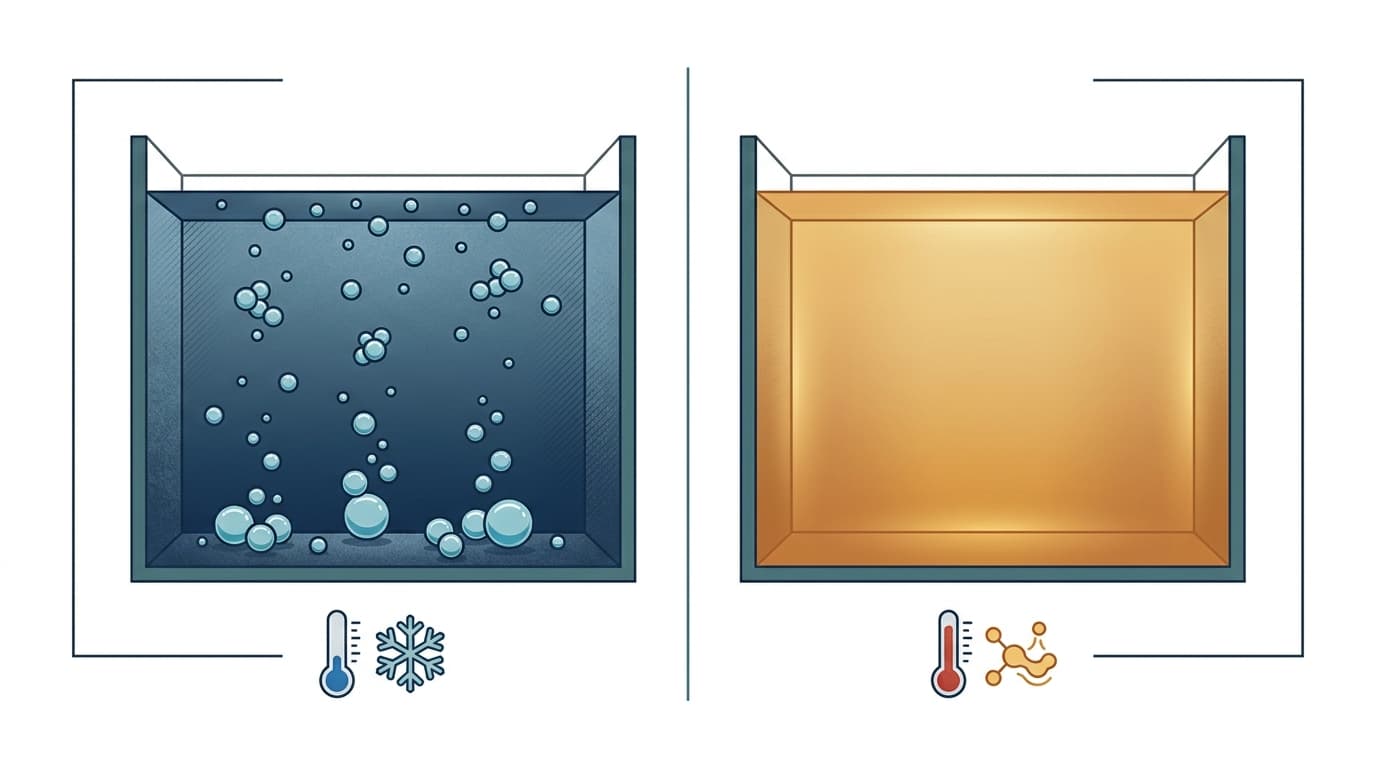
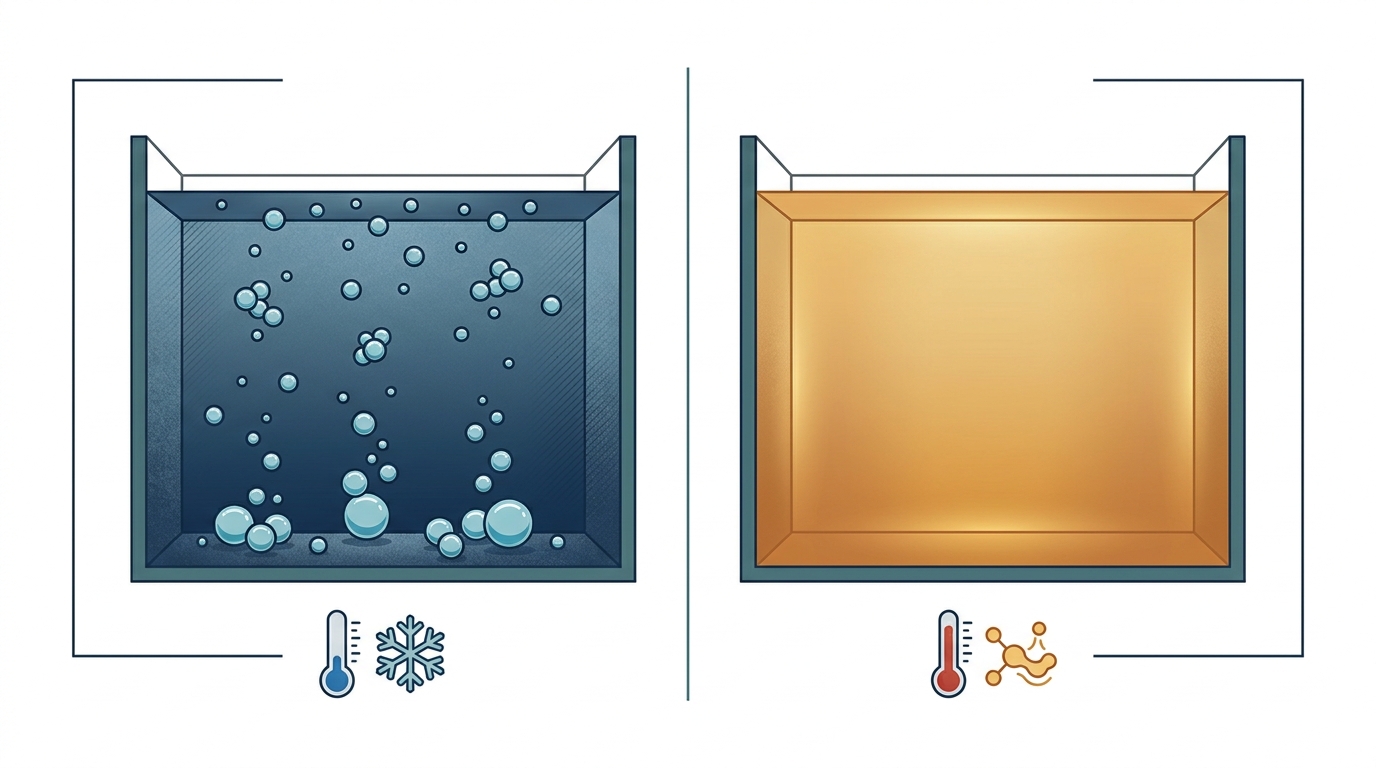
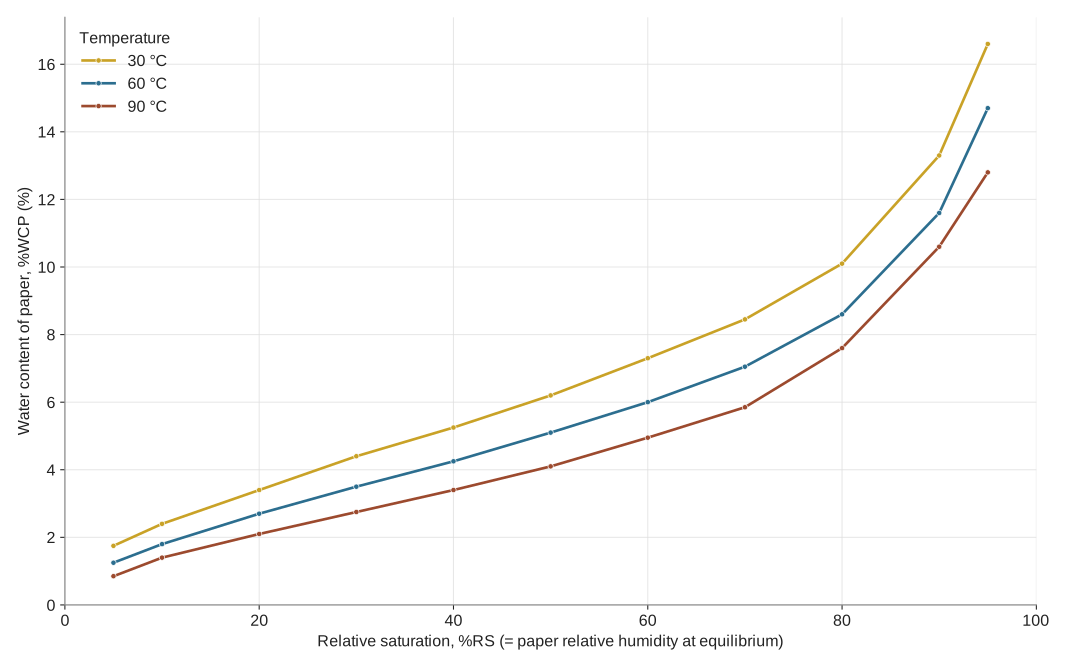
Cellulose is polar and strongly hygroscopic. Oil is non-polar and holds very little water. Put them in the same sealed tank and water migrates between them until its chemical potential — its escaping tendency — is equal in both phases. The concentration is not equal at that point; nowhere near it. What equalises is the water activity.
In the oil, water activity is expressed as relative saturation:
where is the dissolved water (ppm) and is the saturation limit at that temperature. In the paper it is expressed as an equilibrium moisture content. The two are tied together by an isotherm.
The saturation limit itself is not a constant — it climbs steeply with temperature, following an Arrhenius-form law:
with in kelvin and the coefficients , specific to each fluid (IEC 62975:2021 / IEC 61203:2025, Annex A). The single most important consequence falls straight out of that equation: a saturation value with no temperature attached is meaningless, and so is a ppm reading you want to interpret as risk. Warm the oil and rises, so the same dissolved water is a smaller fraction of saturation — lower %RS, lower risk. Cool it and the reverse happens, with no change in the water inventory at all.
Why ppm is an ambiguous unit
There are three distinct ways the same ppm number misleads, and they stack.
First, the same ppm is a different risk at different temperatures. Take a sealed mineral-oil unit holding 25 ppm of dissolved water. Run that constant inventory through a cooling curve and the relative saturation climbs relentlessly:
| Top-oil temperature | %RS at 25 ppm (mineral oil) |
|---|---|
| 60 °C | 10.8 %RS |
| 40 °C | 21.6 %RS |
| 20 °C | 47.6 %RS |
| 10 °C | 73.6 %RS |
Same water. The ppm slip reads 25 either way. But at 60 °C the oil is comfortably dry, and at 10 °C it is three-quarters of the way to free water — and the water keeps coming out of solution entirely (100 %RS) at about 3.4 °C. We will return to this case below, because it is the one that catches people.
Second, the same activity gives different ppm depending on sampling temperature. Run it backwards: a bottle drawn from a warm unit and one drawn from the same unit cold will report different ppm for identical water activity. If nobody recorded the top-oil temperature at the moment of sampling, the ppm is uninterpretable as risk.
Third — and worst — ppm cannot cross fluids at all. Here is the same dissolved-water figure read against four different fluids at 20 °C:
| Fluid | 30 ppm water → | 200 ppm water → |
|---|---|---|
| Mineral oil | 57.1 %RS | 380 %RS (free water) |
| Silicone | 15.6 %RS | 104 %RS (free water) |
| Natural ester | 3.2 %RS | 21.6 %RS |
| Synthetic ester | 1.6 %RS | 10.6 %RS |
Thirty ppm is more than half-saturated in cold mineral oil and essentially bone-dry in a synthetic ester. Two hundred ppm is free water in mineral oil and silicone, and merely "watch it" in the esters. A single ppm threshold applied across a mixed fleet is not conservative or liberal — it is meaningless.
This is why IEC 60422's category-tiered ppm limits for mineral oil and the voltage-tiered ppm limits in IEEE C57.166-2026 both work yet feel brittle. They are not wrong. But each prints one ppm figure per equipment class, whatever the temperature. IEC 60422 Table 5 states water content in mg/kg at transformer operating temperature and requires the value to come with recorded temperatures, yet prints a single limit per category. C57.166 leaves temperature to a footnote. C57.166 Table 4 sets ≤ 35, ≤ 25 and ≤ 20 mg/kg for in-service mineral oil at ≤ 69 kV, > 69 kV to < 230 kV and ≥ 230 kV. These are the same figures as in IEEE C57.106-2015, which C57.166 supersedes. Of temperature it says only that the limits are relevant above 20 °C. Nor do they carry across fluids: IEC 60422 is written for mineral oil, and C57.166 gives the esters their own, much higher ppm tiers (≤ 450, ≤ 350 and ≤ 200 mg/kg) instead of one scale shared across fluids.
💡 Tip
ppm is a snapshot of how many water molecules are dissolved right now. %RS is a statement about the water itself — how close it is to coming out of solution. For risk, you want the statement about the water, not the molecule count.
The number the standard still defaults to
If %RS is the better unit, why does the lab still hand you ppm?
Because the standards still default to it. IEC 60422:2024 Table 5 — the normative condition table for mineral oil — classifies water content by ppm only: for a Category A transformer, "Good" is below 15 ppm, "Fair" 15–20 ppm, "Poor" above 20 ppm, and the Notes column requires that water always be assessed together with breakdown voltage. There is no normative %RS threshold in the body of the standard.
The %RS apparatus does appear — but in the informative Annex B. Annex B, Table B.1 gives the online-monitoring bands (below 10 %RS good, 10–20 %RS fair, above 20 %RS poor) and is explicitly scoped to continuous online measurement, not to a spot lab sample.
This is real progress, and worth saying plainly: the 2024 edition formalised the relative-saturation method for the first time — the Arrhenius saturation model, the adsorption/desorption hysteresis treatment, the whole Annex B guideline. The standard now knows how to talk about %RS. What it did not do is promote %RS to the normative classifier. There is no "%RS table" you can point a procurement clause at; the binding threshold is still the ppm figure in Table 5.
So even the newest maintenance standard leaves the working engineer with ppm as the default unit and a single ppm limit per category to apply it through — one that asks for the temperature to be recorded but does not move with it. That gap — between the unit the physics wants and the unit the normative table gives you — is precisely the interpretation work a fluid-neutral %RS treatment fills. We are not claiming the standard "switched to %RS." We are saying it built the apparatus and then left it in the annex, and somebody has to bridge that.
The worked gotcha: a winter cool-down spikes %RS toward free water
Here is the case that turns the abstract argument into a maintenance decision.
A sealed mineral-oil unit is sampled in summer, warm, mid-load. The slip comes back at 25 ppm. Against the 20 ppm Table 5 "Poor" line it looks marginally high but unalarming — and at the warm sampling temperature the oil genuinely is dry. The file gets a note and the unit stays in service.
Now read the same 25 ppm inventory through the operating temperatures the unit will actually see, using the conversion table from earlier:
- At 60 °C (summer, loaded): 10.8 %RS — dry, no concern.
- At 40 °C (mild operation): 21.6 %RS — into the Annex B "Poor" band.
- At 20 °C (cool ambient, light load): 47.6 %RS — approaching half-saturated.
- At 10 °C (winter, lightly loaded): 73.6 %RS — three-quarters of the way to free water.
The water never changed. The summer ppm "looked fine." But on a cold winter night at light load, that same inventory pushes the oil toward the free-water regime where breakdown voltage collapses — and free water forms outright (100 %RS) at about 3.4 °C. The risk was always there; ppm just hid it behind a convenient sampling temperature.
The lesson is not "sample in winter." The lesson is that %RS, evaluated at the cold operating point, is what tracks the genuine risk — and the risk moves with temperature even when the water inventory is frozen. A spot ppm reading at whatever temperature the sampler happened to catch is the weakest possible basis for that judgement.
Try it yourself: the fluid-neutral RH calculator below converts a ppm reading at one temperature to %RS at any other, for all four fluid families. Enter your sample ppm and top-oil temperature, then read off the %RS at a cold operating point — the number the warm sample was hiding.
The alcohol markers obey the same form of correction
Now the part no one else writes — and the reason temperature correction is one habit, not several.
Methanol and ethanol are produced when cellulose depolymerises; they are among the most sensitive available markers of paper ageing. Like water, they are small polar molecules that partition between paper and oil and redistribute with temperature. So the ppm of alcohol your lab measures in the oil is, like the water ppm, a temperature-dependent window onto a quantity that mostly lives in the paper.
CIGRE TB 779 makes the parallel explicit. Its temperature-correction factor corrects four markers — 2-FAL, methanol, ethanol, and water — to a reference temperature, all on a single plot (Fig 4-10, p. 35; Eq. 4-3, p. 35). The methanol and ethanol curves sit close to each other and are steeper than the 2-FAL curve. Read the family together and the point is unmistakable: the alcohol markers obey the same form of temperature correction as water.
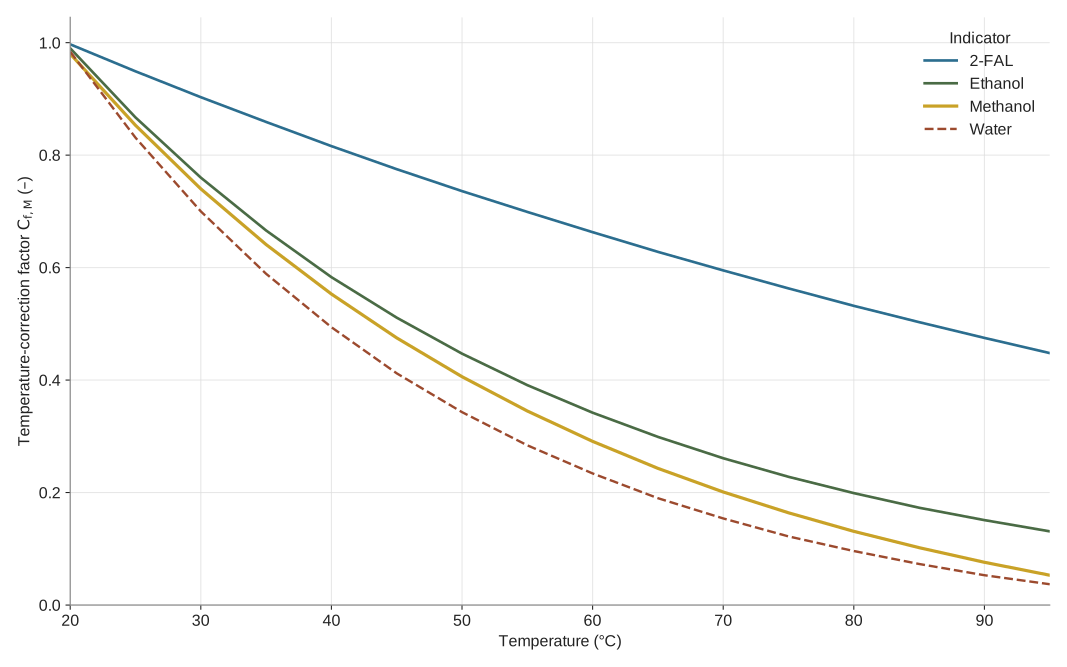
The caveat matters, and we state it: analogous, not identical. Water and the alcohols have different activation energies and different partition coefficients, so the curves are not the same curve — methanol under-reports by roughly two-to-three times more at 70 °C than at 25 °C, a different slope from water's. The claim is about mathematical form, not chemistry. But the practical consequence is exactly what you want: an engineer who already corrects water to a reference temperature already knows how to correct the alcohol markers. It is the same discipline applied to a second set of partitioning molecules.
This is the harmonisation thesis made concrete. Online %RS, lab ppm, and the alcohol-marker correction are three readings of partitioning molecules governed by the same physics. Tying them into one interpretation of the paper's condition is an angle we hold as an independent consultancy — not a clause in any one standard, but a read the standards collectively support.
Two of our calculators apply that one discipline to two different jobs — and the jobs must not be confused. The ageing-marker temperature corrector normalises a methanol, ethanol or 2-FAL reading to a 20 °C reference, so samples drawn at different temperatures become trendable instead of recording a trend in sampling weather. The 2-FAL → paper-DP estimator runs a furfural reading through the four published furan-DP models at once and shows their spread — fed the raw lab value, never a temperature-corrected one, because those models were calibrated on the raw concentration. So the rule splits cleanly: correct the markers for trending; feed raw 2-FAL to the DP estimator.
Decision rules — when to use which unit
The payoff, as crisp rules:
- Use %RS to rank risk across assets and across fluids. It is the only unit comparable across a mixed mineral/ester fleet.
- Reserve ppm for trending within one fluid — and only when the sampling temperature is recorded on the same line. A ppm trend with no temperatures is a trend in sampling weather, not in moisture.
- Judge risk at the cold operating point, not the convenient sampling temperature. A winter cool-down can spike %RS toward free water even when a warm-sample ppm looked fine.
- For procurement of ester-filled units, specify %RS acceptance limits at a stated reference temperature — not a bare ppm figure that means nothing without the fluid's saturation curve.
- Apply the TB 779 temperature correction to the alcohol markers before trending them, the same way you temperature-correct water.
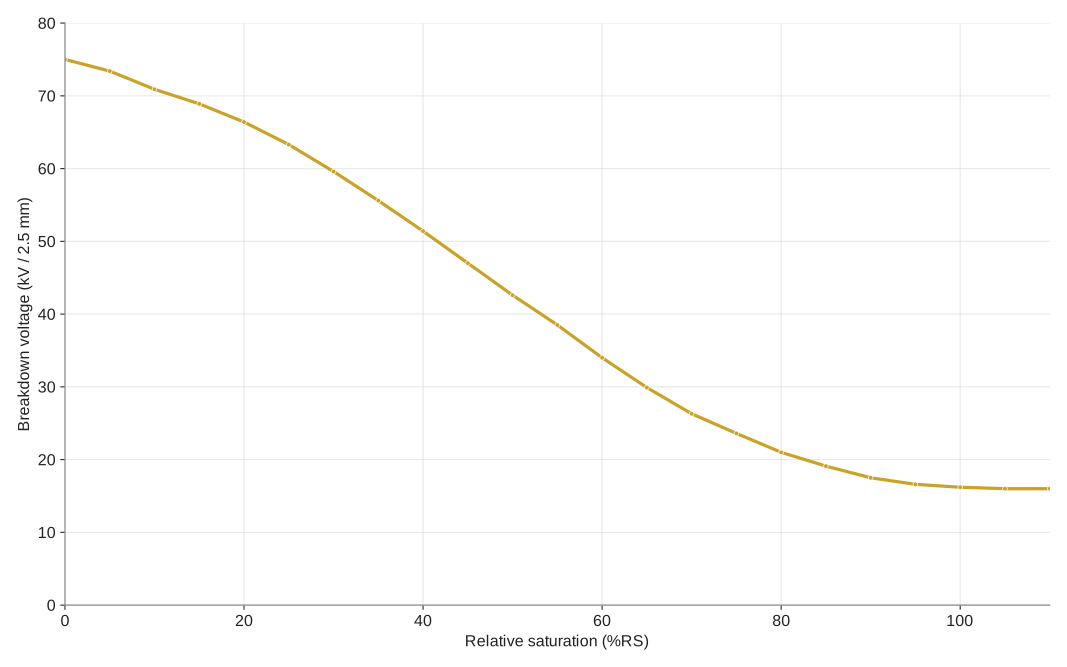
- Always pair %RS with breakdown voltage. IEC 60422 Table 5 requires water and BDV to be read together, and BDV is what the water actually threatens.
💡 Tip
%RS is the right unit for almost every risk question. ppm is still the right unit when the question is "did the sample container leak?" — an absolute molecule count is exactly what you want for a contamination or sampling-integrity check.
What to ask for, what to deliver
If you take one operational habit from this, make it the sampling line. On every moisture sample, demand:
- Top-oil temperature at the moment of sampling — without it, the ppm cannot be converted to %RS or to risk.
- The Karl Fischer method used (coulometric vs volumetric) and whether the result is corrected for the fluid.
- The fluid type on the line — a ppm with no fluid attached cannot be classified at all.
And on a moisture report cover, deliver: ppm as measured, %RS at the sampling temperature, %RS at a stated cold reference temperature, the trend, and the paired BDV. That is the difference between a number and a judgement.
"But ppm is one fixed number I can put in a report — why deliver %RS as well?" For a transformer in service, ppm is not the fixed number it looks like. As the unit heats and cools, water migrates between paper and oil, so the oil ppm swings with the sampling temperature: the same unit, same total water, same risk, reads differently on a warm afternoon and a cold morning. The figure that holds still across that swing is %RS referenced to a stated temperature. Keep ppm for the inventory trend; judge the risk on %RS.
When several units in a fleet sit near the boundary, or an online sensor and a lab slip refuse to agree, a dedicated moisture survey — reconciling the sensor %RS, the lab ppm, and the alcohol-marker trend against one another — is usually worth more than another round of spot samples.
That reconciliation is the work TriboTech is built to do: a lab-and-vendor-neutral interpreter that harmonises online %RS, laboratory ppm, and the alcohol-marker temperature correction into one read on the paper. No sensor OEM, lab, or fluid vendor does it, because each owns only one corner of the picture.
Send us your numbers. If you have DGA, online sensor logs, and a lab moisture report for a unit you are unsure about, send them over for a complimentary read on whether you genuinely need a dry-out — or whether the ppm was just hiding behind a warm sample.
For the companion piece on where the water physically sits and how ester fills change the partition, see Where the Water Actually Is — Oil, Paper, and the Ester Difference.
Questions engineers ask
Why does the oil ppm drop when I resample the same transformer cooler?
The oil's carrying capacity falls with temperature, so the oil sheds water back into the paper — while the water activity barely moves. A unit reading 10 ppm at 30 °C reads about 6.7 ppm resampled at 20 °C, and the "missing" ppm never left the tank; the cellulose, which holds the overwhelming majority of the water, reabsorbed it. A one-third swing for an identical physical state — same water, same risk — is exactly why a bare ppm figure resists trending, and why the calculator reports a ppm-equivalent at a reference temperature instead.
How do you convert oil %RS to paper moisture?
Through the water activity the two phases share. Relative saturation in the oil and relative humidity in the paper are two names for one quantity, and at equilibrium they equalise — which is why the water stops moving in the first place. Oil at 13 %RS therefore sits in equilibrium with cellulose at about 13 % relative humidity, and the sorption isotherm translates that into moisture by weight — the calculator's "estimated paper moisture" figure. The chain runs: oil ppm → oil %RS (= water activity) ⟺ paper relative humidity (= water activity) → paper moisture by weight.
Is relative saturation affected by transformer temperature?
It is the far more stable unit, but not a literal constant. Immediately after a temperature change, before water can migrate, %RS moves the way the saturation curve dictates — that is the winter cool-down spike behind the free-water hazard above. Once oil and paper re-equilibrate, the activity settles a little lower cold than hot, because the cellulose sorption isotherm is itself temperature-dependent. Through all of it %RS moves far less than ppm, which is why we trend it; but the calculator's ppm-equivalent at a reference temperature is a constant-activity normalisation, not a predicted re-measurement. To know the exact resampled figure, resample.
Standards referenced
The methods on this page are anchored in these standards — follow each into our standards library.
Put Theory into Practice
Try our interactive Duval diagnostic tools or use our new unified workflow to analyze your transformer oil data.