
Audio player docked to bottom
Listen to this article
Key takeaway: A dissolved-gas result means nothing until you know which population it belongs to. Two of the four insulating-fluid families in general service acquired a new interpretation standard inside twelve months — IEC 63585:2026 for esters, published July 2026, and IEEE C57.146-2025 for silicone, replacing a guide that had stood since 2005. These documents differ in workflow and in population, not by a few ppm. Most wrong conclusions in cross-fluid DGA are made at "is this result diagnosable at all", not at the triangle.
This is the fluid-axis companion to Navigating the DGA Maze, which compares IEC 60599, IEEE C57.104 and CIGRE TB 771 for one fluid — mineral oil. Read that one first if the cross-body picture is new. Here the standards stay put and the fluid changes, which is the harder axis: the same gas vector, in mineral oil, natural ester, synthetic ester and silicone, is four different findings.
What follows is a crosswalk of disagreements, not a synthesis. Nobody has harmonised these documents, and pretending otherwise is how a confident, well-formatted, wrong answer gets written.
Two new standards in twelve months
IEC 63585:2026 is the first International Standard written specifically for dissolved-gas interpretation in ester liquids — natural esters per IEC 62770, synthetic esters per IEC 61099. It supplies the quantitative layer: percentile positions by base oil and two-gas ratio criteria. Rates of gas increase it requires per unit but cannot yet give percentiles for — "90 or 95 percentiles of rates of gas increase cannot be reported presently due to insufficient data" (Clause 5.4, p. 20). It is candid about its limits. Switching equipment is out: "Due to insufficient DGA data available, switching equipment is excluded from this document" (Clause 1, p. 7). On the graphical tools it says plainly that "for the time being there is not enough consolidated evidence that those faults can be identified in esters based on real cases" (Clause 5.6, p. 21).
IEEE C57.146-2025 is not a refresh of the 2005 guide; it is a different standard. Where 2005 gave one consensus threshold per gas, 2025 gives 90th- and 95th-percentile norms drawn from roughly 160 000 silicone-transformer samples (Annex A.1, p. 39), a three-level DGA status, and an IEEE-published Duval Triangle. The 2005 thresholds survive only as informative Table A.1, whose own footnote b (p. 39) disavows total dissolved combustible gas: "Recent developments in DGA do not use the TDCG as a diagnostic parameter."
The gap between the editions is not uniform. Annex A.1 calls the 2005 values "fairly close to the Table 2 values" — true for the carbon oxides, badly false for ethylene, where the retired threshold of 30 ppm sits five to ten times above the 2025 guide's 90th-percentile band of 3 to 6 ppm (Table 2, p. 33). Screening silicone ethylene against 30 ppm is not screening it.
The error is upstream of the triangle
Every DGA interpretation is three decisions in sequence: is this result diagnosable at all — right population, right fluid, right edition, right extraction method, enough gas above the detection limit? Which fault family, at the resolution the fluid supports? Is paper involved, and how urgently?
Step 1 is where the mistakes are made. A Duval zone read off a correctly plotted point is rarely the error. The error is upstream: ester ethylene read against the wrong base-oil percentile table, silicone screened on carbon-oxide bands three times too tight, a 2005 threshold quoted from a guide that retired it in 2025.
Every document tells you what it does not cover
Scope clauses are the cheapest diagnostic in the landscape, and the least read.
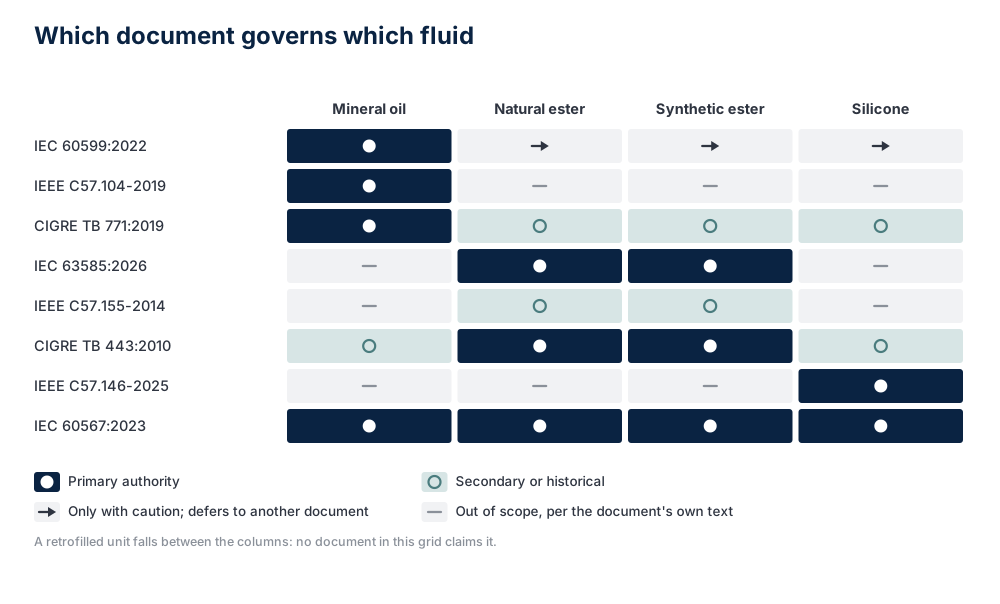
- IEC 60599:2022 says of itself that it "can be applied, but only with caution, to other liquid-solid insulating systems" (Clause 1). Its whole treatment of the other three families is Clause A.8 — a few lines saying the gases are the same but the zone boundaries need adjusting, pointing at one bibliography reference: CIGRE TB 443:2010. Anyone who says "we interpret this ester per IEC 60599" is, by IEC 60599's own instruction, pointing at TB 443.
- IEEE C57.104-2019 routes explicitly: esters to C57.155, silicone to C57.146, tap changers to C57.139, factory tests to C57.130 (Clause 1.3, pp. 13–14). The same clause carries a subtlety for anyone in wind — wind-turbine and network transformers are not excluded from the guide's applicability; their data subset was left out of the norms study, so the guide's own norms over-flag them.
- IEC 63585:2026 excludes switching equipment, and does not cover silicone at all.
- IEEE C57.146-2025 applies to "silicone-immersed transformers in which the silicone liquid was the liquid supplied when the transformer was originally manufactured" (Clause 1.1, p. 13). Retrofills are outside scope; so is gas-space analysis (Clause 1.2, p. 13).
- IEEE C57.155-2014 has been Inactive-Reserved since 27 March 2025, revision under development. Citable for provenance — its limitation clause described its own basis as "a limited amount of in-service DGA results and several laboratory-based experimental data sets" (Clause 1.3, p. 2) — but not as current guidance.
- IEC 62975:2021, the natural-ester maintenance guide, states that "the interpretation of gas composition is out of the scope of this document" (Clause 9.7, p. 21).
A retrofilled unit therefore falls between every column: excluded by name from C57.146-2025, unaddressed by IEC 63585's specification-based scope, and carrying a residual mineral fraction that shifts baseline and zone geometry alike. Name it as an uncertainty; do not pick the nearest pure-fluid column.
The percentile axes do not line up
The strongest consensus in the landscape is that a percentile is not a limit — and it is the one most often broken in practice, including in vendor limit tables. IEC 60599:2022 states that typical values "shall not be used to ascertain whether or not a fault exists within the equipment" (Clause 8.2.1). IEC 63585:2026 carries the same position forward — "As pointed out in IEC 60599, percentile values shall be used just as a management tool" (Clause 5.2, p. 16). IEEE C57.146-2025 says its own norms "should not be considered, at any time, as 'universal,' 'absolute,' 'authoritative,' or 'immutable' references" (Clause 6.1.2.5, p. 33).
Having agreed on that, they agree on nothing else. IEEE C57.104-2019 and IEEE C57.146-2025 both stratify on the O2/N2 ratio (split at 0.2) crossed with transformer age (Unknown / 1–9 / 10–30 / over 30 years) — eight columns each. IEC 63585:2026 stratifies on base oil type. CIGRE TB 771:2019 builds sub-databases per fault type and location; CIGRE TB 443:2010 splits by fluid product and by network versus traction service.
These axes are mutually unintelligible. There is no mapping from an O2/N2 column to a base-oil column, so comparing percentile numbers across fluids is not comparing two populations — it is comparing unrelated statistics that share a unit.
And the base-oil axis has more spread inside it than most people expect. In IEC 63585:2026, the 90th-percentile ethane for a soybean-based natural ester is 332 ppm (Annex B, Table B.2, p. 25); for a high-oleic sunflower natural ester it is 4.5 ppm (Table B.3, p. 25). A factor of roughly 74, inside one fluid family, that no other document in the landscape sees at all. Establish the base oil before you reach for a number.
Natural ester: the ratio whose denominator moves
This is the counter-intuitive part, and it needs stating precisely, because the blunt version of it is wrong.
The quotients themselves carry over. IEC 63585:2026 says so in terms: "the data from transformers filled with ester liquids show that aforementioned gas ratios for mineral oil can also be applied for synthetic and natural ester liquids as well" (Clause 5.3.1). What does not carry over is IEC 60599's mineral-oil numerical criteria, replaced by percentile-coupled criteria of 63585's own — so a ratio alone never triggers anything.
The thermal criterion for a natural ester is C2H4/C2H6 at or above 1 and C2H4 above the 90th or 95th percentile (Clause 5.3.5, p. 19). The trap is the denominator: certain natural esters — the standard's own example is "linolenic acid containing" esters — develop relevant ethane concentrations with no fault present at all, because ethane formation is "significantly dependent on the poly-unsaturation level and base oil type". Its poly-unsaturation figures make the range concrete: soybean 61 %, sunflower 69 %, high-oleic sunflower 8 % (Table 2, p. 19).
So a genuine high-temperature fault may go unrecognised: the ratio never reaches 1, because the ethane floor keeps rising underneath it. IEC 63585 puts it cautiously — a significant increase in C2H4/C2H6 "could suggest the possibility of an incipient high-temperature thermal fault, even if C2H4/C2H6 does not reach values > 1", to be tested by a regular DGA survey (Clause 5.3.5, p. 19). On a poly-unsaturated natural ester, the ratio must be trended, not read.
One detail not to smooth over. The same standard writes that condition with a strict inequality for natural ester — C2H4 greater than the percentile (Clause 5.3.5, p. 19) — and greater than or equal to for synthetic ester (Clause 5.3.4, p. 18). Keep whichever operator belongs to the fluid in hand.
Silicone: carbon oxides three times higher, ethylene eight times lower
The most consequential cross-fluid number set in the landscape is four cells wide. Both columns below are 90th-percentile norms at O2/N2 at or below 0.2, transformer age Unknown — the directly comparable stratum.
| Gas | Mineral oil (IEEE C57.104-2019, Table 1, p. 38) | Silicone (IEEE C57.146-2025, Table 2, p. 33) |
|---|---|---|
| Carbon monoxide | 900 | 2 500 |
| Carbon dioxide | 9 000 | 30 000 |
| Ethane | 90 | 15 |
| Ethylene | 50 | 6 |
Read it in both directions, because both directions are wrong in service. A silicone unit flagged on mineral-oil carbon-oxide norms is unremarkable in its own population; screening it that way manufactures false paper-degradation findings. A silicone unit at mineral-oil-normal ethylene is already at roughly eight times its own 90th percentile; screening it that way misses real thermal faults.
The 2025 revision also gave silicone something it had never had: a Duval Triangle in an IEEE guide, with zone boundaries in Table 6 (p. 37). It disagrees with the older geometry on one edge — the D1/D2 boundary is printed at 8 %C2H4 where CIGRE TB 443:2010, Table 4 puts it at 9 — so a point in that narrow band is low-energy discharge on one reading and high-energy discharge on the other. State the conflict; do not pick silently.
What silicone still does not have is a Pentagon with published coordinates. CIGRE TB 443:2010 predates the Pentagons; CIGRE TB 771:2019 states that non-mineral oils, silicones included, need "only relatively minor adjustments to fault zone boundaries of the Triangles and Pentagons for mineral oil" (p. 15), but the Pentagons 3 it publishes are drawn for four esters only (Appendix H.8); IEEE C57.146-2025 publishes a Triangle and no Pentagon. If a report shows you a silicone Pentagon, ask which document its zone boundaries came from — no standard has printed them.
💡 Tip
Establish the mineral-oil reading before you leave it. Plot the gas vector in the Duval Triangle tool and run the ratio scheme in the IEC 60599 tool, then read the difference against the numbers above. Seeing where the mineral-oil frameworks land a result is how the fluid-specific shift becomes visible — and the shift, not the mineral-oil answer, is the finding.
The number is fluid-dependent before interpretation starts
None of the above matters if the number itself was produced differently.
IEC 60567:2023 Annex F is normative: the mineral-oil methods of Clauses 6 to 11 still apply to esters and silicones, but with the differences Annex F lists. Vacuum exposure goes up to 10 minutes against 3 minutes for mineral oil, viscosity-dependent; the extracted gas volume must be corrected by subtracting the water vapour extracted with it, negligible in mineral oil and large in an ester; and headspace calibration is recommended in the same liquid. IEC 63585:2026 pulls that Annex in normatively for esters, alongside IEC 60475 for the act of sampling (Clause 5.1; the reference is undated).
IEEE routes silicone elsewhere entirely: the normative sampling and analysis references of IEEE C57.146-2025 are ASTM D923 and ASTM D3612, with IEEE C57.143 for monitoring equipment (Clause 2). Two bodies, one fluid, two method chains.
The consequence is short. A trend that crosses a laboratory, an extraction method or a sampling-point type is not a trend. It is two populations plotted on one axis.
Do not use
- IEC 60599:2022 Table 1's numerical criteria and six-code output on an ester. The quotients transfer; the criteria do not (IEC 63585:2026, Clauses 5.3.1 to 5.3.5).
- C2H4/C2H6 alone on a poly-unsaturated natural ester.
- Mineral-oil hydrogen norms, partial-discharge criteria or key-gas patterns on silicone — and Duval Triangle 1's mineral-oil zones on any of the three non-mineral fluids.
- Mineral-oil CO/CO2 bands on an ester without stating the caveat — the fluid itself contributes the baseline.
- IEEE C57.104-2008 Conditions 1–4, or TDCG, anywhere. Both were removed in the 2019 revision (Introduction, "Changes in this revised guide", p. 9), and TDCG is disavowed for silicone too.
- IEEE C57.146-2005 Table 1 as operative silicone thresholds. In the 2025 edition Table 1 is the gas-solubility table; the 2005 values survive only as informative Table A.1.
- IEEE C57.155-2014 presented as current guidance, or any pure-fluid document on a retrofill blend.
What to do with a mixed fleet
- Record the fluid, the base oil and the fill history — not just "ester". Soybean and high-oleic sunflower differ by a factor of 74 at the 90th-percentile ethane, and no guide is written for a retrofill.
- Record O2, N2 and transformer age on every silicone and mineral-oil sample. Both IEEE guides stratify on them; without them no column can be selected.
- Pin the edition in your specification, not just the number. "Per IEEE C57.146" was a stable instruction for twenty years and stopped being one in 2025.
- Trend ratios on natural ester; do not read them. The ethane denominator moves on its own.
- Freeze the method chain before you freeze the trend — same laboratory, same extraction route, same sampling point.
If your fleet has crossed from one fluid family into two or three, the question is not which standard is best. It is which document has authority over each unit you own — and whether the last report you received knew.
Frequently asked questions
Can I use IEC 60599 to interpret DGA in an ester transformer?
Which standard covers DGA in natural and synthetic ester transformers?
Why can't I read the C2H4/C2H6 ratio directly on a natural ester?
How different are silicone DGA norms from mineral-oil norms?
Is there a Duval Pentagon for silicone fluid?
Does an ester DGA trend need the same laboratory every time?
Standards referenced
The methods on this page are anchored in these standards — follow each into our standards library.
Put Theory into Practice
Try our interactive Duval diagnostic tools or use our new unified workflow to analyze your transformer oil data.