
Audio player docked to bottom
Listen to this article
Key Takeaway
Regeneration restores the oil, not the transformer. Sorbent treatment strips out the polar degradation products and brings acidity, interfacial tension (IFT) and dissipation factor (DDF) back toward new-oil levels. But a clean oil result is not proof the transformer is healthy: most of the water sits in the paper insulation, the oil rebounds toward equilibrium in the weeks that follow, the natural antioxidants have been stripped out and must be replaced — and a residual corrosive-sulphur problem can hide behind the very numbers the treatment restores. For an asset manager, deciding to recondition, regenerate or replace the oil is therefore as much about verifying the work as commissioning it. (This article is about mineral oil only; esters and silicone follow different rules.)
The Clean Numbers Don't Tell the Whole Story
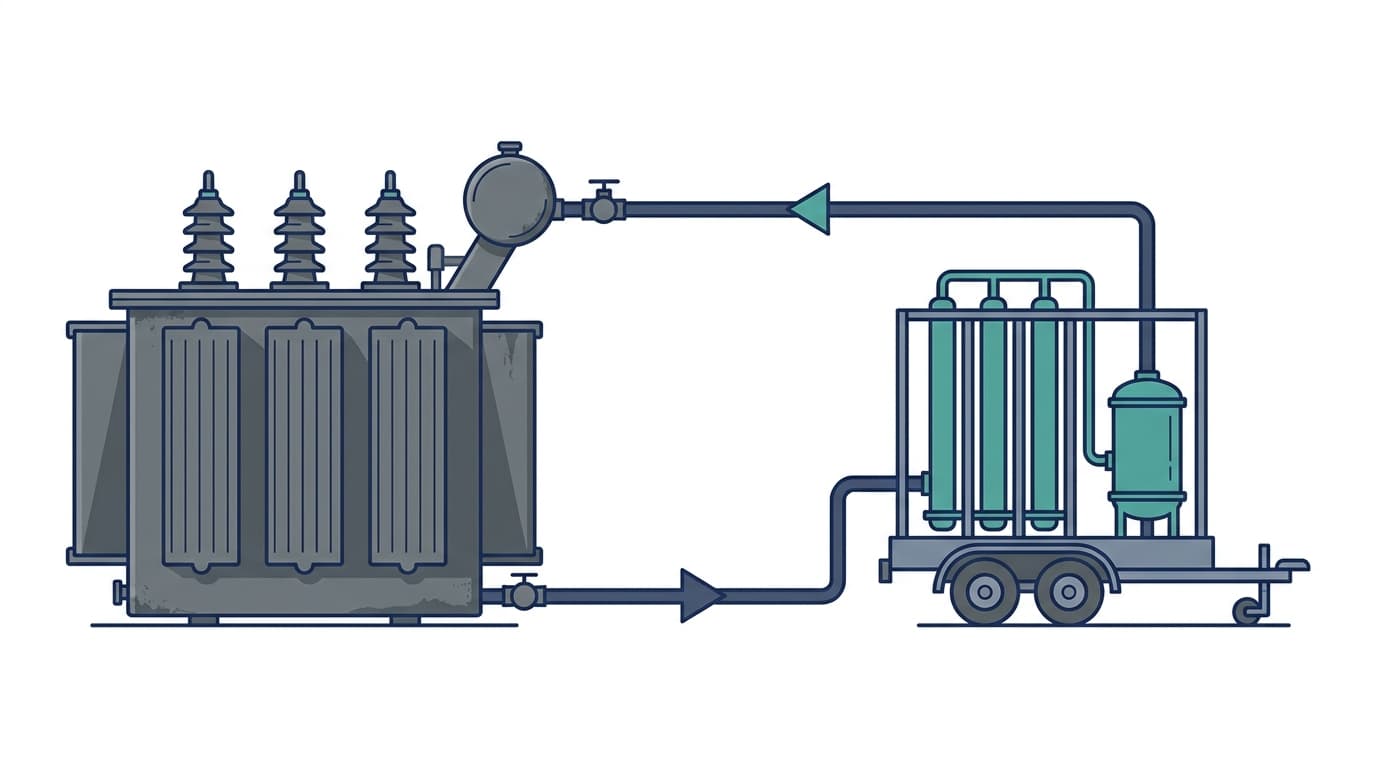
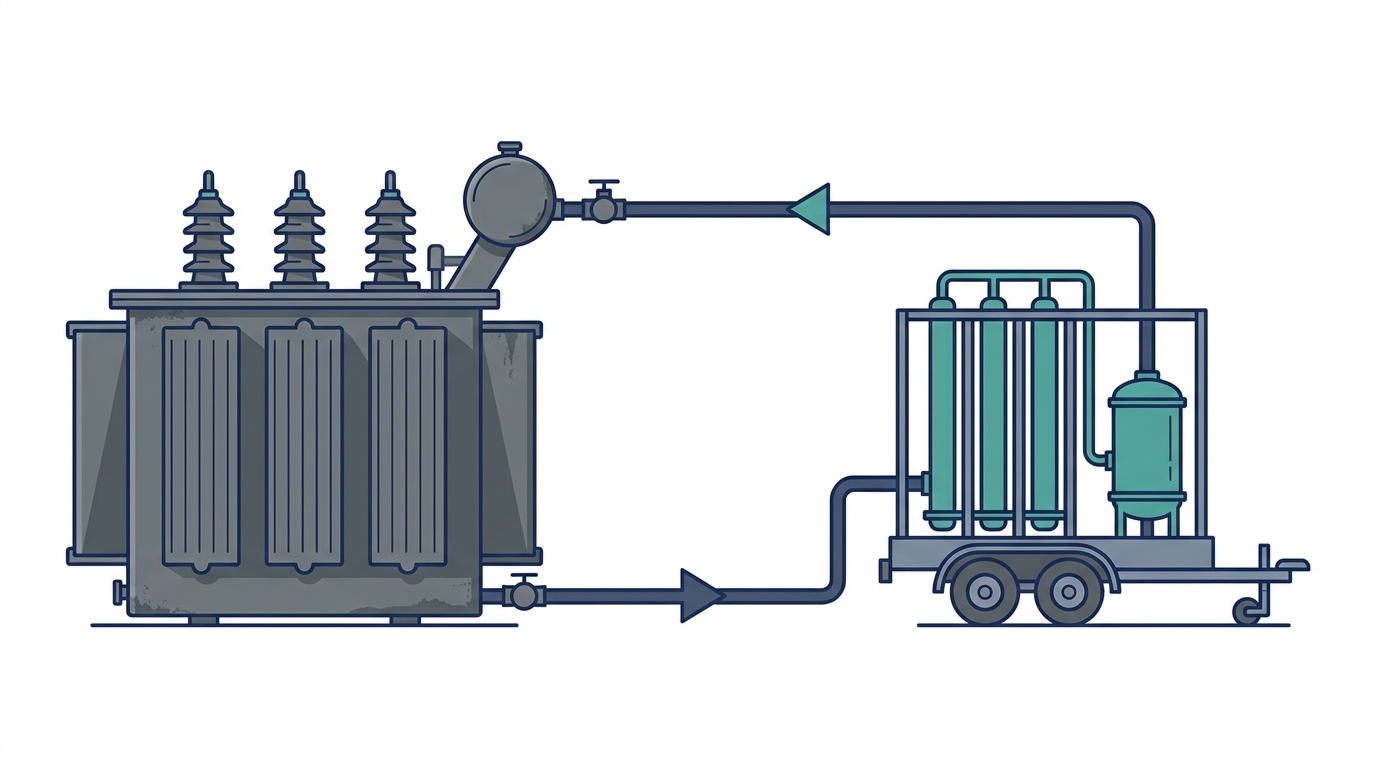
An ageing mineral oil can be brought back to good condition in three ways, and they must not be confused. Reconditioning is purely physical — filtration, drying and degassing remove particles and water but do not restore the oil's chemistry. Regeneration (the industry synonym for reclamation) runs the oil through a clay-based sorbent (Fuller's earth) that binds the soluble and insoluble polar contaminants — acids and sludge — and brings the chemistry back toward new-oil levels. Replacement drains the oil and fills fresh.
The trap is in what regeneration doesn't touch. The sorbent cleans the oil. It does not dry the paper, it does not restore the antioxidants, and a routine ageing-oriented treatment is not designed to remove corrosive sulphur. The post-treatment result can look like new oil and still hide an unresolved problem.
Recondition, Regenerate or Replace — When to Do What
The choice is governed by how far down the oil has gone, and IEEE C57.637 puts numbers on it. An oil with acidity up to 0.2 mg KOH/g and IFT down to 24 mN/m (Group I) can be handled by reconditioning, while an oil with acidity up to 0.5 mg KOH/g and IFT down to 16 mN/m (Group II) calls for regeneration. Below the Group II limits the oil should be discarded — unless regeneration can bring it all the way up to the Table 2 limits (IEEE Std C57.637-2015, §4.2 and Table 1). The point for an asset manager: acidity and IFT don't just describe the condition, they decide which intervention is even worth doing.
What Regeneration Restores — and What It Doesn't
After a single pass, the sampled oil looks clean. But most of the transformer's water sits in the solid insulation, and oil-side treatment only partially dries the paper (CIGRE TB413:2010, Section 9.8). If degradation products remain in the insulation, they diffuse back into the oil within a short time — a bounce-back in which the numbers you just restored drift the wrong way again. That is why regeneration is not one circulation: treatment must continue until the bounce-back is gone, and IEC 60422 recommends a follow-up oil sample some months later, once the insulation has had time to give up the rest (IEC 60422:2024, § 14.1).
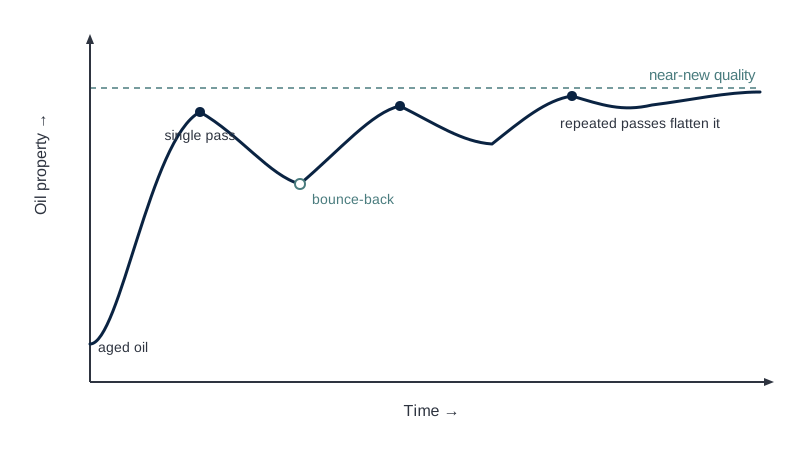
It also means time on site cannot be reduced to a formula in advance. No standard states m³/day or a number of days — the duration is set by how many passes it takes before the bounce-back stops.
Re-inhibition Is Not Optional
The sorbent works chromatographically: the polar compounds bind first, and because many of the oil's natural antioxidants are aromatic, they are stripped out with them. The result is that after regeneration the oil oxidises faster than before — whether or not it was originally inhibited (CIGRE TB413:2010, Section 9.7). So inhibitor has to be added back. The target is the inhibited (I-class) mineral-oil band of 0.08 % to 0.40 % measured per IEC 60666 (IEC 60296:2020, Clause 3.7). The dosing itself — how many kg of antioxidant per m³ — is not in the standards; it depends on the inhibitor supplier's data. The requirement is that the re-inhibited oil lands inside the I-class band, not any particular dosing figure. One sequencing point carries into the next section: this antioxidant is dosed only after the oil has been verified non-corrosive, never before (CIGRE TB625:2015, Section 5).
Corrosive Sulphur: The Risk Behind the Clean Numbers
This is the single most important reason to verify a regeneration. A routine Fuller's-earth treatment is designed to remove polar oxidation products (CIGRE TB413:2010, Section 9.4) — and that removal is what restores acidity, IFT and DDF. It is not designed to remove DBDS and corrosive sulphur (CIGRE TB625:2015, Section 4.3). And because the routine quality numbers are restored whether or not the corrosive sulphur is removed, a clean result can mask an unresolved corrosive-sulphur problem. So corrosive sulphur has to be tested after treatment — it cannot be inferred from the oil otherwise looking healthy.
Three points sharpen the picture:
- Regeneration can create corrosive sulphur. Reactivating the clay (600–900 °C) can form elemental sulphur (S₈) that contaminates the treated oil and can produce silver sulphide on tap-changer contacts — a risk created by the treatment (CIGRE TB625:2015, Section 4.3.3).
- Passivation doesn't remove sulphur, it masks the test. A metal passivator can make the oil test non-corrosive on IEC 62535 even while it still contains harmful DBDS. A non-corrosive result on passivated oil is not evidence the oil is free of corrosive sulphur (IEC 60296:2020, Annex B).
- Longer treatment can remove DBDS — but that isn't the routine. Reactivatable clay can remove DBDS, but it can take longer treatment times than a treatment aimed only at ageing products (CIGRE TB625:2015, Section 4.3.1).
The conclusion is firm: after regeneration, run both IEC 62535 and DIN 51353 (silver), and dose the antioxidant back in only once the oil is verified non-corrosive on both tests — this is the DBPC re-inhibition described above, not the metal passivator (CIGRE TB625:2015, Section 5). DIN 51353 matters especially given the S₈ risk (CIGRE TB625:2015, Section 5). The order is not arbitrary: re-inhibiting a still-corrosive oil can drive the copper-sulphide deposition into the paper insulation — TB625 records a case of incomplete DBDS removal in which copper sulphide previously laid down on the copper reappeared as deposits on the paper after improper reclamation and inhibition (CIGRE TB625:2015, Section 4.3.3, Figure 77).
Benchmark to Near-New Quality — and Be Honest About How Firm That Is
The yardstick for regenerated oil is near-new quality — not the lenient in-service limits. But the standards do not agree on how firm that requirement is. IEC 60296 places off-site-reclaimed oil fully within the new-oil specification (IEC 60296:2020, Clause 1). IEEE C57.637 has its own reclaimed-oil tables, close to new — for example an interfacial tension of at least 35 mN/m (IEEE Std C57.637-2015, Table 2); for breakers and tap-changers the requirement is 25 mN/m (Table 3). For scale: new oil in the delivered state must reach an interfacial tension of 40–43 mN/m depending on type (IEC 60296:2020, Tables 3 and 4), so the IEEE values mark the floor of near-new, not its ceiling. CIGRE's reclamation brochure draws the practical conclusion — new-oil pass values are readily achieved by a properly run treatment unless the oil was in very poor condition, and "there is little reason why an equipment user should accept poorer results" (CIGRE TB413:2010, Section 9.8). IEC 60422 ED5 (2024) is softer: here the target is agreed between owner and provider, guided by either Table 3 (new oil after filling) or Table 5 (in-service oil) (IEC 60422:2024, Annex A). CIGRE TB413 sets no numeric acceptance criteria of its own. So "must meet new oil" is not one shared rule — but in every case the reference is near-new, not the lenient in-service bands.
Two practical consequences follow. First: agree a follow-up sample 1–3 months after treatment; the sample taken immediately after overstates the durable result (IEC 60422:2024, Annex A, § A.2). Second: because regeneration returns the same oil, the need for make-up is inherently minimal. After a full oil change (Um < 72.5 kV) up to 10 % of the old oil can still be adsorbed in the insulation (IEC 60422:2024, § 12.1) — but for a regeneration cycle, neither IEC 60422 nor IEEE C57.637 states a figure for how much oil the sorbent holds back. Where make-up is needed, the top-up oil should share the in-service oil's classification — same class, group, type, inhibition level and LCSET (IEC 60422:2024, § 7.14.2).
How to Verify the Regeneration
The discipline behind all of this is short, and it is about verifying the work, not just commissioning it.
- Judge the intervention on acidity and IFT, not on feel. These two numbers decide whether the oil can be reconditioned, needs regeneration, or should be discarded (IEEE Std C57.637-2015, Table 1).
- Require a follow-up sample 1–3 months later. The sample immediately after shows process efficiency; the sample months later shows the durable condition, once the paper has given up the rest (IEC 60422:2024, Annex A).
- Confirm re-inhibition into the I-class band. Regenerated oil must have inhibitor added to 0.08–0.40 % measured per IEC 60666 (IEC 60296:2020, Clause 3.7).
- Test corrosive sulphur after treatment — every time. IEC 62535 and DIN 51353 must be run and be non-corrosive before the job is finished. Restored acidity and IFT are not evidence the problem has gone (CIGRE TB625:2015, Section 5).
Regeneration is a powerful tool. But it restores the oil — not the transformer. The verification is the difference between an oil that looks new and an oil you can trust.
Talk to TriboTech
Are you weighing up whether to regenerate the oil on an ageing transformer — or have you just received a service-provider quote? Then the right questions are whether the acceptance regime targets near-new quality, whether corrosive sulphur is tested after treatment, and whether a follow-up sample is in the agreement. We assess the oil's condition against IEC 60422 and tell you, in plain language, whether it should be reconditioned, regenerated or replaced — and whether a completed job actually holds. Get in touch and we'll look at your fleet.
Frequently asked questions
How long does on-site regeneration take?
Does regeneration remove corrosive sulphur?
Does regenerated oil have to be re-inhibited?
What are the acceptance requirements — and what minimum IFT?
How much top-up oil should I expect?
Does oil regeneration dry the transformer?
Standards referenced
The methods on this page are anchored in these standards — follow each into our standards library.
Put Theory into Practice
Try our interactive Duval diagnostic tools or use our new unified workflow to analyze your transformer oil data.