
Audio player docked to bottom
Listen to this article
Key takeaway
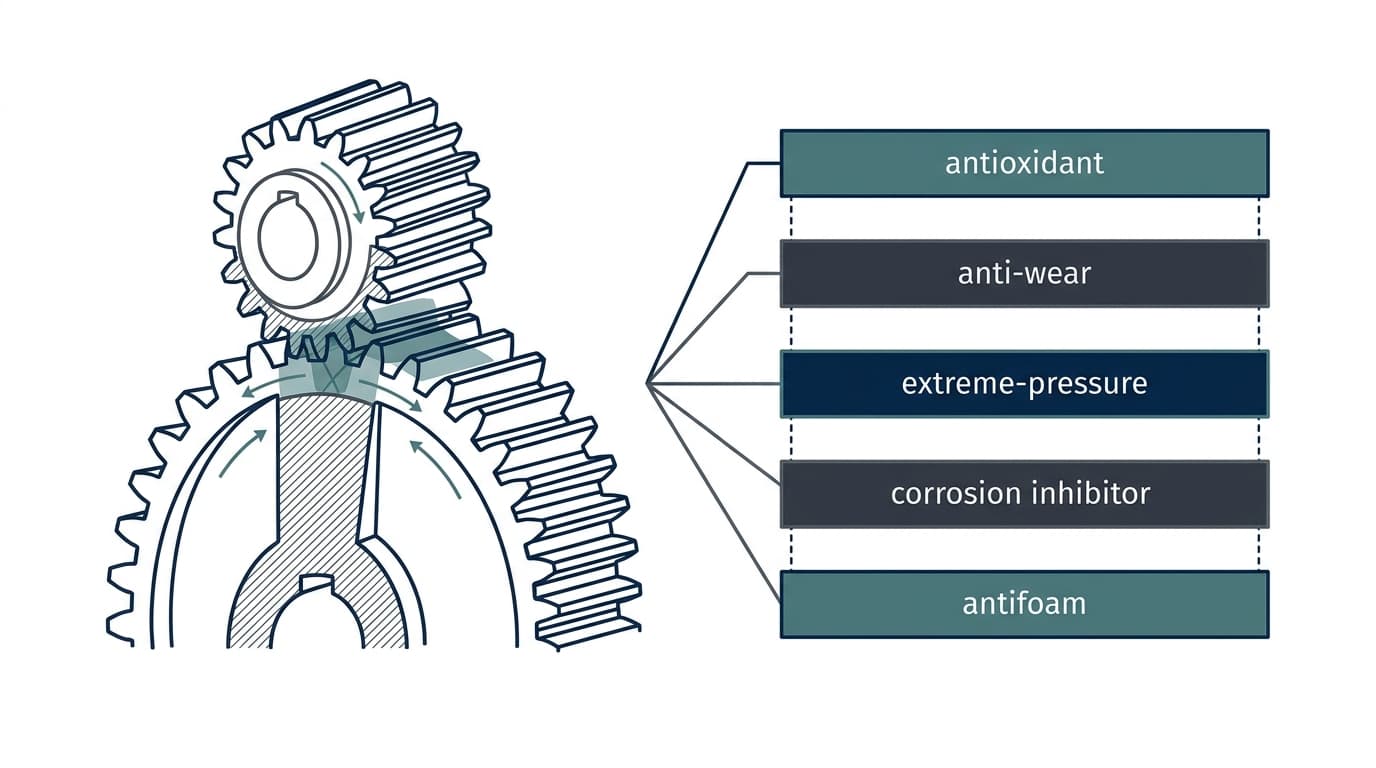
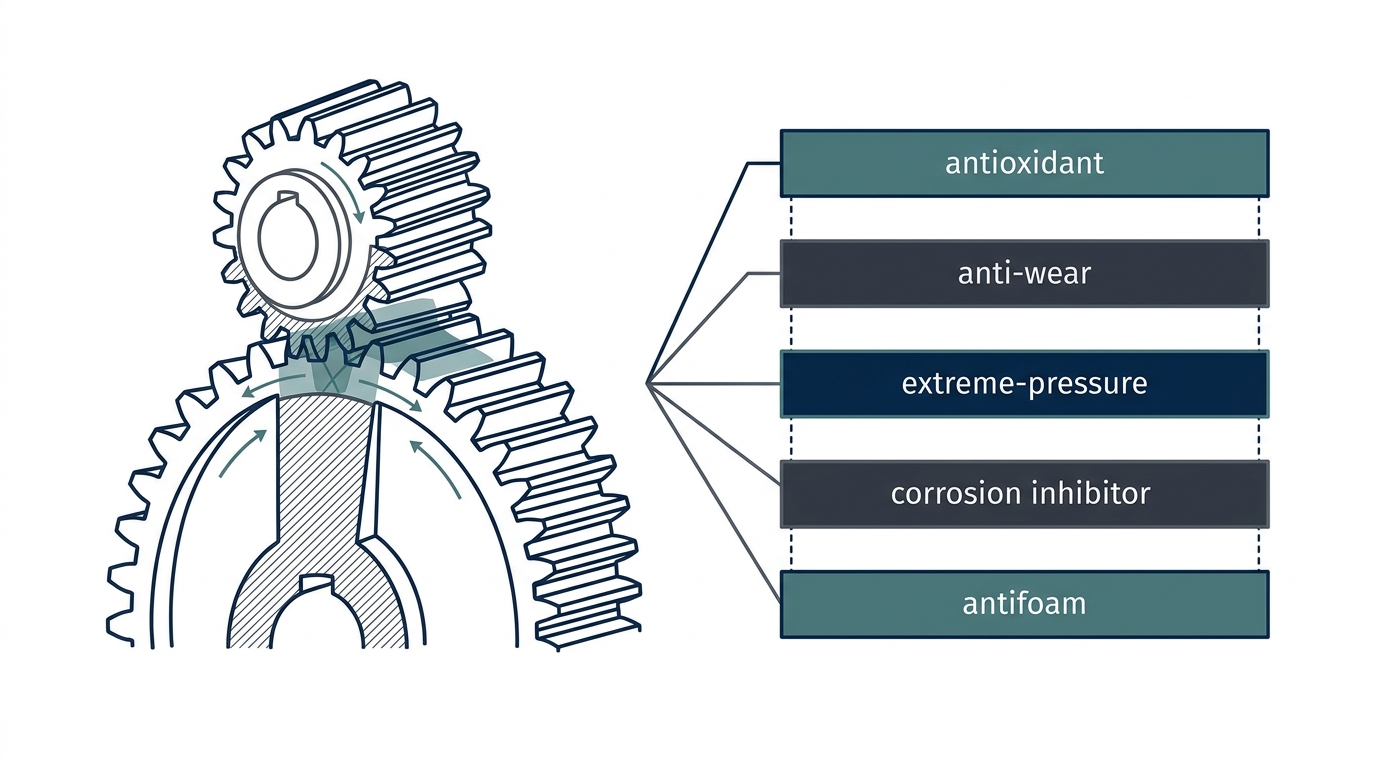
An industrial gear oil is an engineered package: antioxidants, anti-wear and extreme-pressure chemistry, corrosion inhibitors, antifoam. No single analysis sees all of it — and the part that protects the gear teeth, the sulphur-phosphorus EP system, is the part no molecular method can see. Elemental analysis sees atoms but not molecules; the functional tests see consequences, not causes; and voltammetric antioxidant monitoring is fundamentally a turbine-oil technique that only sees the smallest part of a gear-oil package. So a defensible programme is built on the elemental and functional tests — viscosity, ICP, acid number, FTIR oxidation, water, cleanliness, wear debris — read with discipline. Voltammetry is an optional adjunct, not the backbone.
What is actually in a CLP gear oil
The reference specification for industrial gear oils in Europe is DIN 51517-3 — the "CLP" line on virtually every industrial gear oil datasheet. The three letters carry the formulation logic: C is the base lubricating oil, L adds additives for corrosion protection and ageing stability, and P adds additives that reduce wear in the mixed-friction regime. The standard defines eleven viscosity grades, from ISO VG 32 to VG 1 500, and for each a table of minimum requirements — including the FZG gear scuffing test at failure load stage 12 or better, a rolling-bearing wear test, and an ageing test.
Behind the letters sits a package that typically runs from a few percent up towards ten percent of the oil. The antioxidants, corrosion inhibitors, antifoam and demulsifiers are common to almost every gear oil — but the heart of the formulation, the anti-wear and extreme-pressure chemistry that actually protects the gear teeth, comes in two distinct philosophies, and they read very differently on a lab printout.
- Ashless sulphur-phosphorus EP is the modern CLP mainstream — the chemistry behind most industrial gear oils, including most wind-turbine gear oils. There is no zinc, no molybdenum, and little or no calcium; the EP function is carried by sulphur and phosphorus compounds. The engineering rationale is clean, low-ash performance: compatibility with servo valves and yellow metals, long drain intervals, and environmental acceptability. On ICP it shows as phosphorus and sulphur, and nothing else. Phosphorus is the closest thing to an anti-wear marker, but it is not specific — and sulphur arrives from the base oil and several additive classes at once.
- Ca/Mo-containing packages are a higher-performance, often synthetic, specialty variant — sulphur-phosphorus EP with calcium and molybdenum added on top. Calcium comes from a detergent/sulphonate that does double duty: it neutralises acids and lays down a protective rust film. Molybdenum comes from an organo-molybdenum friction modifier that forms low-shear MoS₂ films to reduce friction. These are chosen where friction reduction and a detergent reserve are wanted under high load and temperature. On ICP they add molybdenum and calcium to the phosphorus and sulphur — still no zinc.
- ZDDP — zinc dialkyldithiophosphate, the dual-function anti-wear and antioxidant additive that defines engine oils. It was historically common in industrial gear oils too, but in modern heavy-EP/CLP and wind-turbine gearbox oils it has been largely displaced by ashless sulphur-phosphorus chemistry, chosen for cleaner long-drain performance and oxidation stability at high oil temperatures. Where ZDDP is still present, ICP shows zinc and phosphorus together, and a coordinated fall in Zn and P is a workable depletion signal.
The practical point for monitoring is that the family a gear oil belongs to determines what its ICP printout can tell you — and published vendor data shows that different anti-wear technologies deplete their phosphorus and sulphur quite differently over service life. There is no universal element trend; there is the trend for the oil you actually have.
One specification subtlety is worth knowing when you compare a datasheet claim against fresh-oil verification testing: many buyers assume every ISO VG grade was individually FZG-tested, but DIN 51517-3 permits "read-across" within a homologous product series, so the mechanical-dynamic tests behind a compliance claim for, say, a VG 320 may have been run on a different grade in the same series. The claim is legitimate — but it is a series claim, not necessarily a grade-by-grade test record.
Element versus molecule: what each method measures
The central trap in additive monitoring is mistaking what a method reports for what you want to know.
ICP elemental analysis reports atoms: zinc, phosphorus, sulphur, molybdenum, calcium. It is the backbone of additive monitoring on a gear oil because it sees whichever of the two EP philosophies the oil belongs to — phosphorus and sulphur for an ashless package, with molybdenum and calcium added for the specialty family, and zinc only where ZDDP is present. But the element is not the molecule — phosphorus from a decomposed additive is still phosphorus, and sulphur arrives from the base oil and several additive classes at once, so the EP-specific sulphur signal is buried in a multi-source total and is effectively useless as a precision depletion marker. One classic misread: when all additive elements fall proportionally, suspect dilution by a top-up with a less fortified oil before concluding "depletion".
Voltammetry (LSV/RULER) reports electrochemically active molecules — the antioxidants, class by class, plus ZDDP where present. In the neutral solution, ZDDP responds at 0.5–0.8 V, aromatic amines at 0.8–1.2 V, and hindered phenols at 1.3–1.6 V (ASTM D7590-22). It is the only method that measures the sacrificial antioxidants as molecules, and the full method story is in our RULER deep dive. But its reach on a gear oil is narrow: it sees the antioxidant fraction, which on an EP-dominated industrial gear oil is the smaller part of the package, and it is blind to the sulphur-phosphorus EP chemistry that does the actual gear-tooth protection. That scope limit — and the fact that the underlying test methods are turbine-oil methods — is the subject of a section of its own below.
The functional and consequence tests — acid number, FTIR oxidation, RPVOT — measure what the additives have or have not prevented. Indispensable, but lagging by construction.
What no method sees: the sulphur-phosphorus EP package itself, in molecular form. There is no EP equivalent of RULER. That blind spot — the thing that matters most on a gear oil is the thing no molecular method can read — and the layered strategy that compensates for it is the heart of the ashless monitoring problem, and it applies to gear oils exactly as it does to hydraulics.
Molybdenum and calcium: the specialty family's two traps
The element-versus-molecule lesson is not confined to ZDDP. The Ca/Mo specialty packages — sulphur-phosphorus EP with molybdenum and calcium on top — add two elements to the ICP printout, and each carries its own trap. The traps are the reason the choice of EP philosophy is not just a formulation detail: it changes how the ICP table must be read.
Molybdenum friction modifiers (MoDTC/MoDTP) reduce friction in the boundary and mixed regime by forming low-shear films. It is well established that MoDTC decomposes under tribological action to molybdenum disulphide (MoS₂), and that the MoS₂ is the species actually doing the friction reduction. For monitoring, the headline is the familiar one: ICP sees Mo, the element — and Mo persists in the oil after MoDTC has converted, because MoS₂ still contains molybdenum. So ICP-Mo cannot tell active friction modifier from spent MoS₂; it is the same element-not-molecule limit the printout already imposes on ZDDP. What ICP-Mo can tell you is loss: a real drop in molybdenum means the additive has left the oil — into deposits or by dilution. (MoDTC is itself a dithiocarbamate, and non-metallic carbamates do show up in the voltammetric window — but whether the molybdenum version does is not settled, so we track moly by ICP and leave voltammetry to the antioxidants.)
Calcium detergent / rust inhibitors (Ca sulphonate) are dual-function: they neutralise acids and they protect against rust and corrosion by laying down films. They appear in some highly-loaded and zinc-free gear oils. ICP sees Ca, and a declining calcium trend signals the loss of both functions at once. The caveat is directional: calcium also enters the oil from contamination — hard water, calcium grease — so a rise in Ca reads nothing like a fall. A rising calcium line is a contamination question; a falling one is a depletion question.
And both feed straight back into the dilution lesson: when Zn, P, Mo and Ca all fall together, in proportion, the first hypothesis is not depletion but a top-up with a less fortified oil. The discipline is the same across all of them — read the element for what it is, never for the molecule it stands in for. And in every case the sulphur-phosphorus EP system that actually carries the load is seen only as elements, never as the active molecule. That is the permanent limit of elemental gear-oil monitoring, and the reason the functional and physical tests carry the diagnostic weight.
Re-additivation: the dilution signature in reverse
There is a mirror image of that dilution signature worth knowing, because it reads the opposite way. When additive really has depleted, on a large-volume gear or circulating system, one option is to replenish it with a supplier-matched concentrate — a top-treat rather than a full drain and refill. This is a recent and still-maturing option, not a long-settled industry routine: it is only in the past few years that oil suppliers began to advise re-additivation as an alternative to a full oil change, and more recently still that some have acknowledged a further, repeated re-additivation as viable — so the supplier position itself is still moving toward it. TriboTech's founders were actively involved in investigating and documenting the effect, through field trials and test-rig work to verify it.
Whether to top-treat or change the oil is a judgement call with several factors on the scale: the downtime of a full change; the cost of new oil; the CO₂ saved by extending the oil's life; and keeping the gear system healthy by re-additivating in time — dosing calculated amounts at normal service intervals rather than letting additive levels run low before a change, which gives more operational flexibility. It works only when the base oil is still sound; it cannot reverse oxidation, lift varnish or contamination, or repair wear, which is why it belongs to the same in-service maintenance philosophy as ASTM D4378. Different additive classes deplete at different rates, so a single top-treat never reproduces the original balance — it is supplier- or lab-controlled, dosed by analysis and re-tested afterwards, never poured in blind.
The trend consequence is the point: a deliberate top-treat is the inverse of the dilution signature — elements rise against trend — and the analyst has to know it happened, or the rising line reads as contamination.
Where the formal basis ends — and why that matters
Here is the part most lab reports gloss over. Voltammetric antioxidant monitoring is, at its foundation, a turbine-oil technique. The two ASTM voltammetric test methods are formally scoped to non-zinc turbine oils: ASTM D6971 covers refined mineral oils with rust and oxidation inhibitors but no anti-wear additives, and ASTM D6810 adds, in so many words, that the method has not yet been established with sufficient precision for anti-wear oils. A gear oil with a 3–5 % EP package is outside both scopes by design.
The bridge to gear oils is ASTM D7590 — but it is a guide, not a test method. Its scope explicitly includes gear oils, hydraulic oils, bearing lubricants, and ZDDP-bearing circulating and transmission oils, and it supplies what the test methods cannot: a documented basis for applying the technique to gear oils, the monitoring-frequency framework, and the 25 % RUL alarm and condemning limit. But it bridges the scope, not the demonstrated diagnostic value. There is no matrix-specific precision statement for gear oils, and the guide is equally explicit about a second limit: no ASTM test method exists for measuring ZDDP by voltammetry, so even the ZDDP peak is a guide-level trending signal, not a standardised measurement.
So the honest position is precise: a gear-oil antioxidant trend is a guide-level application of a turbine-oil technique, the published precision statements were developed on turbine-oil matrices and are not quoted as covering gear oils, and any diagnostic weight rests entirely on the comparative trend — same baseline, same solution, same lab. The electrochemistry does not care what the oil is called; the paperwork does. That is why voltammetry sits where it does in a gear-oil programme — as an optional, application-driven adjunct, not a routine step — and knowing exactly where its formal basis ends is the advisory layer.
The carbamate trap — why voltammetry is ambiguous on EP gear oils
There is one interference in gear-oil work that deserves its own section, because it sharpens the case for not relying on voltammetry here. Sulphurised carbamates are dual-role additives — secondary antioxidants and anti-wear/EP agents — and they are voltammetrically active. In the neutral (Green) solution they respond in and immediately adjacent to the hindered-phenol region; ASTM D7590 itself assigns that detection window to "hindered phenols or carbamates". A carbamate-bearing gear oil can therefore show a healthy-looking "phenol" reserve that is partly EP additive.
There is a discrimination tool inside the technique's own toolbox: carbamates respond in the Green solution but give no signal in the basic (Yellow) solution, so scanning with both and comparing attributes the signal — Yellow shows the phenol alone, the difference is the carbamate (Ameye, Wooton & Livingstone, OilDoc 2015). The two trends would then carry different meanings: phenol depletion tracking the primary antioxidant reserve, carbamate depletion tracking a combined secondary-antioxidant and anti-wear function.
But notice what this interference actually tells you. On a carbamate-bearing EP gear oil, the single voltammetric reading you would most want — the antioxidant reserve — is ambiguous by construction: a healthy-looking "phenol" peak may be partly EP additive, and untangling it takes the extra dual-solution scan and a clean baseline to compare against. That ambiguity is itself an argument for where the diagnostic weight should sit. On a gear oil it is steadier to lean on the elemental and functional spine — ICP, acid number, FTIR oxidation — than to build the programme around a voltammetric antioxidant reading that the chemistry of the oil makes hard to interpret in the first place.
A defensible gear-oil programme
The backbone is the set of tests that actually see a gear oil — elemental and functional — read with the discipline the sections above describe. Voltammetry is not in the backbone; it is an option for the cases that earn it.
- Baseline first. A retained new-oil sample, analysed at the programme lab, for ICP elements, acid number, and viscosity. Without product-specific element baselines, ICP is wear-and-contamination monitoring only — and the element trends only mean something against the oil's own EP philosophy.
- Build on the elemental and functional spine. Viscosity at 40 and 100 °C; ICP elemental analysis; acid number; oxidation by FTIR; water by Karl Fischer; particle count and cleanliness; wear-debris and ferrography. This is the set that monitors a gear oil — additive condition where the elements allow it, and equally the consequences the additives are there to prevent.
- Read the ICP table for the right family. Phosphorus and sulphur for an ashless oil; molybdenum and calcium added for the specialty family; zinc only where ZDDP is present. Remember the traps — Mo persists after the friction modifier has converted, calcium reads in both directions, and a proportional fall across all elements is a dilution question before it is a depletion one.
- Add voltammetric antioxidant monitoring only where the application calls for it — an oxidation-sensitive duty, or an OEM that specifically requires antioxidant trending. It is an optional adjunct, not a routine step, and it is worth saying plainly that it sees only the antioxidant fraction and is blind to the sulphur-phosphorus EP package that does the gear-tooth protection. When it is used, run it the disciplined way: a fixed solution against a clean baseline, same lab throughout.
- State the scope honestly in the report. When voltammetry is reported, it is a guide-level application of a turbine-oil technique, comparative trend, turbine-matrix precision not claimed. That sentence costs nothing and is the difference between a defensible advisory position and an over-claimed one.
Viscosity, as always, comes first on the printout — if that story is unfamiliar, start with Viscosity and the Viscosity Index.
Where TriboTech sits in all this is worth stating plainly: we do not sell chemicals, oil, additives, or gear systems, and we do not physically service the turbine. We are the independent third-party advisor. That matters most on the re-additivation question — because we have no product or service in the decision, the advice carries no conflict of interest. Whether to top-treat or change the oil is purely a question of the asset owner's economics and the oil's condition. And if your gearbox programme is producing element tables nobody interprets, that is a solvable problem: talk to us.
Services
Gear and Hydraulic Oil Analysis ConsultingPut Theory into Practice
Try our interactive Duval diagnostic tools or use our new unified workflow to analyze your transformer oil data.