
Audio player docked to bottom
Listen to this article
Key takeaway
Antioxidants are the part of an oil that is designed to be consumed. Their depletion is the earliest measurable stage of oil ageing — acid number, viscosity change, and varnish all come later, when damage has already started. Linear sweep voltammetry (the RULER technique) measures the remaining antioxidant content directly, class by class, and the ASTM framework around it is more standardised than most people assume: D6971 and D6810 define the test methods, and D7590 sets monitoring frequencies by remaining-antioxidant band and places both the lower alarm level and the condemning limit at 25 % RUL.
The additive that spends itself so the oil doesn't
Every quality turbine, hydraulic, gear, and compressor oil carries primary antioxidants — typically hindered phenols, aromatic amines, or both. Their job is sacrificial: they interrupt the free-radical chain reactions of oxidation by giving up electrons, sparing the base oil. A well-formulated oil does not age gracefully because its base oil is invincible; it ages gracefully because the antioxidants take the damage first.
That has a direct consequence for condition monitoring. As long as antioxidant reserve remains, the base oil is largely protected and the classic degradation tests sit quietly in the normal range. Acidity rises, viscosity climbs, and varnish precursors appear in earnest only once the reserve is close to exhausted. Those tests are honest — but they are late. They report that oxidation has happened.
Antioxidant depletion typically follows an S-shaped curve: a long induction period of slow, steady consumption; an accelerating phase once the remaining reserve drops low enough that fewer molecules carry the same oxidative load; and finally exhaustion, where base-oil oxidation begins in earnest and the lagging indicators wake up. The economic window for condition-based oil management is the accelerating phase — sweeten, top up, or change the oil before exhaustion. To act there, you need a test that reads the reserve directly.
How the measurement works
The RULER technique (Remaining Useful Life Evaluation Routine) is linear sweep voltammetry applied to oil. The electrochemistry is on the oil's side: antioxidants are, by design, easily oxidised — their willingness to give up electrons is the property being exploited. The method, developed by Robert E. Kauffman at the University of Dayton in the mid-1980s and commercialised by Fluitec International, turns that willingness into a measurement:
- A small oil sample is mixed with an electrolyte test solution and a layer of chromatographic sand in a glass vial. The solvent makes the oil's antioxidants available to electrochemistry; the sand settles the oil droplets and adsorbs polar oxidation products that would otherwise interfere.
- A linear voltage ramp is applied through a three-electrode probe in the clear solution.
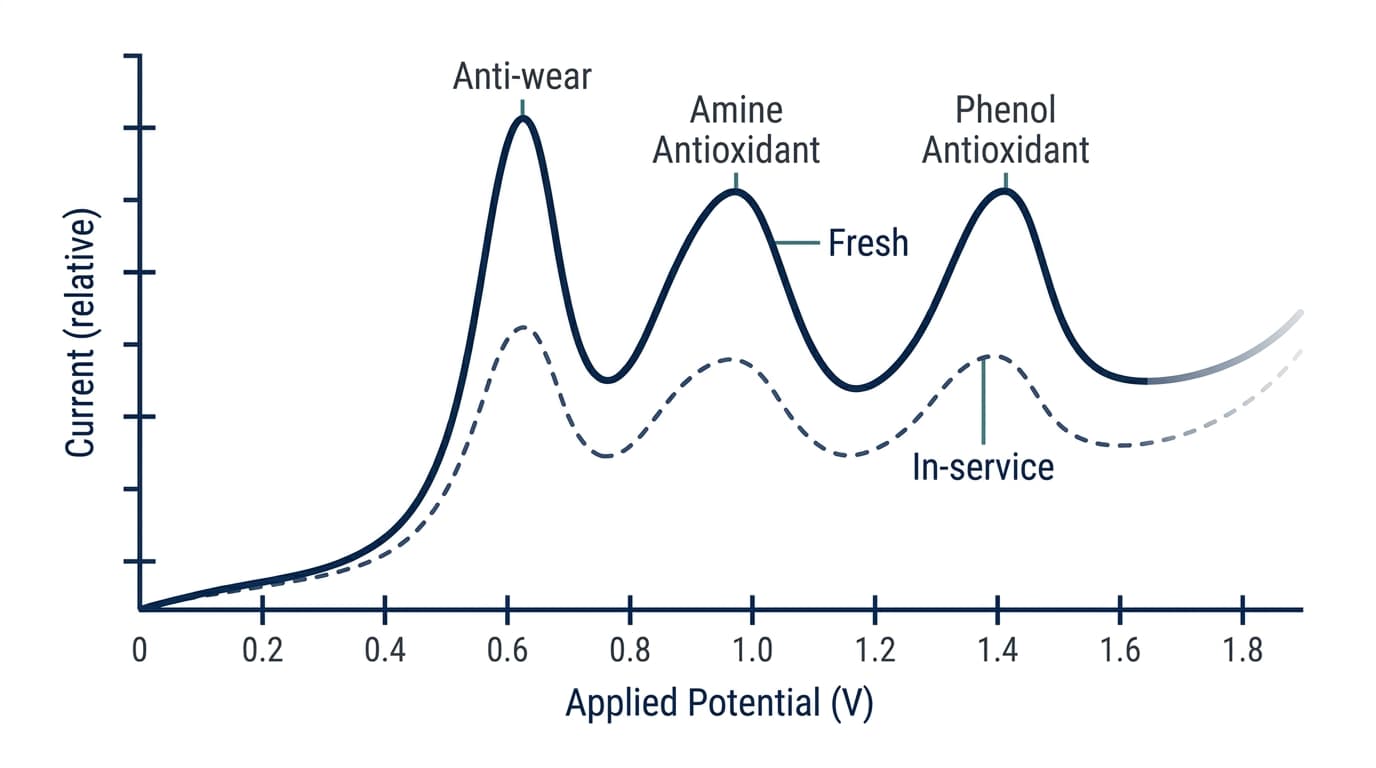
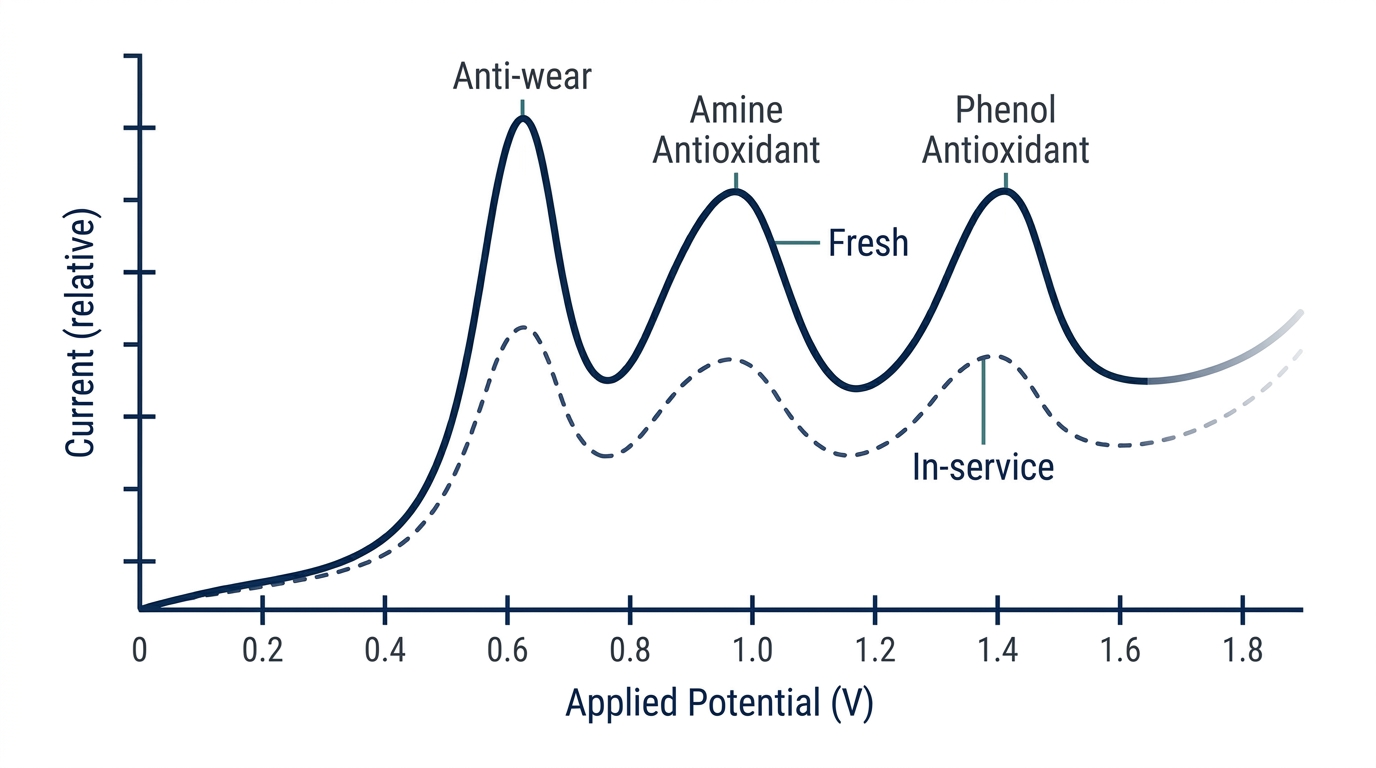
- Each antioxidant class oxidises at its own characteristic potential, producing a current peak in the voltammogram. One peak per additive class.
- The peak area is compared with the same peak in a reference sample of the new, unused oil. The result is reported as percent remaining antioxidant — for each class separately.
The last point is the one to internalise: this is a comparative method. ASTM D7590-22 is explicit that the test measures depletion relative to a baseline, not an absolute concentration, and that trending over time is the intended use. No new-oil reference, no trend.
Two solutions, one principle
The technique uses two standard electrolyte solutions, and the choice is not cosmetic.
The neutral ("Green") solution is the universal one. In it, the main additive classes separate cleanly along the voltage axis: zinc dialkyldithiophosphate (ZDDP) responds at 0.5–0.8 V, aromatic amines at 0.8–1.2 V, and hindered phenols at 1.3–1.6 V (ASTM D7590-22). One scan resolves the full primary-antioxidant picture of a mixed formulation.
The basic ("Yellow") solution is the phenol specialist. The alkaline chemistry shifts the phenol response down to 0.3–0.6 V (ASTM D6810-22), isolating the hindered-phenol peak as the preferable choice for phenol-only formulations. In practice that low-potential peak is also the sharper, better-resolved one; amines remain visible in the Yellow scan but are not quantified there.
One scope note belongs here. These LSV methods are written for non-zinc turbine and industrial oils (D6971, D6810) and in-service industrial lubricants (D7590) — transformer oils are not part of their stated scope. Voltammetric monitoring of DBPC-inhibited mineral transformer oils is a field adaptation, useful for trending inhibitor depletion — but insulating oil has its own dedicated standards: inhibitor content is determined to IEC 60666 (the route we follow for transformer oil), and IEC 60422 frames the supervision of the oil in service. The phenol-specialist logic still applies — just don't read it as the ASTM method claiming a transformer scope it does not have.
One discipline follows immediately: a monitoring trend must stay on the same solution throughout. Switching mid-trend invalidates the comparison to the baseline.
The ASTM family — more standardised than its reputation
A persistent half-truth in the industry is that RULER results rest on vendor guidance alone. The actual standards basis has three layers:
- ASTM D6971 is the core test method: hindered phenols and aromatic amines in non-zinc turbine oils, measurable from 0.0075 % by mass, using the neutral solution. It defines the electrode system, the scan, the calculations, and a formal precision statement.
- ASTM D6810 is the phenol-only sibling, using the basic solution for maximum phenol sensitivity, with its own precision statement. (A fourth document, ASTM D7527, extends the same electrochemistry to greases.)
- ASTM D7590 is the guide that puts the numbers to work. Its scope is deliberately broad — in-service industrial lubricating oils, including turbine, compressor, gear, hydraulic, and bearing oils — and it standardises the part of the programme the test methods leave open: how often to test, and when to act.
D7590's monitoring cadence (ASTM D7590-22, Table 1) is worth quoting, because it converts the remaining-antioxidant number into a sampling schedule:
| Remaining antioxidant (RUL %) | General oil analysis frequency | Gas turbines |
|---|---|---|
| 50–100 % | Quarterly to max. every 6 months | Every 3 months |
| 25–50 % | Max. every 3 months | Once a month |
| < 25 % | Every month | Every 2 weeks |
And the action anchor is equally explicit: the guide sets the lower alarm level and condemning limit at 25 % RUL, with the caveat that oxidation products can inflate the apparent RUL %, and advises complementary testing — FTIR, acid number, or RPVOT — once the alarm is approached.
What is not standardised is also worth knowing. The finer four-band action semantics in circulation (above 75 % normal, 50–75 % watch, and so on) come from application guides and OEM recommendations, not from any ASTM document. They are reasonable practice — but when a report needs a citable limit, the standardised numbers are the frequency bands and the 25 % alarm.
Two antioxidants, two clocks
A formulation with both phenols and amines is not one reservoir; it is two, draining at different rates — and, perhaps counter-intuitively, the phenol is usually the one that goes first. The aromatic amine is the more efficient radical scavenger; the hindered phenol works as its sacrificial partner, donating hydrogen to regenerate the amine and keep it in service. The phenol is spent doing that regenerating, so it falls away while the amine lingers as the longer-term reserve. That synergism is exactly why you track the two peaks separately instead of collapsing them into a single "total antioxidant" number — the pattern of which class is dropping, and how fast, is itself the diagnostic.
An oil showing 20 % remaining phenol but 75 % remaining amine is in a very different condition from one showing 55 % of each — the first is well into the sacrificial phase, its phenol nearly exhausted while the amine reserve still looks comfortable, whereas the second is depleting more evenly. A single averaged "antioxidant remaining" figure would hide that distinction entirely. The order is not a law of nature, though: a phenol-only oil has no amine to regenerate, and under some formulations or thermal stress the balance shifts — which is the whole point of watching each class on its own clock rather than assuming one. Read the pattern that way and an unexpectedly fast amine drop — when the amine is supposed to be the durable reserve — is the anomaly worth a root-cause look, not just a calendar entry.
What LSV honestly does not see
The technique measures electrochemically active antioxidants, and only those. It does not measure:
- Oxidation products — acids, varnish precursors, sludge. Those are the territory of acid number, MPC varnish potential, and FTIR.
- Base-oil oxidation resistance. RPVOT measures how the oil resists oxidation; RULER measures how much sacrificial additive is left. They are complementary, not interchangeable.
- Contaminants — water, particles, dissolved gases.
- Non-electroactive additives — viscosity improvers, detergents, dispersants, most corrosion inhibitors.
Two practical caveats belong in the same honest column. Heavily degraded oils can overwhelm the sample cleanup, showing up as elevated baselines and tailing in the voltammogram — a limitation of the method, not operator error. And the published precision statements were developed on turbine-oil matrices; applying the method to other formulations is legitimate and common, but it leans on the comparative-trend discipline rather than on the formal precision figures. How that plays out in gear and hydraulic oils — where anti-wear and EP chemistry enters the picture — is a story of its own: see what oil analysis actually sees in gear oils and monitoring zinc and zinc-free hydraulic oils.
What to do with this
- Retain a new-oil sample of every fill. The baseline is the measurement. Without it you have a number; with it you have a trend.
- Trend phenol and amine separately, on the same solution, against the same baseline, ideally at the same laboratory.
- Schedule by the D7590 bands — and tighten the interval as the reserve falls, rather than waiting for a lagging indicator to move.
- Treat 25 % RUL as the citable alarm, and bring in acid number, FTIR, or RPVOT to confirm before the oil-change decision.
- Read an unexpected RUL above 100 % as information, not good news — it usually means a different oil was topped up, which resets the baseline question.
Antioxidant trending is the cheapest early warning an oil programme can buy: it reads the part of the formulation that is supposed to disappear, while there is still time to act on it. If you want a second opinion on an antioxidant trend — or a monitoring programme built around the leading indicators rather than the lagging ones — get in touch.
Standards referenced
The methods on this page are anchored in these standards — follow each into our standards library.
Put Theory into Practice
Try our interactive Duval diagnostic tools or use our new unified workflow to analyze your transformer oil data.