
Audio player docked to bottom
Listen to this article
Introduction: The Silent Killer in Your Most Critical Asset
A power transformer is one of the most critical and expensive assets in any electrical network. Its sudden failure can lead to catastrophic outages, significant financial loss, and safety hazards. For decades, the industry has sought to predict the lifespan of these vital components, focusing on what has long been considered their ultimate life-limiting factor: the solid cellulose insulation. The paper and pressboard that insulate the windings have been seen as an aging clock, ticking down to an inevitable end.
This article explores a paradigm shift in how we interpret the aging of this insulation. We will challenge the long-held belief that a single number—the Degree of Polymerisation (DP)—is a definitive death sentence for a transformer. We draw on field evidence published by Duval et al. in 2017 and on two CIGRE Technical Brochures on the subject: TB 738:2018 on cellulose ageing chemistry (WG D1.53) and TB 967:2025 on the mechanical properties of insulation materials (WG D1.65). On that basis, we argue that our understanding must evolve from a rigid, number-based "end-of-life" verdict to a more nuanced, holistic, and condition-based assessment of the entire asset.
Key Takeaways
DP 200 is a flag, not a death sentence. About 90 transformers reported to a CIGRE working group, many of them large high-voltage units, were still operating normally with DP between 250 and 75 (Duval et al. 2017).
No confirmed failure from paper weakness alone. No transformer failure due exclusively to the mechanical weakness of its paper had been reported with certainty to the CIGRE working group that collected these cases (Duval et al. 2017). Failures in aged units typically involve moisture, oil degradation, or component defects.
Mechanical withstand is a separate question from chemical DP. CIGRE TB 967:2025 stresses that winding clamping forces must stay sufficient throughout the transformer's life, and that aged pressboard stacks of similar DP can shrink very differently under load. It also records that the compressive and shear behaviour of aged insulation is still little studied.
Oil quality may matter more than DP. Paper resistivity remains stable even at very low DP, but drops dramatically when impregnated with highly oxidised oil. Maintaining excellent oil condition is critical for extending life.
Beware the furan trap. Oil processing removes dissolved furans and creates false confidence. Recovery can take more than a year. After processing, compare the cumulative 2-FAL (before plus after treatment) with the furan/DP table, and establish a new baseline.
Hands off aged windings. Transformers with low DP can remain serviceable if the clamped winding structure stays undisturbed. Avoid internal inspections, tank draining, and high-velocity oil circulation.
No single number decides fate. Modern asset management requires integrating DGA, oil quality testing, furan analysis, DFR, and operational history into a holistic condition assessment.
1. The Foundation: Why Paper Insulation Has Always Been the Focus
To understand the shift, we must first appreciate why paper insulation has historically been the primary focus of transformer life assessment.
1.1. The Backbone of the Transformer
In an oil-filled transformer, the cellulose-based paper and pressboard serve two fundamental and non-negotiable roles:
Mechanical Support: They provide the essential clamping pressure and physical separation for the windings, ensuring the structure can withstand immense electromagnetic forces, especially during through-faults.
Dielectric Barrier: They act as a critical electrical insulator, preventing short circuits between windings and between windings and the core.
Cellulose is a natural, linear polysaccharide consisting of long chains of D-glucose units connected by β(1→4)-glycosidic bonds. Transformer kraft paper is made from softwood pulp that is typically 75–85% cellulose, 10–20% hemicelluloses and 2–6% lignin (CIGRE TB 738:2018, §2.2.3). Given these vital functions, the mechanical and dielectric integrity of the cellulose has logically been viewed as the primary determinant of a transformer's operational lifespan.
1.2. The Unrelenting March of Time and Temperature
The principles of thermal aging for insulation are well-established. The historical foundation was laid in the 1930s with Montsinger's 8 °C rule, a simple yet powerful observation: for every 8 °C increase, the life of the varnished-cambric insulation he tested was halved. The current IEEE loading guide replaces the fixed-increment rule with an Arrhenius relation, IEEE Std C57.91-2025, Clause 5.2, Equation (5): — referenced to a 110 °C hot-spot temperature for a 65 °C-rise insulation system. IEEE C57.91 (Annex I) attributes this Arrhenius approach to Dakin; Montsinger's rule is a linearisation of such a relation (CIGRE TB 738:2018, §3.8). The IEC loading guide uses a fixed doubling of the ageing rate for every 6 °C, referenced to 98 °C and stated as valid between 80 and 140 °C (CIGRE TB 738:2018, §3.8, Eq. 14). Under an Arrhenius relation, by contrast, the halving interval widens with temperature. CIGRE TB 967:2025 summarises Montsinger's result as a doubling every 6 °C below 110 °C and every 8 °C above.
The modern CIGRE reference formalises this in a chain-scission framework. CIGRE TB 738:2018 (WG D1.53, Executive Summary, Eq. 1, p. 4) expresses the ageing of cellulose as
where is the starting degree of polymerisation, is the value after time , is the activation energy of the dominant degradation reaction, and is an environment-dependent pre-factor that captures the influence of water, oxygen, and acid concentration. Both and are material- and process-specific — "no universally valid parameters exist" (CIGRE TB 738:2018, Exec Summary, p. 4), and the loading-guide values should not be applied uncritically outside the conditions they were calibrated for.
1.3. The Three Horsemen of Paper Degradation
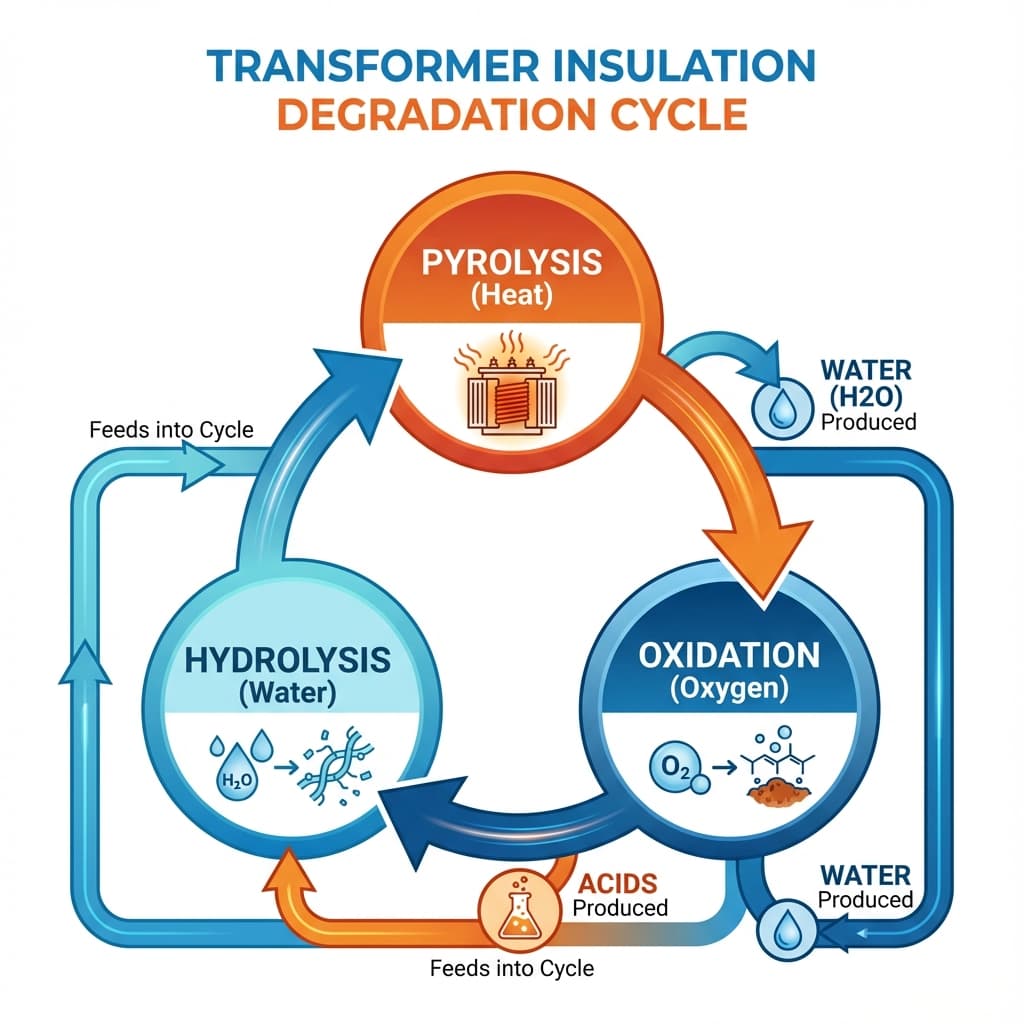
Three primary chemical mechanisms work together to degrade cellulose insulation, often in a devastating self-accelerating cycle.
Hydrolysis: Degradation caused by water and catalysed by low-molecular-weight acids. At normal service temperatures, cellulose ageing fits a model of acid-catalysed hydrolysis (CIGRE TB 738:2018).
Pyrolysis: Degradation by heat alone, without water or oxygen. It is of little relevance at normal operating and overload temperatures (below about 140 °C) and becomes dominant only at higher temperatures, where it forms CO and CO₂; furanic compounds are also formed by oxidative pyrolysis (CIGRE TB 738:2018, §3.4.4, §4.2.3).
Oxidation: Degradation caused by the presence of oxygen, which also produces water and organic acids as by-products.
These three processes are deeply synergistic. CIGRE TB 738 (Exec Summary, p. 4) quantifies two of the key dependencies directly: ageing rate approximately doubles for each additional percent of water in the paper, and the presence of oxygen seems to accelerate ageing by a factor of 2–3. Low-molecular-weight acids — produced both by oil oxidation and by paper/pressboard ageing itself — further catalyse hydrolysis, closing the feedback loop.
The Moisture Feedback Loop: Each hydrolytic scission of the cellulose chain releases water into the system. This newly released moisture then catalyses further hydrolysis, which releases more water. In older, wetter transformers, this self-accelerating mechanism can dramatically shorten remaining life — a point reinforced by the TB 738 "water-doubles-the-rate" quantification.
1.4. The Hot Spot Paradox: A Transformer Fails at Its Weakest Point
A transformer's life is not dictated by the average condition of its insulation. Instead, it is determined by the condition of its most aged and degraded section—the winding "hot spot." A catastrophic failure, whether dielectric or mechanical, will originate at this weakest point, not at the statistically average location.
This creates a fundamental challenge for diagnostics: the chemical markers we measure in the oil (furans, CO₂, methanol) reflect the average degradation of the entire cellulose mass. A critically degraded hot spot containing only a small volume of paper may be masked by the much larger volume of healthier insulation elsewhere in the unit. This is precisely why understanding the limitations of indirect markers—and combining multiple diagnostic approaches—is so critical to preventing asset failure.
2. The Classic Diagnostic Toolkit: Reading the Signs of Aging
Several methods, both direct and indirect, have been developed to assess the health of cellulose insulation.
2.1. Degree of Polymerisation (DP): The Gold Standard
The Degree of Polymerisation (DP) is the most direct and widely accepted measure of the paper's remaining mechanical strength. However, determining the DP value requires obtaining a physical paper sample from inside the transformer, making it an invasive, offline test that is rarely performed on in-service units.
The standard method for DP determination is the destructive viscometric method according to IEC 60450, where cellulose fibres are dissolved in a solvent (typically Cupriethylenediamine/CED) and the viscosity is measured. DP is then calculated from the viscosity using the equations and constants given in IEC 60450. New kraft paper used in transformers starts with a high DP value, typically around 1,200 (CIGRE TB 738:2018, Exec Summary, p. 3). After extended ageing, DP reaches a "levelling-off" value corresponding to the crystalline regions that remain once the amorphous regions are consumed.
Historically, a DP value of 150 to 200 has been considered the end of reliable life. CIGRE's earlier A2.18 guide (TB 227, 2003) gives DP 200–150 as the usual end of life, notes that some experts prefer about 450 from a short-circuit standpoint, and lists DP below 400 as a caution level.
Thresholds also vary by region and operator, reflecting differing risk tolerances and the recognition that operating conditions vary significantly across grids—factors such as grid stability, fault frequency, and ambient temperature profiles all influence how much margin is prudent. The field evidence of transformers surviving at DP 110 (discussed in Section 3) does not invalidate conservative thresholds; rather, it demonstrates that under carefully controlled conditions, life extension beyond these limits is technically feasible, though not universally advisable.
| DP of paper | Remaining tensile strength (Duval et al. 2017, Table 2) |
|---|---|
| 1,200 | 100% |
| 400 | 80% |
| 200 | 40% |
| 150 | 30% |
| 100 | 15% |
| 30 | 0% |
CIGRE TB 738 puts DP 200 at about 30% remaining tensile strength.
2.2. Chemical Fingerprints: Indirect Markers in the Oil
Because direct DP testing is impractical for in-service units, the industry relies heavily on non-invasive methods that analyse the insulating oil for chemical by-products of paper degradation. For a comprehensive guide to oil analysis methods, see our article What Your Transformer Oil Is Trying to Tell You.
Furanic Compounds (2-FAL): When cellulose breaks down through pyrolysis and hydrolysis, it releases a family of chemicals known as furanic compounds into the oil. The most common and diagnostically useful of these is 2-furfural (2-FAL). Its concentration in the oil has been correlated with paper aging, and empirical models attempt to estimate DP from furan concentration.
The commonly cited De Pablo equation (De Pablo 1999; reproduced in IEEE C57.140-2017 §5.4.2 Eq. 8) expresses this relationship as:
           7100
DP  =  ───────────────
        8.88 + F
where F is 2-furfural concentration in ppm. Other furan/DP correlations (Chendong 1991, Pahlavanpour, Shkolnik) are tabulated in IEEE C57.140-2017 §5.4.2 and may be preferred for specific paper types or operating histories.
An Important Caveat: This formulation applies specifically to standard kraft paper. Thermally upgraded paper (TUP), which uses chemical stabilisation to reduce hydrolytic degradation, follows different degradation kinetics and requires modified correlations. Furthermore, while the correlation has been intensively studied in laboratory accelerated aging tests, it is not directly applicable to transformers in the field due to complicated operating conditions and design characteristics. Furan analysis estimates the average aging degree of the entire solid insulation mass—a critically degraded hot spot may be masked by healthier insulation elsewhere.
Methanol — The Early Warning Marker: CIGRE TB 779:2019 identifies methanol as a paper-ageing marker that indicates early-stage ageing and can indicate ageing of thermally upgraded paper. It also proposes ethanol as an indicator of abnormal ageing at localised high temperatures. Methanol is formed by scission of the cellulose chains and rises rapidly as DP falls from about 1,200 to 400, a range in which furans change little. Once DP falls below ~400, methanol production levels off while furan production accelerates (Duval et al. 2017 — see reference 3). The two markers are therefore complementary: methanol for early ageing, furans for advanced ageing.
Carbon Oxides (CO and CO₂): Carbon monoxide (CO) and carbon dioxide (CO₂) are gaseous by-products of cellulose degradation, monitored as part of standard Dissolved Gas Analysis (DGA). Per IEC 60599:2022 Clause 5.5, the CO₂/CO ratio is interpreted in conjunction with absolute concentrations: a CO₂/CO ratio < 3 with high CO (e.g. 1000 ppm), in the presence of other fault gases, signals probable paper involvement with possible carbonization, while a ratio > 10 with very high CO₂ (> 10 000 ppm) suggests mild paper overheating below 160 °C or oil oxidation. Importantly, the standard explicitly states (Clause 5.5) that paper involvement shall not be diagnosed from the CO/CO₂ ratio alone — confirmation requires correlation with other fault gases, furanic compounds (per IEC 61198 / ASTM D5837), or oil analysis. Instrument transformers and some bushing types can show low CO₂/CO ratios without paper degradation (Clause 5.5, Note 3).
For detailed guidance on interpreting DGA results and using graphical diagnostic methods, see our comprehensive guide Navigating the DGA Maze: IEC vs IEEE vs CIGRE.
Practical Furan/DP Thresholds: Duval et al. (2017) compiled the following typical relationships, drawn from several published studies of transformers in service:
| 2-Furfural Concentration | Estimated DP |
|---|---|
| >2 ppm | <400 |
| >5 ppm | <200 |
| >10 ppm | <100 |
These thresholds are field observations from transformers in service, not outputs of the De Pablo equation above, which returns a higher DP at the same furan level. They assume the oil has not been recently processed. Oil filtration, degassing, or reclamation will dramatically reduce dissolved furan concentrations, rendering these correlations invalid until equilibrium is re-established. If the oil has been processed, compare the cumulative 2-FAL (before plus after treatment) with the table (Duval et al. 2017).
Advanced Dielectric Methods: Modern electrical testing techniques, such as Dielectric Frequency Response (DFR), offer another powerful, non-invasive tool. DFR analysis is extremely sensitive to moisture content in the solid insulation and to conductive contaminants within the complete oil-paper system.
DFR encompasses two main techniques:
- Frequency Domain Spectroscopy (FDS): Measures capacitance and dielectric loss (tan δ) over a broad frequency range
- Polarisation and Depolarisation Currents (PDC): A time-domain measurement method
Modern dielectric analysers estimate the water content of the cellulose and the conductivity of the oil; the estimate is reliable only if the analysis compensates for conductive ageing products. Oil treatment changes the measured dielectric response: in one reported oil exchange, tan δ at 0.1 Hz fell from 0.894 to 0.187, while the model-derived moisture estimate for the solid insulation moved only from 3% to 2.7% (CIGRE TB 414:2010, §5.2.3). A model-based analysis that separates oil conductivity from the solid insulation therefore still gives a usable moisture estimate, which makes DFR a useful complement when historical data are incomplete or the oil has been treated.
3. A Paradigm Shift: New Evidence Challenges Decades of "Rules"
For years, the DP threshold of 200 was treated as a line in the sand—cross it, and the transformer's useful life was over. Recent research, most notably the 2017 work published in IEEE Electrical Insulation Magazine by Duval, de Pablo, Atanasova-Hoehlein, and Grisaru (all leading authorities in transformer diagnostics), has presented compelling field evidence that forces us to rethink this rigid rule.
3.1. Surprising Survivors in the Field
The most striking finding from this research comes directly from field experience. Duval et al. (2017) list about 90 transformers, reported to a CIGRE working group, operating normally with DP between 250 and 75 (most values later confirmed on paper samples). This is not limited to small, low-voltage distribution units — the list includes high-voltage transformers at the 100–500 kV class, with ratings up to several hundred MVA. Some of these mechanically "weak" units even survived external short-circuit events and the stresses of being physically transported to new locations.
3.2. The Colombian Case: A Decade Beyond "End-of-Life"
One case reported to CIGRE is particularly instructive. In 2005, five 110 kV, 12.5 MVA transformers in Colombia were found to have DP values of 200—the traditional end-of-life threshold. A decision was made to keep them in service rather than immediately replace them.
Ten years later, in 2015, these same transformers were still operating normally. Their DP had fallen to 110—well into what would traditionally be considered catastrophic territory—yet they had experienced no failures.
This case alone challenges the notion that DP 200 represents an imminent failure point. It suggests that, under the right conditions, transformer life can be extended by several years beyond traditional thresholds.
3.3. Has Paper Weakness Ever Caused a Failure?
The field evidence led Duval and his co-authors to a powerful and provocative conclusion that every asset manager should carefully consider: no transformer failure attributable exclusively to the mechanical weakness of its paper had been reported with certainty to the CIGRE working group (Duval et al. 2017).
This finding reflects a fundamental diagnostic challenge: transformer failures are typically multi-causal events. When an aged unit fails, disentangling whether the root cause was brittle paper, moisture ingress, oil degradation, or a latent manufacturing defect is often impossible. The absence of documented "pure" paper-weakness failures may partly reflect this attribution difficulty rather than absolute proof that such failures cannot occur.
This does not imply that paper aging is irrelevant. But it strongly suggests that low mechanical strength alone may not be the direct cause of failure that the industry has long assumed it to be. When aged transformers do fail, the causes are typically: high moisture content, dielectric problems from sludge precipitation, oil leaks, rusting of tank or radiators, or defective components — not the mechanical rupture of brittle paper.
3.4. The Physics of Resilience
There is a clear physical reason why a transformer can continue to operate with brittle paper. While aged cellulose loses most of its tensile strength, it retains significant compressive strength perpendicular to the fiber axis.
Once the windings are manufactured, fully assembled, wrapped with paper, and placed under high clamping pressure, the insulation system becomes a solid, composite structure. In this state, the short, brittle cellulose fibres act as reinforcing filler material — similar to how mineral particles strengthen composite materials. As long as this structure remains tightly clamped and undisturbed, it can withstand considerable operational forces, even with a very low DP value. Because degraded paper also becomes thinner, the clamping force may decrease with DP, and additional mechanical forces can then contribute to winding distortion (Duval et al. 2017).
Even at DP 100, where remaining tensile strength is only ~15%, the paper retains its visual structural appearance with no tearing. At DP 30, tensile strength is essentially zero, but the fibres still provide compressive reinforcement. Duval et al. argue that in a clamped winding, compressive strength matters more than tensile strength; CIGRE TB 738, however, still treats the paper's resistance to shear during a short circuit as the critical parameter.
3.5. The Mechanical Dimension: What CIGRE TB 967 Says
CIGRE TB 967:2025 (WG D1.65) reviews the mechanical properties of the solid insulation materials themselves — paper, pressboard and laminated wood — and how ageing changes them. It complements TB 738's chemistry and kinetics, but it does not yet translate a DP value into a winding's short-circuit withstand.
The brochure covers mechanical characterisation methods, property baselines for new kraft paper, thermally upgraded paper, pressboard, and wooden support structures, and the retention of mechanical properties as a function of ageing. It stresses that clamping forces must stay sufficient throughout the transformer's life. It shows that two pressboard spacer stacks aged to similar DP (164 and 152) shrank by very different amounts under load, so a winding's clamping condition cannot be read from paper DP. It records that the compressive and shear behaviour of aged material, and of complete windings, is still little studied. And it does not make the case for low-DP paper: it states that the mechanical properties of the paper are already minimal before DP 200, and that a levelling-off DP of around 150–200 is where the insulation gets brittle and might fail to insulate.
The mechanical argument for keeping low-DP units in service is therefore Duval et al.'s, not TB 967's: the compressive strength of clamped short fibres (Section 3.4). What TB 967 adds is a reason for any RLA (remaining-life assessment) to look at the winding-support system as well as the paper, because clamping condition cannot be read from DP.
3.6. The Real Culprit? The Oil Itself
Duval et al.'s work offers another profound insight: the condition of the insulating oil may be far more critical to preserving dielectric integrity than the paper's DP value.
Duval et al. report that the resistivity of paper at DP below 200 is the same as that of new paper. However, that same paper's resistivity can plummet by a factor of approximately 500 when it is impregnated with highly oxidised oil.
Furthermore, cellulose fibres in the oil, especially moist ones, can reduce the oil's dielectric properties and its breakdown voltage (CIGRE TB 738:2018).
This finding suggests that poor oil quality, not low DP, is the more likely trigger for a dielectric failure in an aged transformer. It reinforces the critical importance of maintaining good oil quality throughout the life of the transformer — and especially in its later years.
3.7. Acknowledging the Limits of the Evidence
A note of caution is warranted. The documented cases of transformers surviving at very low DP values represent units that continued to operate successfully. We have less visibility into units that may have failed suddenly without warning. Some degree of survivor bias may exist in the data.
This does not invalidate the findings, but it does reinforce that extending operation beyond traditional DP thresholds requires rigorous condition monitoring and strict operational discipline — not complacency.
4. A New Playbook: Practical Guidance for Asset Managers
This new understanding requires a revised strategy for managing aging transformer fleets. The focus shifts from a single number to a comprehensive condition assessment.
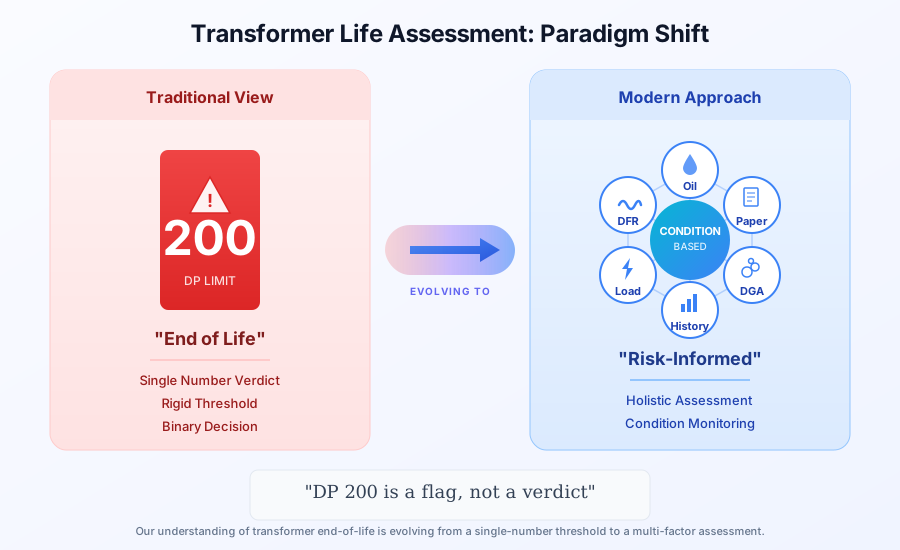
4.1. DP 200: A Flag, Not a Final Verdict
A DP value approaching 200 should no longer be viewed as an automatic trigger for replacement or retirement. Instead, it should be treated as a critical flag that signals the need for heightened vigilance, more frequent condition monitoring, and stricter operational control.
This does not mean DP monitoring becomes irrelevant. On the contrary, a low DP reading should intensify your attention to the asset — it demands more rigorous oil quality maintenance, more frequent DGA and furan testing, and careful consideration of operational constraints. The appropriate response to a low DP is disciplined asset management, not complacency or knee-jerk replacement.
4.2. Conditions for Continued Operation
Safely extending the life of a transformer with a very low DP is possible, but only if specific conditions are rigorously met:
Excellent Oil Quality: The oil must be maintained in excellent condition, precisely defined by measurable engineering targets. According to IEC 60422:2024, Table 5, key parameters should be kept within the "Good" category:
- Acidity: Below the "Fair" threshold (e.g., <0.10 mg KOH/g for Category A/B transformers)
- Dielectric Dissipation Factor (DDF) at 90 °C: Maintained at a low value (e.g., <0.10)
- Water Content: Actively managed within the "Good" range, evaluated in conjunction with breakdown voltage
- Interfacial Tension (IFT): Monitored as an indicator of oil oxidation and contamination
- Oxygen Exclusion: Transformers equipped with membrane conservators or nitrogen blanketing systems age significantly more slowly than free-breathing designs. This matches the TB 738 finding that removing dissolved oxygen reduces ageing rate by a factor of 2–3. For units with traditional open conservators, retrofitting a membrane or rubber bladder system can substantially reduce oxidation rates and extend remaining life — a particularly valuable intervention for aged assets where oil quality preservation is critical.
Stable System Conditions: The transformer should be operating in a stable part of the grid, not subject to frequent severe electrical stresses from nearby faults or extreme mechanical vibrations. CIGRE TB 738 notes that failure risk is lower where short circuits are rare and higher where they are frequent. Duval et al. make a stable network a condition for keeping low-DP units in service.
Strict Operational Constraints: For aged but stable units, a strict "hands-off" policy is paramount. The tightly clamped winding structure must not be disturbed:
- Do NOT attempt internal winding inspections
- Do NOT drain the main tank for any reason
- Do NOT use high-speed, high-velocity oil circulation during any oil processing
- Do NOT subject the unit to hot-oil spray drying
In one documented case, a transformer with very low DP that had been operating normally failed after the oil was mistakenly circulated at high speed for degassing. A possible explanation is that the strong oil flow displaced the oil-impregnated short fibres on the unsupported vertical sides of conductors.
4.3. The Furan Trap
Asset managers must be aware of a common diagnostic pitfall. After oil reclamation or reconditioning, furan levels in the oil can drop to near-zero, creating a false sense of security about the paper's condition. The furanic compounds are polar molecules that partition between the oil and paper; aggressive oil treatment removes the dissolved fraction but leaves the bulk of contamination absorbed in the solid insulation.
Over time, furans will slowly leach back from the paper into the clean oil, but this is slow: in three processed transformers, 2-FAL had not recovered 30% of its original level after about six months, and full recovery is expected to take more than a year (Jalbert et al. 2012; CIGRE TB 779). In the interim, applying standard furan-to-DP correlations will dramatically overestimate the remaining paper strength.
The solution: When the oil has been processed, compare the cumulative 2-FAL (before plus after treatment) with the furan/DP table (Duval et al. 2017) and establish a new furan baseline. Methanol recovers faster than 2-FAL and is a useful cross-check (CIGRE TB 779). DFR complements this by estimating moisture in the solid insulation, but it does not measure DP.
4.4. The Power of a Holistic View
Decisions about the life and serviceability of an aging transformer must never rest on a single parameter. The modern approach requires a multi-faceted assessment combining:
- DGA: For active fault detection and trending
- Routine Oil Quality Tests: Breakdown voltage, acidity, water content, DDF, interfacial tension
- Furan Analysis: For paper aging estimation (with awareness of processing history)
- DFR/PDC Analysis: For moisture-in-paper and dielectric system health. IEC 60814:1997 (coulometric Karl Fischer) is the method for water in the oil and, in its Clause 4, in oil-impregnated paper and pressboard (methanol extraction, direct titration or oven evaporation). IEC 60422 uses it for its water-in-oil values.
- Mechanical Withstand Context: CIGRE TB 967:2025 reviews the mechanical properties of paper, pressboard and laminated wood and how ageing changes them. It notes that the compressive and shear behaviour of aged material, and complete windings, are still little studied.
- Operational History: Loading patterns, fault exposure, maintenance records
IEEE Std C57.140-2017 provides guidelines for evaluation and reconditioning of liquid-immersed power transformers, including methods for testing remaining insulation life (DP estimates).
By integrating these data streams, an asset manager can build a complete and reliable picture of the asset's true condition and make informed, risk-aware decisions.
5. Conclusion: From a Simple Number to a Smart Strategy
Our understanding of transformer end-of-life is evolving. The traditional focus on a single, rigid DP number is giving way to a more sophisticated and holistic assessment of the entire insulation system, supported by field evidence published in 2017 and by the ageing chemistry in CIGRE TB 738:2018. CIGRE TB 967:2025 adds a review of the mechanical properties of the insulation materials. While historical DP thresholds remain valuable as conservative guidelines — and should continue to trigger heightened attention — compelling field evidence demonstrates that transformer life can be safely extended beyond what was once thought possible.
The key to this extension is not a miracle cure but careful, intelligent management. By prioritising the health of the insulating oil, maintaining strict operational discipline, and respecting the physical constraints of an aged asset, reliability can be preserved.
The bottom line: A DP value of 200 is not a death sentence. It is a call to action — a signal that your transformer has entered a phase requiring more rigorous care, more frequent monitoring, and more informed decision-making. A comprehensive oil analysis programme, combined with advanced diagnostics like DFR, an explicit look at the winding's clamping and mechanical condition, and a deep understanding of the asset's full operational context, is the true cornerstone of modern asset management strategy for aging transformer fleets.
Ready to Assess Your Transformer Fleet?
TriboTech advises on transformer oil programmes, including DGA, furan analysis and oil quality assessment. Our diagnostic experts can help you develop a condition-based assessment strategy for your aging assets.
Contact us to discuss your monitoring program
Related Tools
Put theory into practice with our interactive diagnostic calculators:
- Duval Triangle Calculator — Classify fault types from DGA results
- Duval Pentagon Calculator — Comprehensive 5-gas analysis
- Unified Diagnosis Flow Tool — Integrated workflow with trend analysis
References
- CIGRE Technical Brochure 738, Ageing of liquid impregnated cellulose for power transformers, WG D1.53, Convenor L.E. Lundgaard, August 2018. ISBN 978-2-85873-440-5. e-cigre.org publication page.
- CIGRE Technical Brochure 967, Mechanical properties of insulation materials for power transformers, WG D1.65, Convenor L.E. Schmidt, June 2025. ISBN 978-2-85873-672-0. e-cigre.org publication page.
- Duval, M., de Pablo, A., Atanasova-Hoehlein, I., & Grisaru, M. (2017). "Significance and Detection of Very Low Degree of Polymerization of Paper in Transformers." IEEE Electrical Insulation Magazine, 33(1), 31–38.
- IEC 60422:2024: Mineral insulating oils in electrical equipment — Supervision and maintenance guidance.
- IEC 60599:2022: Mineral oil-filled electrical equipment in service — Guidance on the interpretation of dissolved and free gases analysis.
- IEC 60450:2004: Measurement of the average viscometric degree of polymerisation of new and aged cellulosic electrically insulating materials.
- IEC 60814:1997: Insulating liquids — Oil-impregnated paper and pressboard — Determination of water by automatic coulometric Karl Fischer titration.
- IEEE Std C57.91-2025: IEEE Guide for Loading Mineral-Oil-Immersed Transformers and Step-Voltage Regulators.
- IEEE Std C57.104-2019: IEEE Guide for the Interpretation of Gases Generated in Mineral Oil-Immersed Transformers.
- IEEE Std C57.140-2017: IEEE Guide for Evaluation and Reconditioning of Liquid Immersed Power Transformers.
- CIGRE TB 227 (WG A2.18, 2003): Life management techniques for power transformers.
- Dielectric Response Analysis of Transformers — Technical overview.
- OMICRON: Why is water killing power transformer insulation?.
- ResearchGate: Evaluation of Alternative Insulation Failure Criterion to Assist Asset Management of Aged Transformers.
- CIGRE Technical Brochure 779, Field experience with transformer solid insulation ageing markers, JWG A2/D1.46, October 2019.
- CIGRE Technical Brochure 414, Dielectric response diagnoses for transformer windings, WG D1.01 (TF 14), 2010.
- Jalbert, J., Gilbert, R., Denos, Y., & Gervais, P. (2012). "Methanol: A Novel Approach to Power Transformer Asset Management." IEEE Transactions on Power Delivery, 27(2), 514–520.
Standards referenced
The methods on this page are anchored in these standards — follow each into our standards library.
Put Theory into Practice
Try our interactive Duval diagnostic tools or use our new unified workflow to analyze your transformer oil data.