

Audio player docked to bottom

Listen to this article
Key takeaway
On 31 December 2025, the EU deadline for taking PCB-contaminated transformers out of use expired. The line that triggers the duty is 50 mg/kg — not the 500 mg/kg decontamination trigger many asset owners remember from the 1996 Directive. A transformer above 50 mg/kg that is still in service today is in breach of the POPs Regulation, and the duty does not lapse with the date: the unit must come out of service as soon as possible. And where no analysis exists, the default runs the other way: the equipment counts as PCB-containing — an OEM declaration or a filling history does not rebut that — and the oil drained from it, including the sample drawn for routine oil analysis, cannot be assigned to any waste code other than 13 03 01 until the analysis is in hand. Below: the three concentration bands and their duties, a worked example, and the laboratory detail that decides the borderline cases.
One measurement decides — and without one, the answer is already given
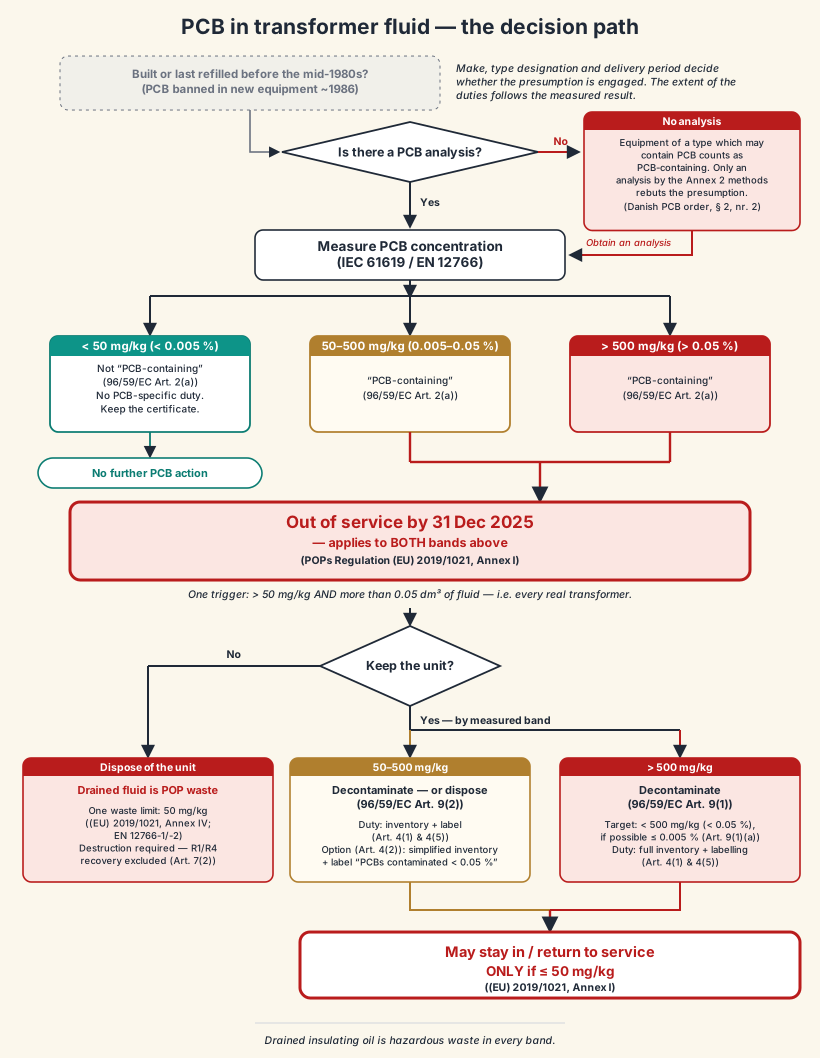
PCB was the dominant non-flammable dielectric fluid for transformers until its use in new plant and equipment was banned by international agreement in 1986 (IEC 60422:2024, Clause 7.18). Forty years on, the issue has not aged out of the fleet. A mineral-oil transformer built before the mid-1980s can still carry PCB — either as residue of the original fluid or as cross-contamination from shared handling infrastructure: tankers, filtration rigs, reclamation plants. A unit that is mineral-oil on paper can be PCB-containing in law.
Whether it is, is normally decided by one number: the measured total PCB concentration. But where no measurement exists, the question is not open — it has already been answered. Under the Danish PCB order, equipment of a type which may contain PCB counts as PCB-containing unless an analysis shows otherwise. Missing documentation is therefore not a neutral state: it holds the unit in the PCB-containing category until an analysis releases it. Age and nameplate are consequently more than a testing-priority key — make, type designation and delivery period are precisely what the authority screens on. And keep the two small numbers apart: the acceptance criterion for new oil — not detectable, below 2 mg/kg (IEC 60296:2020, Tables 3 and 4) — is a product specification. The legal floor is 50 mg/kg, and the decision flow around it looks like this:
Your obligations, band by band
Read off the band your measured concentration falls in, then read across.
| Measured PCB | Legal status | What you must do | Documentation to hold | Deadline status |
|---|---|---|---|---|
| No analysis | Equipment of a type which may contain PCB counts as PCB-containing (Danish PCB order, § 2, nr. 2). Without an analysis the unit cannot be placed in any of the bands below. | Obtain an analysis by the Annex 2 methods. Only the result shows whether the unit falls under the decontamination duty in § 12 or the § 13 route — and an undocumented unit may just as easily sit above 500 mg/kg as below. | None — which is the problem. The holder must produce documentation on request (§ 15) | The presumption runs until the analysis exists |
| < 50 mg/kg (< 0.005 % wt) | Not "PCBs" in the legal sense (96/59/EC, Art. 2(a)) | No PCB-specific action. Keep the certificate on file as proof of status. | The PCB certificate (method + result) | — |
| 50–500 mg/kg (0.005–0.05 % wt) | PCB-containing; drained oil is POP-waste (Reg. (EU) 2019/1021, Annex IV) | Inventory and label the unit (96/59/EC, Art. 4(1) and Art. 4(5)). Take it out of use; then decontaminate or dispose of it as POP-waste. | Inventory entry + label. Art. 4(2) additionally permits a simplified inventory entry and the label "PCBs contaminated < 0,05 %" for this band — an option, not the duty itself. POP-waste consignment papers at disposal. | Out of use by 31 December 2025 — passed (Reg. (EU) 2019/1021, Annex I) |
| > 500 mg/kg (> 0.05 % wt) | PCB-containing; decontamination obligation (96/59/EC, Art. 9(1)) | Inventory and label (Art. 4(1) and Art. 4(5)). Take it out of use; decontaminate to below 0.05 % — and, if possible, to no more than 0.005 % (Art. 9(1)(a)) — or dispose of it as POP-waste. | Inventory entry + label; the decontamination record; POP-waste consignment papers at disposal | Out of use by 31 December 2025 — passed; decontamination per the Directive |
One thing holds across every row: the drained oil is hazardous waste regardless of PCB content. There is no non-hazardous waste code for drained insulating oil — every code in group 13 03 of the Danish waste order is hazardous. The 50 mg/kg line does not decide whether the oil is hazardous waste, but whether the POPs destruction requirement applies on top. "Below 50 mg/kg" therefore does not mean "ordinary waste oil".
Two volume thresholds sit behind the table, and they must not be merged. The inventory and labelling duties apply once a unit holds more than 5 dm³ of PCB-containing fluid (96/59/EC, Art. 4(1)). The removal-from-use duty applies already above 0.05 dm³ (Reg. (EU) 2019/1021, Annex I) — in practice, every transformer. Note also what fluid replacement is: where decontamination is performed by replacing the fluid, the replacement must meet the conditions in Art. 9(1)(b)–(d) — the replacement fluid must entail markedly lesser risks, the replacement must not compromise the subsequent disposal of the PCBs, and the unit must be re-labelled. Replacing the fluid is a way of meeting the decontamination duty, not a shortcut around it.
A worked example
A pre-1986 mineral-oil distribution transformer is sampled. The certificate reads PCB = 120 mg/kg (Method A). That places it in the 50–500 mg/kg row of the table:
- It is legally PCB-containing. Sitting "well under 500" changes nothing.
- It holds far more than 5 dm³ of oil, so it must be inventoried and labelled.
- The removal duty applies, and the table's deadline has expired — the unit should already be out of service and on its way to decontamination or disposal.
- Its drained oil is POP-waste and must be consigned as such.
The reading "only 120 — well under 500, keep it running" is the exact error the band structure exists to prevent.
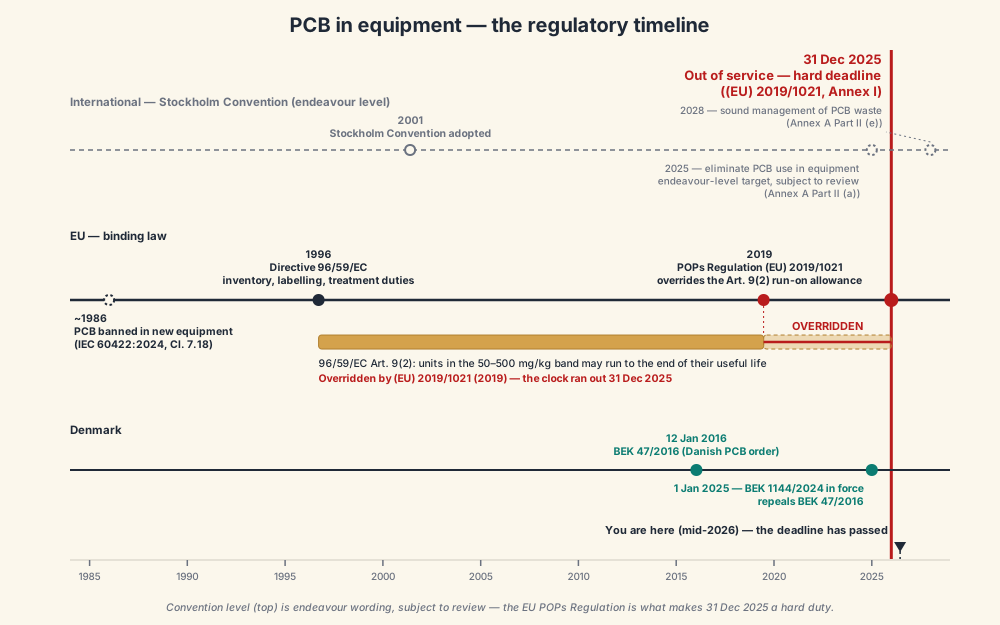
How the run-to-end-of-life option disappeared. Directive 96/59/EC originally allowed a transformer in the 50–500 mg/kg band to stay in service and be disposed of at the end of its useful life instead of being decontaminated (Art. 9(2)). That allowance is the source of the persistent belief that a lightly contaminated unit may quietly run on. The POPs Regulation closed the route in 2019: its PCB entry opens "without prejudice to Directive 96/59/EC" — the Directive's duties remain in force as a floor — and then lays an absolute removal date on top (Reg. (EU) 2019/1021, Annex I). The 500 mg/kg line still sets the decontamination standard; the phase-out duty begins at 50 mg/kg.
Does the unit's age matter in law? Yes — indirectly, and more than owners tend to assume. The extent of the duties follows the measured concentration, but whether the presumption is engaged at all turns on what type of unit it is. In practice the authority screens on make, type designation and delivery period rather than on oil filling as such. Known askarel trade names and type markers — Clophen, Pyralene, AEG designations of the form "C" plus digits, Trafo Union designations of the form "TC" plus digits — are among those that bring a unit into scope. The list is neither exhaustive nor a substitute for the analysis, but it explains why "we have no paperwork on it" is a worse starting point for a 1974 unit than for a 2004 one.
The deadline has passed — what now?
The date was a cut-off, not an expiry of the obligation. A unit above 50 mg/kg holding more than 0.05 dm³ of fluid should already be out of service, and the requirement now reads "as soon as possible" — equally for both contaminated bands. The practical response: pull the certificates you hold, measure where none exists — and note that a unit without an analysis is not in an unresolved middle state. It counts as PCB-containing until the analysis shows otherwise. Then plan removal and treatment for anything above the floor.
The law names the method
Few asset owners know that the 50 mg/kg waste limit comes with its own measurement instruction. Footnote 3 to the PCB row in Annex IV of the POPs Regulation states that the calculation method laid down in EN 12766-1 and EN 12766-2 shall apply (Reg. (EU) 2019/1021, Annex IV). The classification method is not the laboratory's free choice — the law names it.
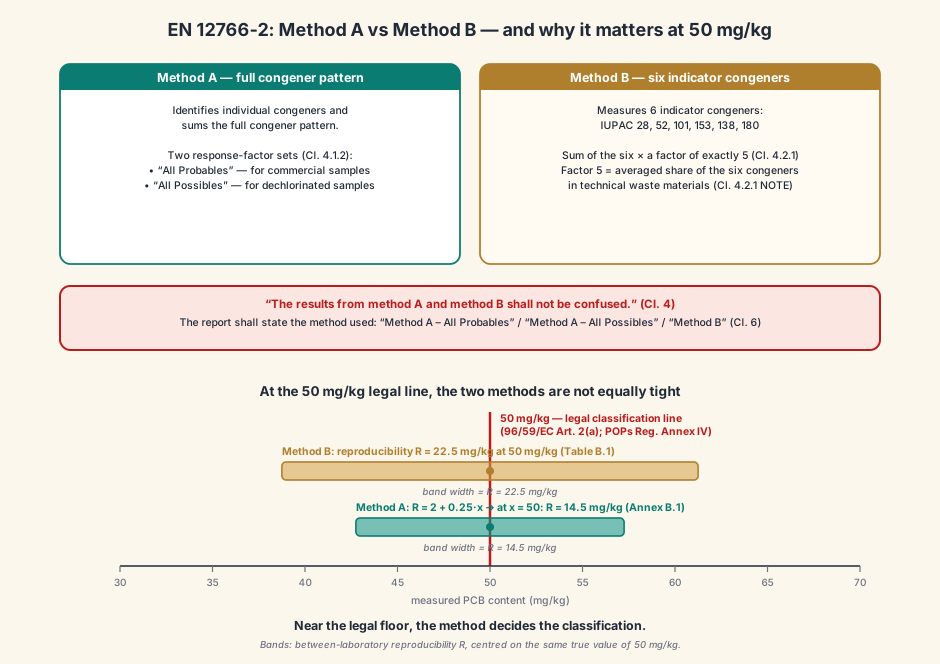
That matters, because EN 12766-2 contains two calculation procedures, and the standard is explicit that the "results from method A and method B shall not be confused" (EN 12766-2:2001, Clause 4, p. 4):
- Method A quantifies the full chromatographic congener pattern. For commercial samples — including insulating oils — it uses the "All Probables" data set (Clause 4.1.2). It is also the method behind an IEC-framework certificate: IEC 61619, the method IEC 60296 and IEC 60422 reference for insulating liquids, is identical to EN 12766-2 Method A (IEC 60422:2024, Clause 7.18).
- Method B sums six indicator congeners — IUPAC 28, 52, 101, 153, 138 and 180 — and multiplies by a factor of exactly five. The factor is an average, derived from the congener content of European waste materials over some fifteen years (Clause 4.2.1 and its NOTE) — not an exact relationship for any single sample.
The UK foreword to the standard adds the warning that matters at the legal floor: Method B may allow samples that should be classified as PCB to escape classification.
Near 50 mg/kg, the precision data makes the same point in numbers. Method B's between-laboratory reproducibility at 50 mg/kg is 22.5 mg/kg (EN 12766-2:2001, Table B.1) — an uncertainty band of nearly half the threshold. Method A's reproducibility is R = 2 + 0.25·x — roughly 14.5 mg/kg at the same level. Close to the floor, the calculation method, not the transformer, can decide which side of the line the certificate lands on.
What a usable certificate must show
Three checks before anyone acts on a PCB number:
- The method — including the calculation procedure. EN 12766-2 requires the report to state "Method A – All Probables", "Method A – All Possibles" or "Method B" (Clause 6). A bare "PCB = 42 mg/kg" cannot be compared to the 50 mg/kg floor.
- The reporting limit for the actual sample — not the standard's nominal value. Matrix and sample size move it.
- The accreditation scope — the laboratory's ISO/IEC 17025 accreditation must cover PCB in oil. Without it, the certificate is informally useful but weak in front of a regulator.
TriboTech's analysis reports go one step further: we report both the Method A and the Method B result for the same sample. Near the 50 mg/kg floor, that pair is the documentation. If both methods land on the same side of the line, the classification is robust to the choice of method. If they straddle it, the certificate itself shows the result is a margin-of-error case — and the Method A figure is the one to act on.
The Danish layer
In Denmark the framework is implemented by BEK nr. 1144 af 05/11/2024, in force since 1 January 2025, which replaced BEK nr. 47 af 12. januar 2016 (§ 19). The structure mirrors the Directive: the 0.005 % definitional floor (§ 2, nr. 1, litra d), labelling of equipment holding more than 5 dm³ (§ 7, stk. 1), notification of the authorities (§ 10), and mandatory decontamination above 0.05 % with the objective of bringing the content below 0.05 % (§ 12).
The provision most owners overlook sits in the definitions: equipment of a type which may contain PCB counts as PCB-containing unless an analysis shows that it does not (§ 2, nr. 2), with the holder required to hold that documentation and produce it on request (§ 15) and a penalty for failing to (§ 18). The Directive allows the presumption to be rebutted where the contrary can reasonably be assumed; the Danish order requires an analysis. Its reach is not unlimited, though — reading it to cover every oil-filled transformer would place practically the whole Danish fleet in retrospective breach of the order's own disposal deadline of 1 January 2000, so in practice the screening runs on make, type designation and delivery period.
Its Bilag 2 prescribes EN 12766-1/-2 and IEC 61619 as the reference analysis methods — the same methods the POPs Regulation names. One point deserves attention: the removal-from-use date is carried by the POPs Regulation itself, which applies directly in Denmark; where the bekendtgørelse's end-of-life wording for the 0.005–0.05 weight-% band (§ 13) appears to differ, the Regulation governs.
Send us the certificate
If you hold a PCB certificate you are not sure how to read — or a pre-1990 unit with none at all, which therefore counts as PCB-containing until an analysis says otherwise — get in touch. We will place the result in the right band and tell you what, if anything, you need to do. The same applies if you are planning a handover, retrofill or scrapping where the PCB documentation has to be in place before the decision is made.
If the worry that brought you here is PFAS rather than PCB — "is silicone oil a PFAS?" — the short answer is no, and the long answer is in our PFAS article. The full documentation picture across contaminants is in our guide to documenting transformer-oil contaminants.
Frequently asked questions
Is my transformer PCB-containing if I have no analysis?
Can a nameplate or an OEM declaration serve as documentation that there is no PCB?
What does the 50 mg/kg limit mean?
Is the oil hazardous waste if it sits below 50 mg/kg?
Does the 31 December 2025 deadline still apply?
Which analysis method is required for PCB in transformer oil?
Are there occupational-health consequences to working on a presumed PCB-containing unit?
Standards referenced
The methods on this page are anchored in these standards — follow each into our standards library.
Regulatory basis
Official texts (external links)
Put Theory into Practice
Try our interactive Duval diagnostic tools or use our new unified workflow to analyze your transformer oil data.