

Audio player docked to bottom

Listen to this article
Key Takeaway
PFAS regulation is moving fast, and the worry has reached the transformer tank. The most useful thing we can tell an asset owner is also the most counter-intuitive: silicone transformer oil is not a PFAS, and neither is any of the four mainstream insulating fluids. The PFAS exposure at a transformer site is the firefighting foam in the surroundings, not the dielectric fluid in the tank. The documentation obligation that does attach to the fluid is PCB — and there the deadline has already passed.
Why the PFAS question reached the transformer tank
A forthcoming EU restriction on PFAS is under assessment, and the parallel tightening of PFAS limits in environmental law has put one question in front of asset owners: are our transformer fluids affected, and is silicone oil a PFAS?
The question is reasonable. "Silicone" and "fluoropolymer" both sit in the popular notion of synthetic, slippery, chemically inert materials, and it is easy to group them. But the chemistry separates them cleanly, and the separation is worth getting right — because it decides whether you commission an analysis you do not need, or scope the real risk to the place it actually sits.
The test that settles it: is there a carbon–fluorine bond?
PFAS means per- and polyfluoroalkyl substances. The defining structural feature is a carbon atom that is fully fluorinated — fluorine in place of hydrogen, bonded to no further hydrogen, chlorine, bromine, or iodine. Under the OECD structural definition, a substance is a PFAS if it contains at least one fully fluorinated methyl (CF₃–) or methylene (–CF₂–) carbon. The EU restriction proposal uses an essentially identical criterion.
So the operative test is simple: does the molecule contain a carbon–fluorine bond in a perfluorinated environment? If yes, it is a PFAS. If there is no C–F bond at all, it is not — regardless of any other element the molecule contains.
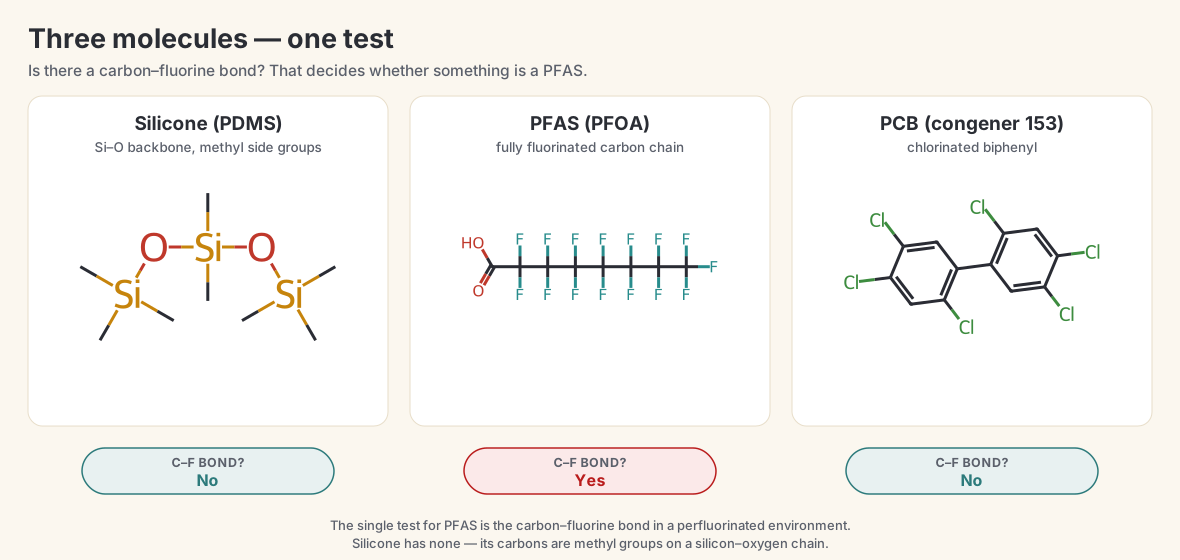
Silicone transformer oil is polydimethylsiloxane (PDMS). Its repeating unit is a silicon–oxygen backbone with two methyl groups on each silicon. Every carbon in PDMS is a methyl carbon bonded to three hydrogens and one silicon. There is no carbon–fluorine bond of any kind — indeed no fluorine in the molecule at all. PDMS therefore falls categorically outside the PFAS definition.
The confusion has a specific source. Fluorosilicones — a different, specialty material with fluorinated organic side chains — do contain C–F bonds and can fall within PFAS scope. But fluorosilicones are not used as transformer insulating fluids. Transformer silicone oil is plain PDMS.
The four fluids — none use PFAS
The point generalises. None of the four mainstream insulating-fluid classes uses a PFAS as the base fluid or as a routine additive:
| Fluid class | Base chemistry | Carbon–fluorine bond? |
|---|---|---|
| Mineral oil | Hydrocarbons (C, H) | No |
| Natural ester | Triglycerides (C, H, O) | No |
| Synthetic ester | Polyol esters (C, H, O) | No |
| Silicone (PDMS) | Polydimethylsiloxane (Si, O, C, H) | No |
There is no historical or current use of PFAS as a dielectric liquid in the way PCB once was. The non-flammable-fluid niche that PCB once occupied is now served by esters and silicone, none of which are fluorinated.
The practical consequence: you do not PFAS-test a transformer fluid. PFAS is not a fluid constituent, so the right action is to confirm its absence from the supplier's safety data sheet, and to screen the fluid for the parameters that do belong on an oil panel — PCB, dissolved gas, and oil quality.
So where is the PFAS risk?
It is real — but it is a site question, not a fluid question.
The dominant pathway is AFFF firefighting foam. Aqueous film-forming foams used historically at substations and around oil-filled transformer compounds are a major legacy PFAS source. A foam discharge, or legacy soil and groundwater contamination from past discharges or training, is where PFAS appears — in the surroundings, not in the transformer oil. Fluorinated component materials (certain gaskets, O-rings, and greases) are a second, hardware-level pathway, relevant at decommissioning rather than in service.
A transformer environmental screening should therefore treat PFAS as a soil-and-water question driven by the site's firefighting-foam history, and treat the dielectric fluid as a separate matrix screened for PCB, gas, and oil quality. Conflating the two on a report is the error to avoid.
The documentation duty that does attach to the fluid: PCB
PFAS is not a fluid question — but one contaminant obligation attaches squarely to the fluid itself: PCB. Polychlorinated biphenyls were the dominant non-flammable dielectric fluid until production was phased out around 1980, and a mineral-oil unit built before the mid-1980s can still carry residual PCB — so a nominally "mineral-oil" transformer can still trigger PCB-waste classification.
The legal mechanics are stricter than many owners assume. Under the EU POPs Regulation ((EU) 2019/1021), the removal-from-use deadline — 31 December 2025 — has already passed, and the line that triggers it is 50 mg/kg, not the 500 mg/kg figure many still treat as the operative threshold. A unit measuring above 50 mg/kg should already be out of service.
What that means for your fleet — the full decision path, a worked example, and what your laboratory certificate must show before you can act on the number — is the subject of our deep dive: PCB in transformer oil: the deadline has passed. For the broader compliance picture across PCB, the revised Water Framework Directive, and corporate reporting, see our guide on documenting transformer oil contaminants.
How TriboTech helps
Reading a fluid certificate correctly — and placing each contaminant in the right matrix — is the advisory work we do every week. If you are holding a certificate you are not sure how to read, or planning a handover, retrofill, or decommissioning where the documentation has to hold, get in touch.
Regulatory basis
Official texts (external links)
Put Theory into Practice
Try our interactive Duval diagnostic tools or use our new unified workflow to analyze your transformer oil data.