
Audio player docked to bottom
Listen to this article
Key takeaway: The counting method is part of the number — ask which method produced a count before you compare two of them. Match the method to the fluid: clear oil to a light-extinction counter, dark or viscous gear oil to a microscope, grease to per-mass size bands and never an ISO code. And remember that a low elemental result does not mean a clean bearing, because large wear particles are invisible to it.
Two labs, one oil, two counts — both right
Send a split of the same oil to two competent laboratories and you can get back two different ISO 4406 cleanliness codes. Neither lab made a mistake. They measured the particles with different instruments, and those instruments size particles on different bases.
A light-extinction counter reports the diameter of a circle with the same cross-sectional area as the particle — a value in µm(c), tied to a calibration standard (ISO 4406:2021, Clause 4.1). A microscope reports the longest physical dimension of the particle (ISO 4407:2025, Clause 3.10). For a round particle those two numbers nearly agree. For an elongated sliver — say 25 µm long and a few µm wide — the microscope calls it "25 µm" while the counter, seeing only its modest cross-section, files it at roughly half that. Same particle, two honest answers.
That is the whole thesis of this article. A particle count is never just a number. It is a number produced by a specific instrument that physically sees only part of the particle population. The skill is not reading the code — it is choosing the counting method to match the fluid and the component, then reading every count as a method-qualified figure.
The instruments — what each one physically sees
There are four counting classes in routine use, and each answers a slightly different question.
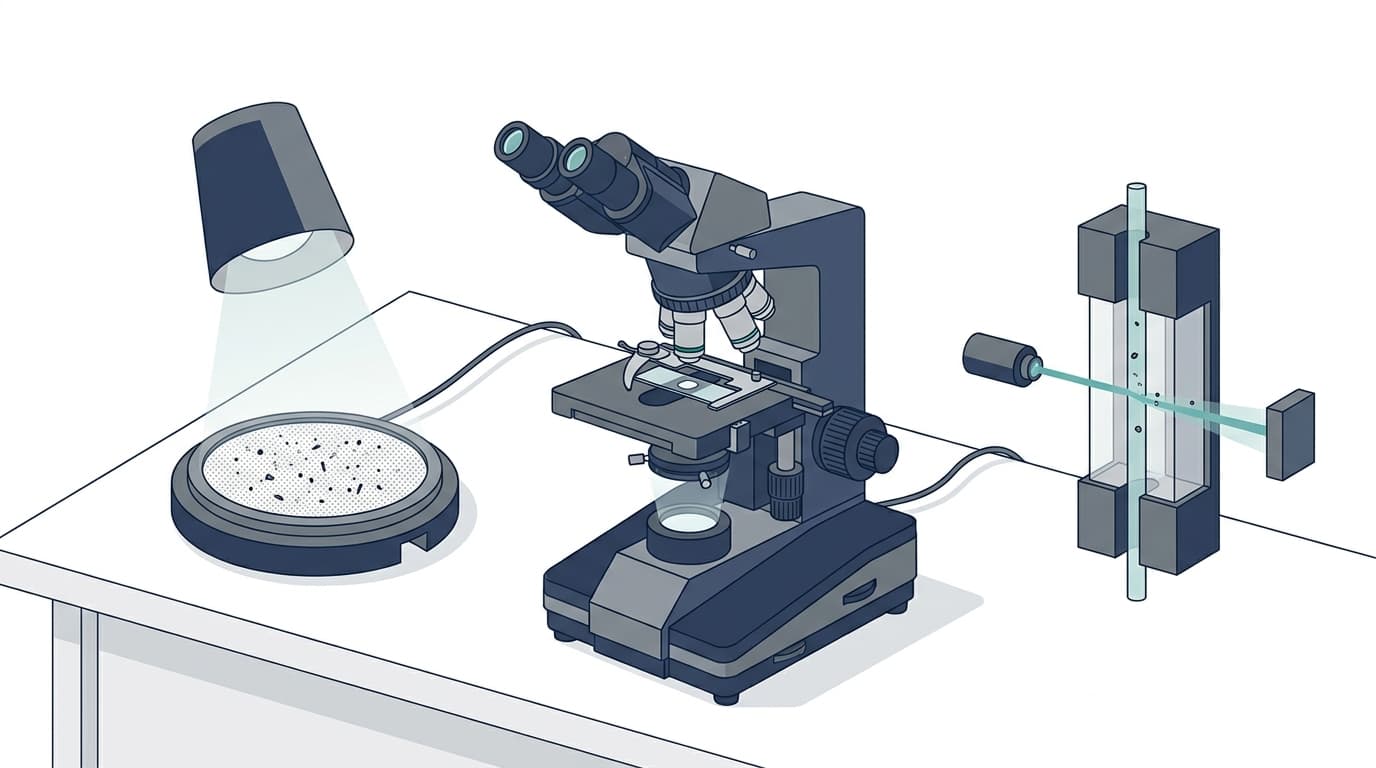
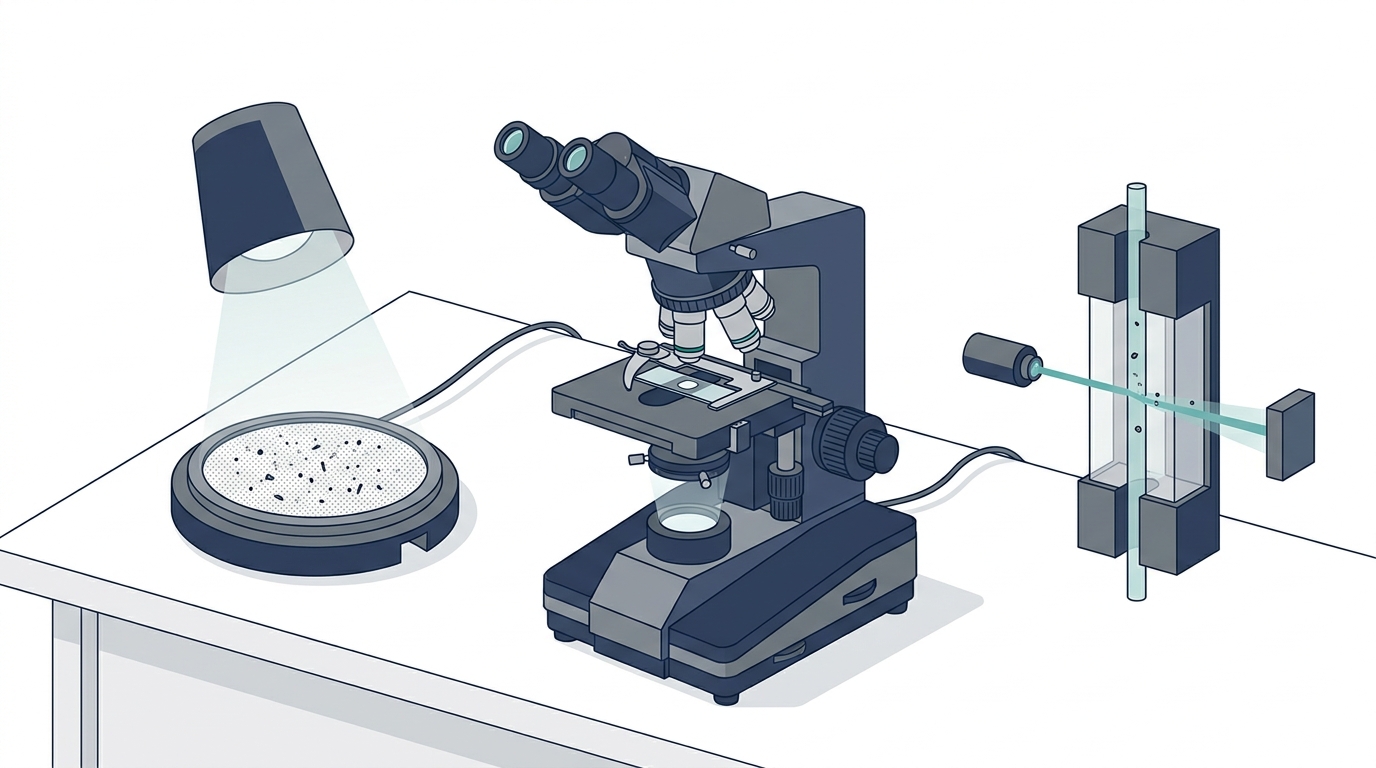
Light-extinction particle counter (the PAMAS-class laboratory workhorse). A narrow light beam passes through a thin stream of the sample; each particle reduces the intensity of the beam as it crosses the sensing volume (ISO 11500:2008, Clause 3.3), and from that signal the instrument derives the size of an equivalent particle based on its cross-sectional area, reported in µm(c) (ISO 4406:2021, Clause 4.1). Calibration against a certified reference standard makes "6 µm(c)" mean the same thing on any brand of instrument (ISO 11171:2016, Clause 6.8). It is fast, counts a metered volume in flow, and reports the three-number ISO 4406 code at 4 / 6 / 14 µm(c) (ISO 4406:2021, Clauses 4.4.2–4.4.4).
Optical microscopy on a membrane. A measured volume of fluid is vacuum-filtered onto a membrane, and each particle is imaged and sized by its longest dimension — though for gear and pitch-hydraulic oils TriboTech sizes on an area-equivalent basis to stay comparable with the counter (see the doctrine section below). The current edition defines both an automated image-analysis route and the manual count (ISO 4407:2025, Scope). It reports a two-number code at 5 / 15 µm, written with a leading dash — --/X/Y (ISO 4406:2021, Clauses 4.5.2–4.5.4). Crucially, it works on dark and viscous fluids where the beam counter fails, and it shows morphology.
Direct-imaging (flow-imaging) counter. This class photographs each particle in flow and classifies both its size and its shape into five particle classes — three wear modes (cutting, sliding, fatigue) plus nonmetallic and fibres — while flagging water droplets and air bubbles by their optics (ASTM D7596-24, Clauses 1.1.4 and 4.3). It is the bridge between count-only and morphology, recovering shape information without the hours-per-sample cost of manual microscopy. But it is a triage signal, not a diagnosis: the shape classifier is trained on lab-generated wear modes (ASTM D7596-24, Section 6.9).
Per-mass particle counting for grease. Grease does not circulate, so a weighed aliquot is dispersed and filtered, and particles are counted per unit mass in size bands. Mechanistically it is microscopy — but with a different denominator: mass, not volume.
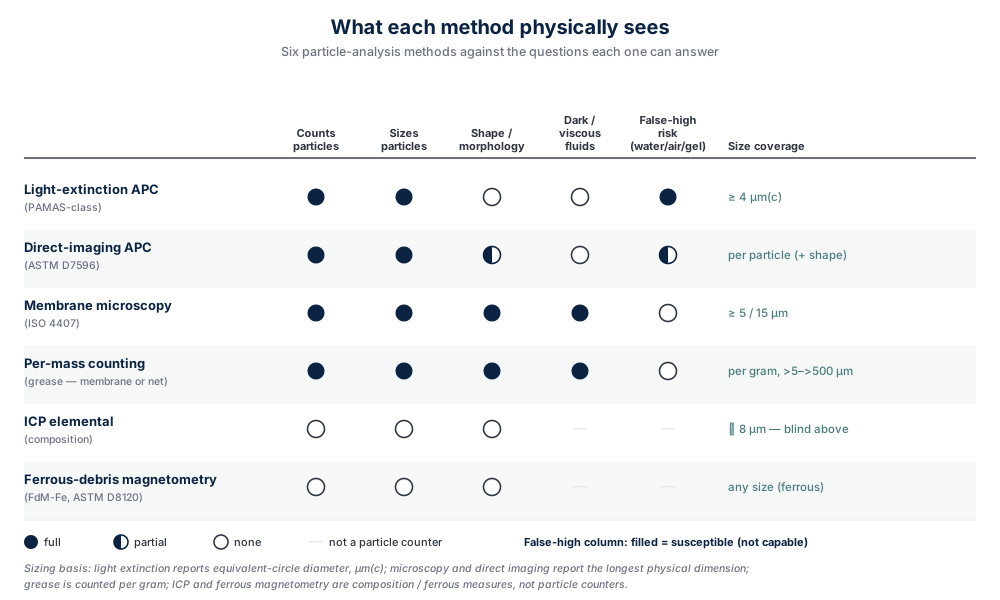
And a warning that spans the counters: a light-extinction counter counts anything that blocks light. Air bubbles, water droplets and gel produce the same signal as hard metal particles — a fluid interface obstructs the light beam and gives false signals (ISO 11500:2008, Clause 1, NOTE 2) — and in practice those false counts land in the small-size channels where droplets are most numerous. A sample carrying enough water to affect the count must not be counted at all (ISO 11500:2008, Clause 6.5.4.3), and dark or viscous fluids force heavy dilution (ISO 11500:2008, Clause 7.2.1). This is exactly what a microscope and an imaging counter can screen out — because they see each object rather than infer it from a light blockage.
Method chosen per component — the doctrine
At TriboTech the counting method is not arbitrary. It is a defined routing with a stated rationale.
Gear oil is always microscope-counted, never by particle counter. Dark, viscous, heavily additised gear oil defeats light extinction; on the membrane, every counted particle is a confirmed solid and its morphology is read, not just tallied. That is where the confidence in a gear-oil count comes from: every object in the tally was imaged on the filter, one at a time.
There is a subtlety worth making explicit. A microscope's default sizing basis — longest dimension — runs coarser than a counter's area-equivalent µm(c) basis, which is exactly why the two methods disagree (above). TriboTech closes that gap on purpose: our automated microscope measures the full projected area of each imaged particle and sizes it as an equivalent-circle diameter — the same basis the light-extinction counter uses. That is a deliberate departure from the standard's own longest-dimension sizing, and it is declared as such in every report that uses it. A gear or pitch-hydraulic count therefore keeps the confirmed-solid confidence of the microscope while staying comparable to the µm(c) code scale the fleet trends on. It is genuinely best-of-both: we image the particle to be sure it is a solid, then size it the way the counter would.
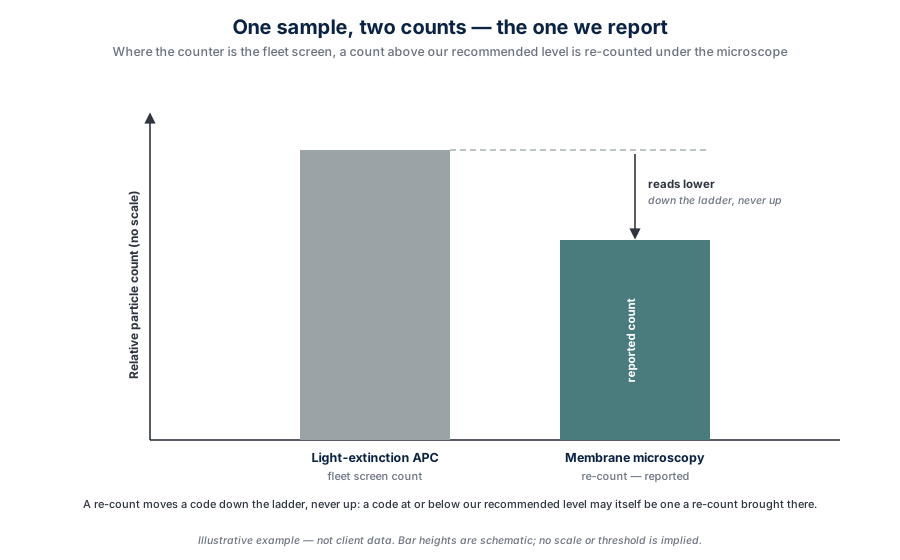
On pitch-hydraulic circuits the counting route depends on the fleet. Some fleets we count on the microscope throughout. On the rest the light-extinction counter is the fast fleet screen, and any count above our recommended level is re-counted under the microscope before it is reported. The microscope reads lower than the counter value it replaces. A re-count can move a code down the ladder, never up — so a code at or below our recommended level may itself be one a re-count brought there. Where the two disagree, the microscope count is the one we report.
The through-line: the darker, more additised or more static the fluid, the more the count must come from a confirmed, imaged particle rather than a light-blockage inference — gear oil at one extreme, clear hydraulic oil at the other.
Size bands are component physics
The numbers on the axis are chosen, not generic.
For oils, the ISO 4406 code. The three-number code sits at 4 / 6 / 14 µm(c) for a counter, and the microscope code at 5 / 15 µm written --/X/Y (ISO 4406:2021, Clauses 4.4.2–4.4.4 and 4.5.2–4.5.4). Read a code like 18/16/13 straight off the scale: each step doubles the count range (ISO 4406:2021, Clause 4.3.2), so 18/16/13 is a normal, well-filtered distribution. The spacing between the three numbers is itself a distribution-shape signal — a flat code means coarse ingress, a steep one means the fluid is dominated by fines.
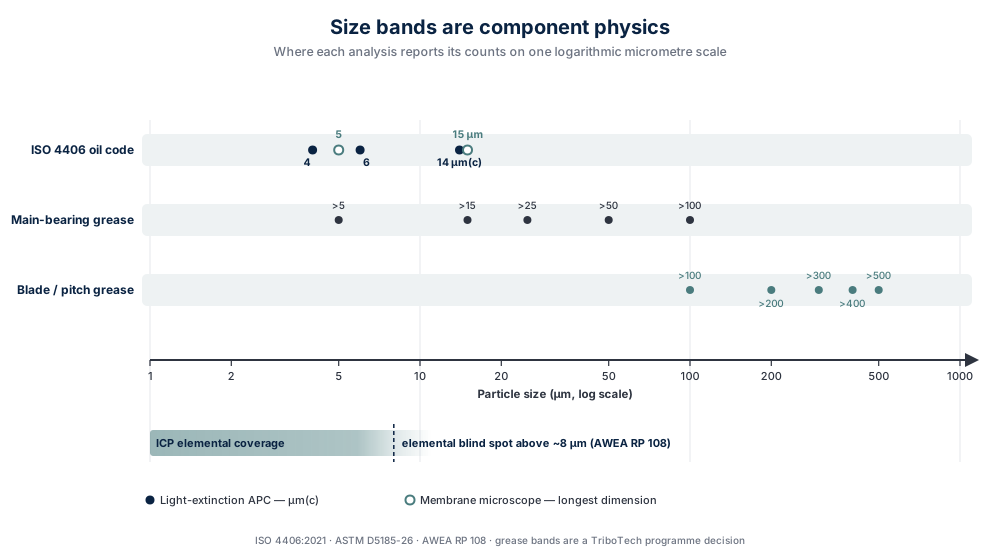
For grease, per-mass bands chosen by component. TriboTech's standard wind-turbine grease programme — a programme design decision, not a standard — trends a continuously-rotating main bearing on fine bands (>5, >15, >25, >50, >100 µm), because its earliest wear signal sits in the fine-to-medium range. An oscillating blade/pitch bearing is screened for large spall debris on coarse bands (>100, >200, >300, >400, >500 µm) on the more-loaded sample.
Grease adds one preparatory twist the oils do not need: the soap thickener clogs a filter membrane before any usable particle loading is captured, so TriboTech first lifts the ferromagnetic wear debris out of a weighed grease aliquot with neodymium magnets — which also fixes what is counted: wear debris, not everything in the grease. That debris is then deposited on a capture substrate matched to the lane's bands — an 80 µm nylon net for blade and pitch bearings, counted from >100 µm; a 5.0 µm mixed-cellulose-ester membrane for main bearings, counted from >5 µm. Each substrate sits at, or just below, the smallest band it feeds, so the substrate is part of the method: change it and the trend breaks.
One hard rule follows: per-gram grease counts never convert to an ISO 4406 code — the two rest on different denominators (mass versus volume), and both grease substrates are coarser than the membrane ISO 4407 requires. And there are no published in-service grease particle-count limits; the bands support within-fleet trending and relative standing, never pass/fail against a standard.
Try it yourself: decode or build an ISO 4406 code with our ISO 4406 particle-count tool — enter counts at each threshold and read the code, or read a code back into its count ranges. And because every count is only as good as the sample behind it, see the physics behind correct oil sampling.
The elemental blind spot
A particle count tells you how many and how big — not what the particles are. Elemental analysis answers the composition question, but it has its own ceiling. ICP gives low results for particles larger than a few micrometres (ASTM D5185-26, Clause 1.4); wind-gearbox guidance states the limit crisply as an eight-micron cut-off for elemental analysis (AWEA RP 108, p. 7). So a bearing shedding coarse spall can read near-zero ICP iron while it is actively failing. The complement is ferrous-debris magnetometry (ASTM D8120-25), which is size-insensitive and catches the large-particle fraction ICP misses — the reason counting and elemental methods are complementary, not redundant. The full transport-physics and grease-digestion story lives in our ICP guide.
Read every count as a method-qualified number
The advisory skill is not memorising a threshold table. It is asking which instrument produced a count, choosing the method that matches the fluid and the component, and reading the result as the method-qualified figure it always was. Get that right and two labs disagreeing stops being a puzzle and becomes information.
If you commission cleanliness reports across a fleet and want the counting method matched to each fluid — and read correctly against the right baseline — get in touch for a cleanliness-programme review, or explore our diagnostic tools.
Frequently asked questions
Why does my lab use a microscope instead of a particle counter for gear oil?
What does an ISO 4406 code like 18/16/13 mean?
Why can ICP iron be low when a bearing is failing?
Can grease have an ISO 4406 cleanliness code?
Why did two labs give different particle counts on the same oil?
What is direct-imaging particle counting (ASTM D7596)?
Standards referenced
The methods on this page are anchored in these standards — follow each into our standards library.
Put Theory into Practice
Try our interactive Duval diagnostic tools or use our new unified workflow to analyze your transformer oil data.