
Audio player docked to bottom
Listen to this article
Key takeaway: ICP elemental analysis is excellent for trending dissolved and very-fine metal — one run gives the full wear, additive and contaminant panel at part-per-million sensitivity. But by design it under-reports metal locked in large particles. On grease it needs a digestion step first, or it measures almost nothing of the wear story. A low iron number is only reassuring once you know the wear is not coarse.
When a low number is the alarm
Picture a gearbox bearing that is audibly degrading. Vibration is up, the maintenance team is uneasy — and the elemental report comes back with iron flat, or even falling, sample to sample. That is not a contradiction, and it is not a laboratory error. It is the measurement's physics asserting itself.
Two competent labs can run splits of the same bottle, report very different iron numbers, and both be correct. One measured the metal the instrument could carry into its source and vaporise; the other used ferrous magnetometry, which reads ferrous debris whatever its size. They answered two different questions with the same sample.
That is the problem this guide is written to solve. If you commission or read oil and grease elemental reports, the decision you actually make is when can I trust a low number? Getting that right starts with understanding what Inductively Coupled Plasma (ICP) analysis sees, what it misses, and — most importantly — why.
What ICP sees, and the physics of how
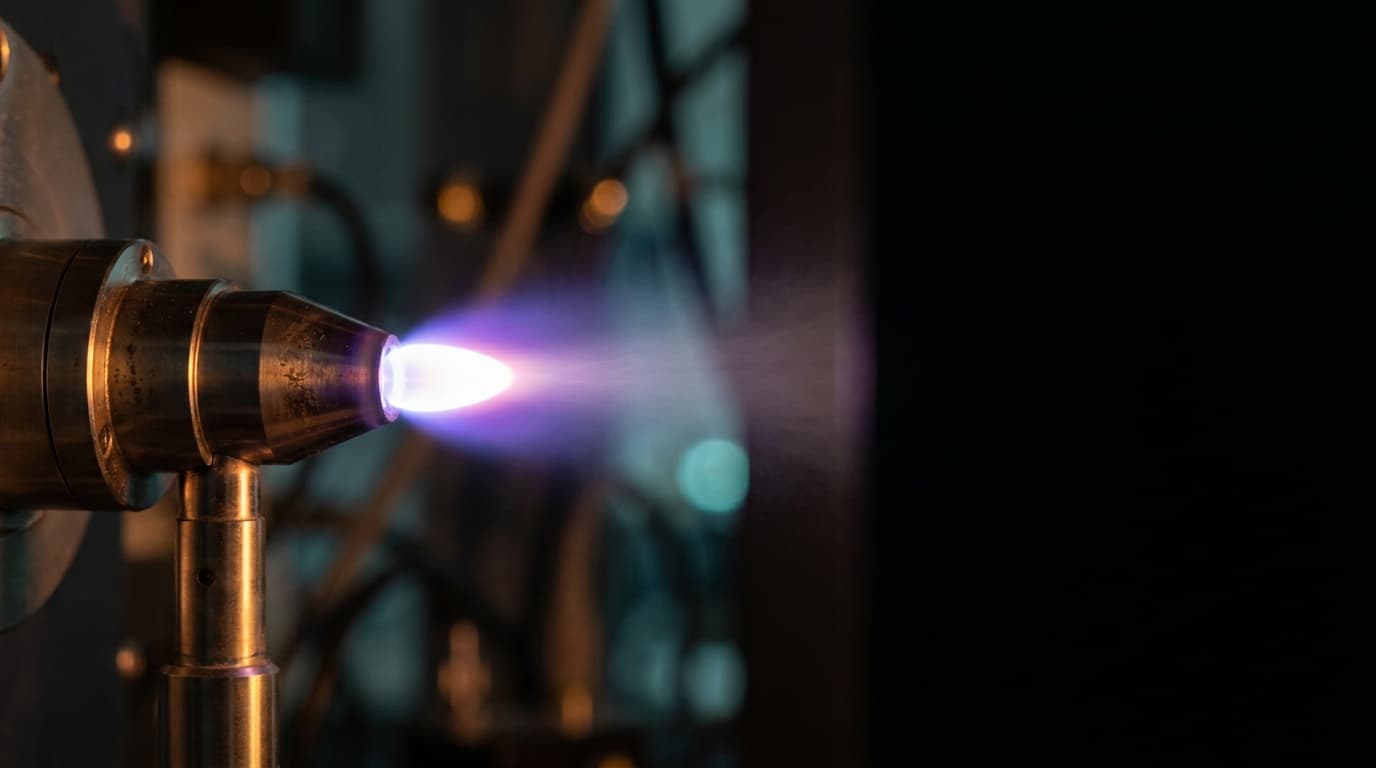
Give ICP its due first, because it earns it. A radio-frequency coil sustains an argon plasma hot enough to atomise the sample and drive every element to emit its own characteristic line spectrum, all read at once. One measurement returns the whole panel — wear metals, additive elements and contaminants — at ppm sensitivity. That breadth and sensitivity is why ICP is the industry workhorse and the correct first call for trending dissolved metals (ASTM D5185).
The detail that decides everything downstream is how the sample gets to the plasma. It arrives as an aerosol. The oil is diluted in a light solvent, then a nebuliser shears it into fine droplets — like a perfume spray, where only the fine mist floats forward and the heavy droplets fall out. A spray chamber passes that fine fraction on to the torch and drops the coarse tail.
Hold onto that spray chamber. It is the hero of the capability and the villain of the limitation.
What ICP does not see, and why
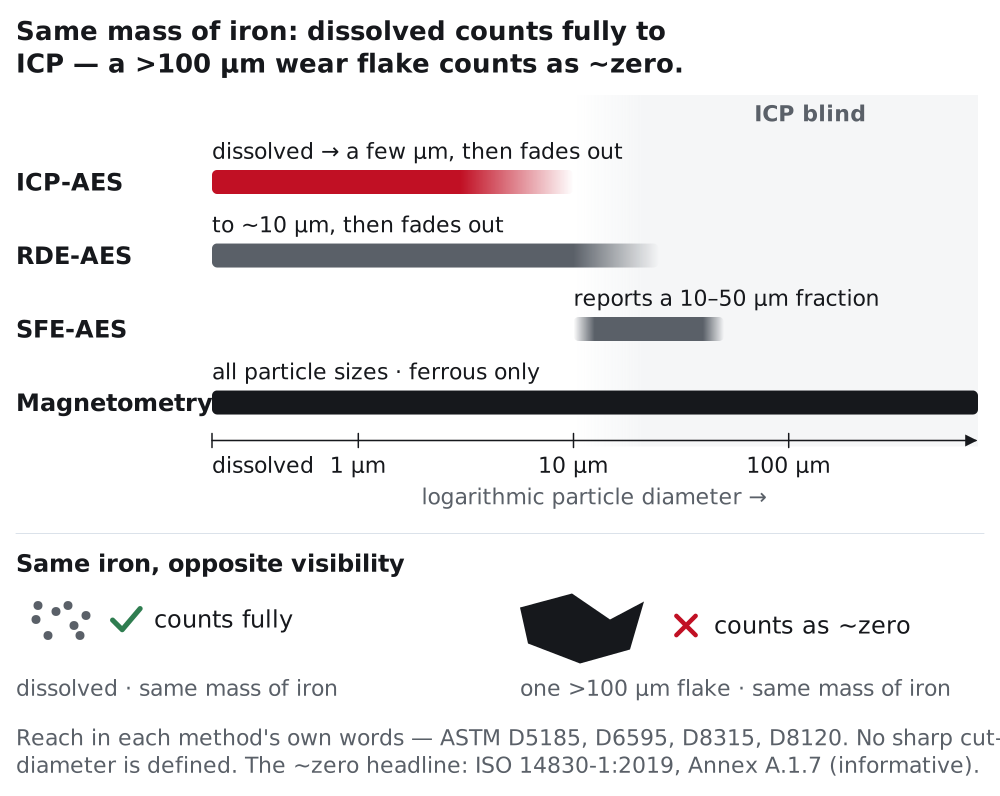
The same spray chamber that gives ICP its clean aerosol is a size filter. Coarse droplets — and any solid particle riding inside one — are removed by inertial impaction before the torch, so they never enter the plasma and never emit. And even a large particle that does reach the plasma may not fully vaporise in the short time it spends there. Two losses stack, both upstream of or within the source. Neither is a plasma weakness; the plasma is more than hot enough for a small particle.
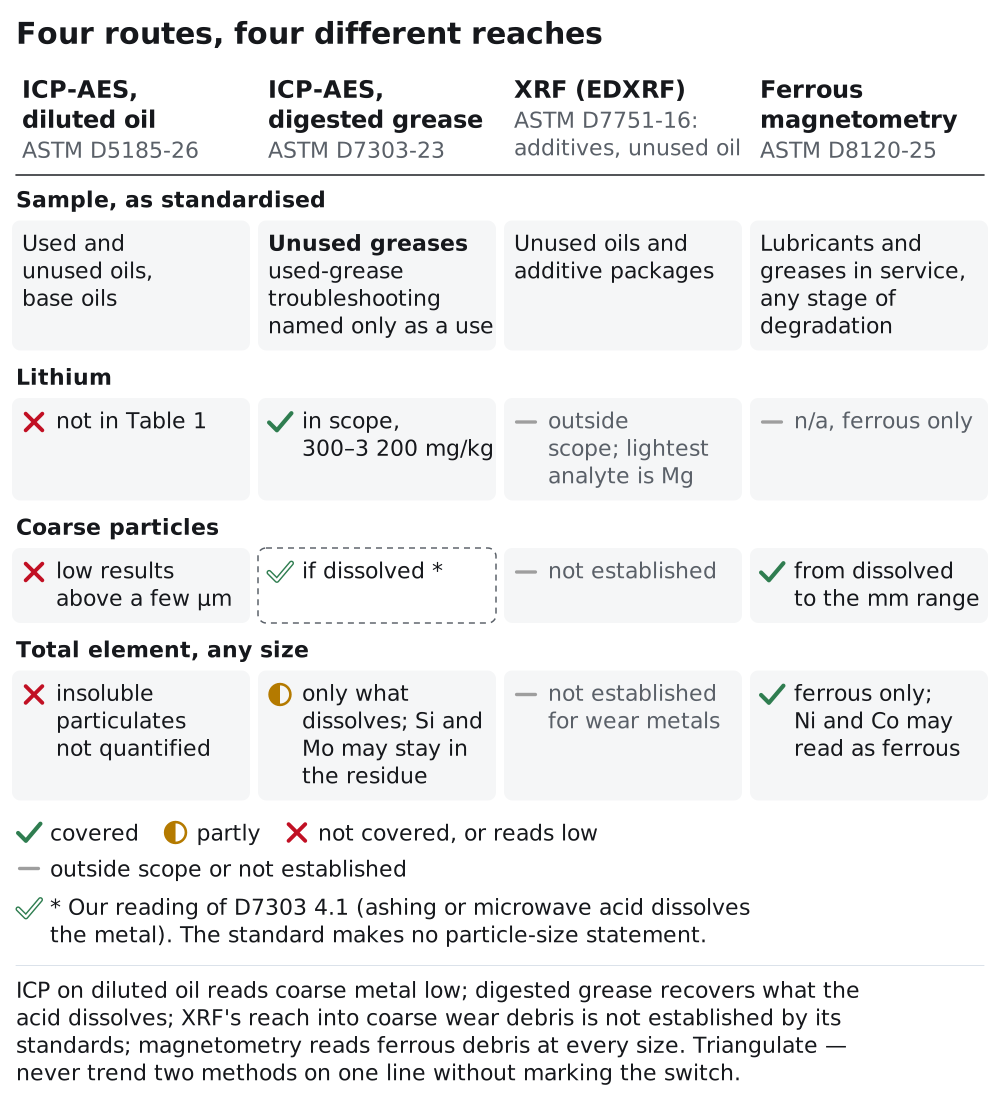
The standard states the consequence plainly: results are particle-size dependent, and low results are obtained for particles larger than a few micrometres (ASTM D5185). The metal you most want to see — the coarse fatigue and spalling debris that signals a bearing or gear in distress — is exactly the metal the ICP front end discards.
Here is the contrast to carry away. Same element, opposite visibility. A dissolved iron atom counts fully. The identical mass of iron riding in a 100 µm spalling flake counts as essentially zero. The number is not wrong — it is faithfully answering "dissolved-equivalent iron", not "total iron". A worsening large-particle wear process can leave ICP wear metals flat, or falling, while the machine is genuinely deteriorating. Concentration is not the limiting variable. Particle size is.
Grease makes it acute — why digestion is mandatory
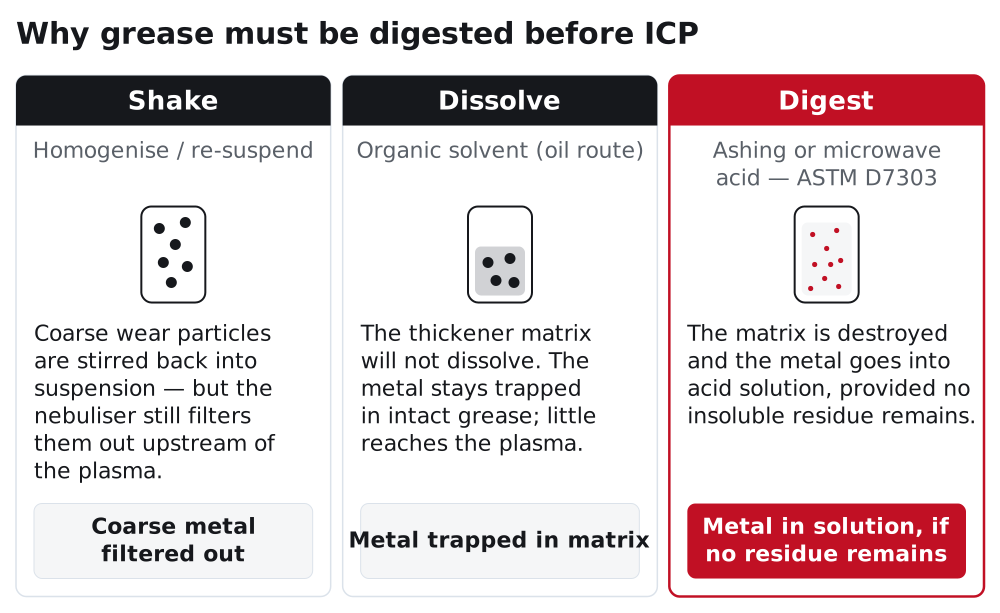
Everything above gets worse for grease, for two compounding reasons. First, the thickener matrix does not dissolve in the organic solvents the oil ICP methods use — so you cannot simply run grease "like a diluted oil". Second, grease bearing wear is predominantly coarse ferrous debris, exactly the fraction the transport ceiling throws away. Run undigested grease through the oil route and you measure a biased, low subset of the metal that is actually there.
The internal standard makes this worse in a quiet way. ICP methods add a known amount of a non-diagnostic element to correct for transport drift — and it works beautifully, for the dissolved fraction. But a dissolved internal-standard ion and a several-micrometre metal particle do not travel together; the ion sails through while the particle is filtered out upstream. So the internal standard polishes the dissolved number to a perfect-looking ratio while the particulate metal is already gone. A pristine ratio sits on top of a badly biased total. That is why an undigested grease result can look so clean.
The fix is chemistry, not a better instrument. ASTM D7303 requires the grease to be digested — by ashing in a muffle furnace or by closed-vessel microwave acid decomposition — which destroys the matrix and takes the metal into an aqueous solution that transports like any dissolved analyte. Only then can ICP measure what the grease contains — provided no insoluble residue remains. The standard is written for unused grease; its own significance section names used-grease troubleshooting as a use.
So the punch line is precise: offering ICP grease elemental analysis without digestion is a method failure, not a close-enough shortcut. The instrument is fine. The preparation threw away the wear signal the analysis exists to catch.
One complementary method is worth knowing, because it fails on a different axis from ICP. Ferrous-debris magnetometry (ASTM D8120) reads ferrous mass regardless of particle size — no dissolution, no nebulisation — so it captures precisely the coarse fraction ICP misses. X-ray fluorescence is often named alongside it, but its lubricant method (ASTM D7751) is written for additive elements in unused oil: iron and the other wear metals are outside its scope, and so is lithium, so it cannot confirm a lithium-soap thickener. Whether XRF recovers coarse wear debris from a used sample is not something that standard establishes. No single technique is best; each is best at the question its physics is built to answer.
Where consulting judgment enters
The physics defines the boundary. Judgment turns the boundary into a correct decision. Three moves separate a good analyst from a number-reader.
- Read the trend, not the snapshot. A falling ICP iron alongside rising vibration is a red flag, not reassurance. Suspect coarse-particle wear and change the measurement physics — do not re-run the same ICP louder and expect a different answer. If the instrument keeps telling you what it is built to tell you, ask a different instrument.
- Triangulate across methods. Use ICP for dissolved and additive trending, ICP on digested grease (ASTM D7303) when a lithium question is in play, and magnetometry or ferrography for coarse ferrous debris. RDE-AES (ASTM D6595) reaches somewhat coarser debris than ICP, and SFE-AES (ASTM D8315) reports a distinct large-particle partition — useful complements when the failure mode throws coarse metal. But never trend two different methods on one line without flagging the switch.
- Set the threshold from the right baseline. A "normal" iron number only means something against the correct reference — the product's additive chemistry, the bearing model, the healthy sub-population of the fleet. The same absolute value can be healthy in one product and an alarm in another.
Practical guidance
For the reader who commissions analysis, this reduces to four rules.
- For oil — use ICP for routine dissolved-metal and additive trending. When a symptom contradicts a benign ICP result, add ferrography or a larger-particle method before concluding "no wear".
- For grease — insist the scope names digestion (ASTM D7303, ashing or microwave) before ICP, or drive ferrous-wear trending from magnetometry (ASTM D8120). An ICP-only grease panel with no digestion line is a red flag on the report, not on the bearing.
- Always read a wear number against the right baseline — product chemistry and bearing model — never against zero.
- Never trend two elemental methods on one line without flagging the method change.
The method is only as good as the question you asked it, and the preparation you gave it.
Not sure your grease scope includes digestion? Send us the method list from your current programme and we will tell you what your reports can — and cannot — see. Request a condition-monitoring programme review or explore our diagnostic tools.
Frequently asked questions
Can ICP detect wear particles in grease?
Why does grease need digestion before ICP analysis?
Why is my ICP iron result low when the bearing is clearly failing?
ICP vs XRF for wear metals — what is the difference?
What particle size can ICP actually measure?
Does a low ICP reading prove the oil or grease is fine?
When should I use ICP vs RDE vs SFE vs ferrous magnetometry?
Put Theory into Practice
Try our interactive Duval diagnostic tools or use our new unified workflow to analyze your transformer oil data.