
Audio player docked to bottom
Listen to this article
Key takeaway
A transformer oil sample is a measurement, not a parcel. Hydrogen, the earliest fault gas, has an Ostwald solubility coefficient of 0.0556 in mineral oil. In a 100 mL bottle holding 95 mL of oil and 5 mL of trapped air, 49 % of the dissolved hydrogen migrates into the headspace before the lab opens the seal. Methane drops by 11 %, carbon monoxide by 29 %. The losses are selective, not uniform — and selective loss flips diagnostic coordinates. A constructed thermal fingerprint sitting on the T2/T3 boundary of Duval Triangle 1 measures as T3 after a 5 mL headspace loss — a 2-percentage-point shift in %C₂H₄ that crosses the 50 % zone line and changes the diagnosed hot-spot temperature band from 300–700 °C to over 700 °C. Same transformer, two different diagnoses, driven entirely by 5 mL of air. The IEC 60475 procedure that calls for zero headspace at the moment of sealing — for a flexible aluminium bottle, by pressing its sides before capping; for a glass syringe, by letting the plunger ride the oil — is not pedantry. It is the physics of correct measurement. Top-filling discipline is the control; the choice of container is secondary.
1. A liquid is harder to sample than it looks
A transformer's oil looks uniform, and IEC 60475 builds on that: the sample should normally come from a point that is representative of the bulk of the oil. The trouble is the sampling point itself. Water and particles can accumulate in the drain valve and at its orifice, and a sample that carries them describes the valve, not the transformer. The diagnostic instruments downstream of the sample — gas chromatography, Karl Fischer titration, breakdown-voltage rigs, dielectric dissipation factor — assume a single composition. They are blind to where in the tank the sample came from.
The standards that govern sampling — IEC 60475:2022 for the procedure, IEC 60567:2023 for DGA preparation, ASTM D923 in parallel jurisdictions — exist to turn oil drawn at one valve into a single defensible number for the whole transformer. The procedure is not aesthetic. Each step compensates for one specific physical process.
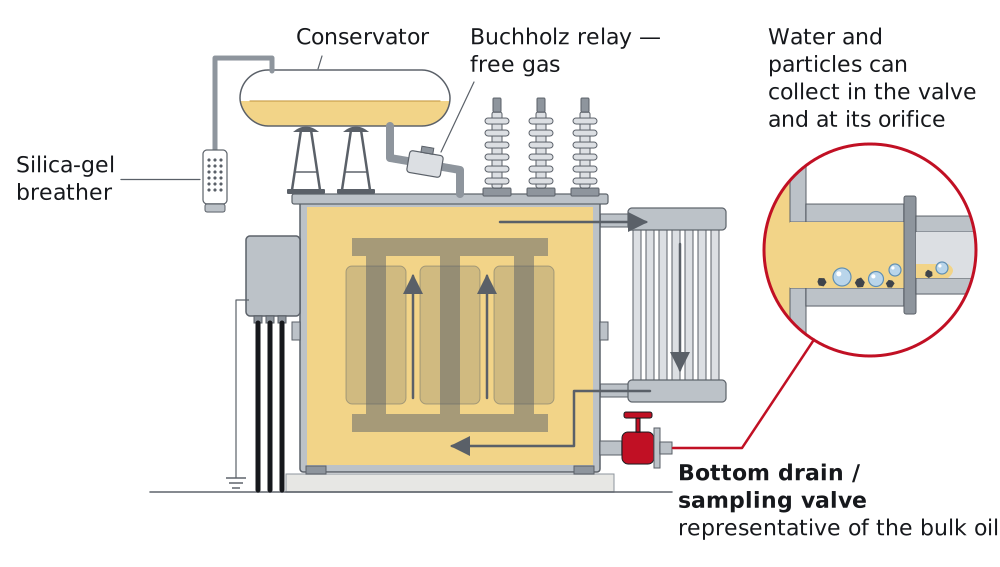
IEC 60475 says the sample should normally be taken from a point where it is representative of the bulk of the oil, and gives the bottom oil drain valve or the oil sampling valve as examples (IEC 60475:2022, §4.2.1.2, p. 14). ASTM D923 explains why the bottom matters for an oil lighter than water: water and some other impurities are most likely to be found on or near the bottom, and equipment that is not hermetically sealed should have its sampling outlet there (ASTM D923-15 (R2023), §3.1.1.1 and §5.3.1, p. 2). Neither standard names a conservator sampling point, and we do not use one in place of the bottom valve.
2. IEC 60475 in practice — what each step is actually doing
Our oil sampling guide walks a technician through steps 0 to 6: flush the valve → flush the hose → rinse the bottle → fill the bottle → let it overflow → close the bottle → label the sample. Behind each step there is a physical reason that, once seen, makes the procedure feel less like ritual and more like instrumentation.
Two-stage flush. IEC 60475:2022 calls for the flush in two distinct stages, each with its own physical job. First, at the drain valve itself: 2 to 5 L under turbulent flow (§4.2.1.3, p. 14) — "a sufficient quantity of oil (typically, 2 l to 5 l), under a turbulent flow, to eliminate any contaminants (water and particles) that might have accumulated in the drain valve and at its orifice." Second, through the sampling line into a waste container: a further 1 to 2 L under laminar flow (§4.2.4.2 a), p. 22) — "about 1 l to 2 l of oil allowed to flow under a laminar flow to waste … ensuring that all gas bubbles are eliminated before the oil sample is collected and gases are not stripped out of the oil by the oil flow." The two stages do different work. The turbulent first stage mobilises water droplets and particulate that may have accumulated in the drain valve and at its orifice; the laminar second stage does the job the clause names: it eliminates gas bubbles before the sample is collected, without stripping dissolved gases out of the oil. Physically it also replaces the oil that stood in the sampling tube, though that is our reading, not the standard's. Volume exchange alone is the easy part; the turbulent regime at the valve is the part that carries the contamination out.
When the standard's numbers fit, and when judgment refines them. The standard is provisioned conservatively for the worst case it must cover. A consulting practice refines that provisioning to the unit in front of you. The 2–5 L turbulent valve flush does two things at once. It eliminates water and particulate accumulated in the valve dead-volume. IEC 60475 says the cleaning of the sampling point and the sampling equipment should be followed strictly for water content, dielectric strength, dielectric dissipation factor, interfacial tension and particle content (§4.2.1.5, p. 18). And it forces the flow regime that mobilises whatever has accumulated in the valve and at its orifice. Both reasons are strong on a unit that is unfamiliar, has not been sampled regularly, has had a breakdown-voltage, water-content or DDF issue, or is being sampled for the first time after an oil change or other intervention. They are weaker on a unit that is sampled regularly, with a stable trend and no breakdown-voltage, water-content or DDF issue. There is also a physical limit. On a compact, hermetically sealed transformer with passive head pressure and a viscous fluid — at 40 °C a natural ester runs at roughly four times the viscosity of a typical mineral oil (manufacturers' data compiled in CIGRE TB 436:2010, Table 5.3, p. 35: 33 and 42 mm²/s for two natural esters, 9 mm²/s for mineral oil) — the turbulent regime the standard asks for may not be achievable at any reasonable flush volume. Pushing 5 L through such a valve in pursuit of a Reynolds number that physics will not allow is not best practice; it is oil loss in service of a flow condition that does not arrive. Our take: on a unit with a stable trend from regular samples and no breakdown-voltage, water-content or DDF issue, the valve flush can be omitted. The 1–2 L laminar flush through the sampling line stays, because that is what clears the tubing of gas bubbles before the sample is collected. Omitting the valve flush is a departure from IEC 60475, not a reading of it. The call belongs to the site owner or asset manager, made deliberately on the unit's history and recorded with the sample; the technician carries it out. When the trend is unknown, or one of those parameters has been an issue, the full IEC flush is the right procedure, and the oil cost is the price of a defensible measurement.
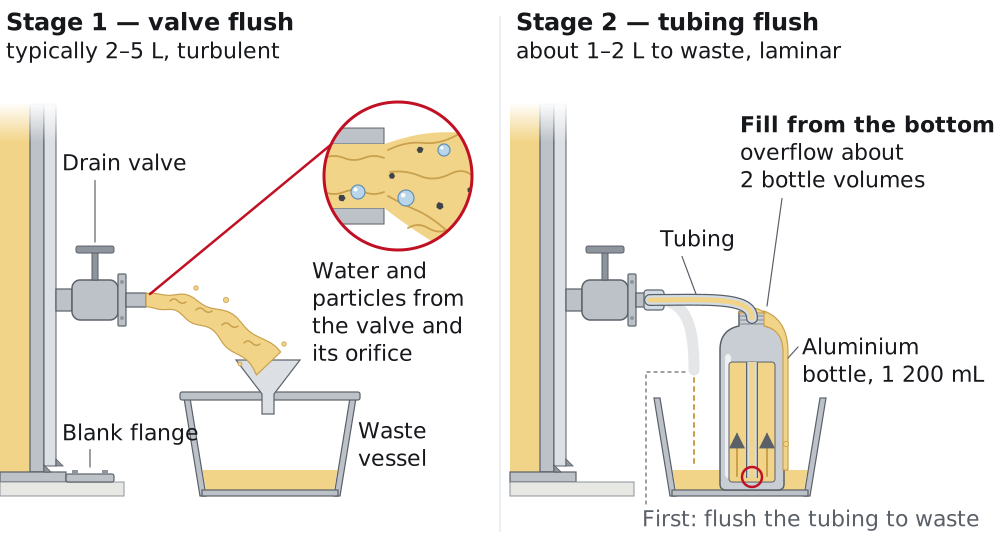
Bottom-fill via a hose to the bottom of the container. When the sample finally goes into a bottle, IEC 60475 (§4.2.4 / §4.2.5) routes it through a hose whose outlet sits at the bottom of the container. Oil fills the bottle from below, displacing air upward through a single exit path — the bottle never has free oil cascading through air. Any cascade would dissolve atmospheric N₂ and O₂ into the sample and lift dissolved fault gases out of it.
Two-volume overflow. The bottle is then allowed to overflow by about two bottle volumes to waste, and the tubing is withdrawn slowly with the oil still flowing (§4.2.4.2 c), p. 22). The purpose is our physics, not the clause's: the overflow washes out the last of the original air.
Squeeze, then cap. Only then are the sides of the bottle squeezed gently until it is entirely filled with oil, and the cap is screwed on securely (§4.2.4.2 c), p. 22). The order matters: the squeeze brings the oil up to the rim after the tubing is out, so the cap closes on oil, not on air. The gasket is single-use unless it is lined with aluminium foil on the oil side (§4.2.4.1 a), p. 21). The gasket material should follow the fluid: for mineral oil, polyethylene (PE), PTFE or nitrile rubber (NBR) with more than 30 % nitrile; for non-mineral oils such as natural and synthetic esters, PTFE, not NBR or silicone rubber (§4.2.4.1 a), p. 21).
These four disciplines do one job: they minimise the air-to-oil contact area at every moment between the tank and the closed bottle. The reason they matter is in section 4.
3. The container — what actually solves the headspace problem
Containers fall into four categories that map onto four different relationships with the gas-loss mechanism.
Plastic bottles. Plastic walls are permeable to small molecules. IEC 60475:2022 (§4.2.1.5, p. 18) states the rule and its reason: "The use of plastic bottles is not permitted for DGA, water and dielectric strength, since ambient air contamination and gas losses can occur by diffusion through the plastic." Plastic is not a budget option for these tests; it is wrong.
Rigid glass bottles. Glass is gas-impermeable on transport timescales and chemically inert. Its weakness is rigidity. IEC 60475:2022 says glass and rigid metal bottles should not be filled entirely. The oil level is left a few centimetres below the rim, typically 1.5 to 3 cm or 3.5 to 7 mL of air, so that the oil can expand as it warms. It also says to fill the bottle with no less than 90 % oil, to allow for air expansion when the temperature falls and to avoid implosion of a glass bottle (§4.2.5.2, p. 22). IEC also records that, where transport and storage conditions are not particularly demanding, some companies fill rigid bottles completely and close them finger-tight with a cap that has a conical polyethylene seal, which lets a little oil escape when it expands. When the oil contracts on cooling, the seal keeps air out, and the bottle then has to be warmed to the sampling temperature so that the gases re-dissolve before dissolved-gas analysis (§4.2.5.2, p. 23). The air left in a rigid bottle is where the diagnostic damage in section 4 occurs.
Drawn-aluminium bottles, topped to the brim. This is the answer to the partition problem that holds up in the field. IEC 60475:2022 (§4.2.4.1 a)) reads: "Metal bottles made of drawn aluminium or of welded tin are flexible and do not need oil expansion devices. They should be filled completely with oil by pressing on the bottle sides before closing the bottle." The bottle is filled from the bottom and overflowed, the tubing is withdrawn with the oil still flowing, the sides are squeezed gently until the bottle is entirely full, and then the cap is screwed on (§4.2.4.2 c), p. 22). The wall then flexes outward when the oil warms and inward when it cools — the bottle skin does the job a syringe plunger does, but distributed across a much larger flexible surface. The residual headspace at the moment of sealing is genuinely zero. The bottle is durable in the field, packs into shipping crates without a fragility budget, opaque to light (an advantage for photo-sensitive fluids), and survives being dropped onto steel grating from a wind-turbine catwalk. IEC 60475 §4.2.4.1 a) accepts flexible metal bottles "made of drawn aluminium or of welded tin", and adds that metal bottles "should not be soldered, as materials used for soldering can contaminate the oil". A drawn-aluminium bottle goes one step further: one piece of metal, no seam at all.
Glass syringes. A matched-piston-and-barrel glass syringe per IEC 60475:2022 (§4.2.2.1) achieves the same zero-headspace condition by a different mechanism. Step 4.2.2.2 c) describes the filling: "the plunger should not be withdrawn but allowed to move back under the pressure of the oil." Any stray air bubble is expelled before sealing. The transport carrier is designed to "hold the syringe firmly in place during transport but [allow] the syringe plunger freedom to move" (IEC 60475:2022, §4.2.2.1 b)). When oil drawn hot from the transformer cools on the way to the lab, the plunger retracts; when it warms, the plunger extends. That is why IEC 60475 prefers a matched piston and barrel for DGA, "to allow the piston to flow freely with oil volume variations" (§4.2.2.1 a), p. 19). On the bottle side, IEC 60475:2022 (§4.2.4.1 a)) sets a quantitative test for a flexible-metal bottle and seal design: it is acceptable if it permits losses of hydrogen of less than 2.5 % per week.
The glass syringe and the topped aluminium bottle are two implementations of the same physical principle: a headspace of zero at the moment of sealing, and a degree of freedom (plunger or wall) that lets the volume track thermal swings without breaking the seal. IEC 60475 lists both as suitable containers for dissolved-gas analysis (§4.2.1.5, Table 2, p. 18). The Ostwald model does not care which container the oil sits in. What decides the loss is the size of the headspace against the volume of oil, scaled by how soluble each gas is.
![Three containers, three different relationships with the headspace problem. The topped aluminium bottle (flexed [[V_G \approx 0]]) and the glass syringe (plunger-mediated [[V_G = 0]]) are two implementations of the same zero-headspace principle; IEC 60475 lists both for DGA (Table 2). A small rigid bottle left with 5 mL of air is the configuration the Ostwald argument warns against.](/images/blog/sampling-physics/sampling-physics-three-containers-svg-en-v1-bc708b30.svg)
Because the variable is the headspace volume and not the container, the field default can be chosen on practical grounds: an aluminium bottle. One sampling event, one bottle, the full panel. A 1 200 mL drawn-aluminium bottle, topped to the brim and pressed on the sides before capping, holds enough oil for DGA, the full general-properties panel (water, BDV, DDF, IFT, AN, viscosity, fire point) and any special tests the asset owner has asked for. IEC 60475 marks the flexible metal bottle as suitable for DGA, water, DDF, breakdown voltage and the other chemical and physical tests (§4.2.1.5, Table 2, p. 18). It also notes that "adsorption on aluminium surfaces of water contained in oil is possible" (§4.2.4.1 a), p. 21), without giving a size for the effect or a remedy. A 120 mL drawn-aluminium bottle, same construction, holds enough for DGA alone when DGA is the only test on the order. That is smaller than the bottle sizes IEC 60475 gives, typically 250 mL to 2.5 L for a flexible metal bottle (§4.2.4.1 a), p. 21) and 125 to 2 500 mL in Table 2. It still holds more than the 25 to 100 mL of oil that Table 2 gives for dissolved gases, and the 1 200 mL bottle sits inside the table's 1 000 to 2 000 mL for all tests (§4.2.1.5, Table 2, p. 18). A glass syringe is not part of the standard kit. We supply one only in special cases: when the client's acceptance protocol specifies it, or by arrangement with the client. That can be where the field environment makes confident top-filling difficult, or a hydrogen-rich fault investigation where a third party may later want a syringe-format sample on file. The pragmatism is honest: we do not present the syringe as "better physics" because it is not. It is the same physics, in a different format, that is harder to keep reliable through field handling than a flexible bottle pressed flat before capping.
4. Ostwald in numbers — why 5 mL of headspace flips a diagnosis
This is the section that justifies the procedure.
The Ostwald solubility coefficient is the ratio of a gas's concentration in oil to its concentration in the gas phase at thermodynamic equilibrium (IEC 60567:2023, Annex A, Table A.1). It is best understood as a distribution: where the molecules sit when the system is at rest.
![Ostwald solubility coefficient as a distribution ratio at thermodynamic equilibrium between equal-volume oil and gas phases. With 200 molecules total: hydrogen ([[k_O = 0.055]]) sits almost entirely in the gas phase; acetylene ([[k_O = 1.2]]) distributes nearly evenly. Same total amount of dissolved gas, very different escape behaviour when a rigid headspace is present.](/images/blog/sampling-physics/sampling-physics-ostwald-distribution-en-v1-037f9547.svg)
The values for the diagnostic gases in mineral oil at 25 °C are:
| Gas | |
|---|---|
| Hydrogen (H₂) | 0.0556 |
| Nitrogen (N₂) | 0.0907 |
| Carbon monoxide (CO) | 0.132 |
| Oxygen (O₂) | 0.172 |
| Methane (CH₄) | 0.429 |
| Carbon dioxide (CO₂) | 1.09 |
| Acetylene (C₂H₂) | 1.24 |
| Ethylene (C₂H₄) | 1.84 |
| Ethane (C₂H₆) | 2.82 |
(Source: IEC 60567:2023, Annex A, Table A.1, p. 53. ASTM D3612-02 (Reapproved 2026), §31 / Table 6, p. 16, reports partition coefficients at 70 °C in Voltesso 35 that differ from the IEC values above by up to ~33 % — H₂ by +33 %, C₂H₆ by −26 %, C₂H₄ by −20 %. The spread illustrates that partition coefficients are temperature- and base-oil-sensitive; the IEC table is at 25 °C across "current types of mineral insulating oil", the ASTM table at 70 °C in a specific oil.)
The smaller the coefficient is, the less the gas wants to stay in oil and the more readily it migrates into any contacting gas phase. Hydrogen — the gas that signals partial discharge and incipient electrical fault, the earliest warning of insulation distress — has the smallest coefficient of all the diagnostic gases.
For a sealed sample bottle holding an oil volume and a headspace volume above it, mass conservation gives the fraction of each gas that remains in the oil phase at equilibrium:
(Mass-balance derivation: ASTM D3612-02 (Reapproved 2026), §27.1, equations (14)–(17), pp. 13–14. IEC 60567:2023, Annex D (informative), p. 58, gives the lab correction for each gas, and describes the air gap of a rigid bottle as about 2 to 5 mL, depending on whether it holds 1 or 2 L. At the 5 % void fraction used below, it under-corrects hydrogen (36.0 → 53.5 μL/L, against 70 by the mass balance).)
The model assumes an initially gas-free headspace; atmospheric backflow (O₂, N₂, trace CO₂ entering from air) is treated separately in the asymmetry discussion below.
Take a 100 mL bottle holding 95 mL of oil as the oil volume and 5 mL of trapped air as the headspace above it. That is a 5 % void fraction: at least ten times the share of air in the 2 to 5 mL gap that IEC 60567 describes for a 1 or 2 L rigid bottle, yet still within IEC 60475's rule that a rigid bottle hold no less than 90 % oil. For that bottle, the table looks like this:
| Gas | (%) | (%) | |
|---|---|---|---|
| H₂ | 0.0556 | 51.4 | 48.6 |
| N₂ | 0.0907 | 63.3 | 36.7 |
| CO | 0.132 | 71.5 | 28.5 |
| O₂ | 0.172 | 76.6 | 23.4 |
| CH₄ | 0.429 | 89.1 | 10.9 |
| CO₂ | 1.09 | 95.4 | 4.61 |
| C₂H₂ | 1.24 | 95.9 | 4.07 |
| C₂H₄ | 1.84 | 97.2 | 2.78 |
| C₂H₆ | 2.82 | 98.2 | 1.83 |
![Selective gas loss to 5 mL of headspace in a 95 mL oil sample at 25 °C. Computed from [[f_{\text{lost}} = V_G / (k_O \cdot V_L + V_G)]], using [[k_O]] values from IEC 60567:2023 Annex A Table A.1 and the mass-balance derivation in ASTM D3612-02(R2026) §27.1, eq. 14–17. Per-gas [[k_O]] and [[f_{\text{lost}}]] are tabulated above.](/images/blog/sampling-physics/headspace-loss-bars-v1-12d21289.svg)
The headline is not the magnitude of the loss. It is the selectivity of the loss. The light, low-solubility gases — H₂, N₂, CO, O₂ — are stripped preferentially. The heavy hydrocarbons and CO₂ stay in the oil. A laboratory that opens the bottle and analyses the oil portion sees a fingerprint that has been shifted, gas-by-gas, away from what was dissolved at the moment the bottle was sealed. The shifts go the wrong direction for diagnostic accuracy: H₂, CH₄ and CO are the early-warning indicators.
Single-gas headspace loss calculator
Pick a fault gas, drag Sample Volume and VG, and see the partition shift through a live bottle animation and a magnifier of the molecular distribution.
The diagnostic consequence shows up where the fingerprint is plotted. Apply the values above to a constructed thermal-fault fingerprint (seven gases, sitting just inside the T2 band of Duval Triangle 1) and recompute the IEC 60599:2022 quantities:
Illustrative example, constructed fingerprint
Gas True (μL/L) Measured after 5 mL headspace (μL/L) H₂ 70 36.0 CH₄ 280 249.4 C₂H₂ 12 11.5 C₂H₄ 280 272.2 C₂H₆ 70 68.7 CO 300 214.5 CO₂ 2 250 2 146.4
Duval Triangle 1 coordinate True Measured Shift Zone %C₂H₄ 48.95 % 51.06 % +2.11 pp T2 → T3 %CH₄ 48.95 % 46.78 % −2.17 pp — %C₂H₂ 2.10 % 2.16 % +0.06 pp — Same transformer, same dissolved gases, two diagnoses. The true fingerprint sits at %C₂H₄ = 48.95 % — just inside the T2 band of Duval Triangle 1, hot-spot 300–700 °C (IEC 60599:2022, Figure B.3). After 5 mL of headspace, the measured %C₂H₄ rises to 51.06 % — across the 50 % line, into T3, hot-spot above 700 °C (IEC 60599:2022, §3.2.2). The driver is selective partitioning: CH₄, whose coefficient is 0.429, loses 10.9 % of its mass to the headspace, while C₂H₄, at 1.84, loses only 2.8 %. The denominator of the Duval coordinate falls faster than the numerator, and the fingerprint walks across the zone line.
The flip lives on the Duval Triangle 1 graphical representation, not on the IEC 60599:2022 Table 1 ratio classification. Table 1 alone would call this fingerprint T2 both before and after — C₂H₂/C₂H₄ stays at ~0.04, CH₄/H₂ runs from 4.00 to 6.94 (+73 %, with no upper bound on CH₄/H₂ for the T2 and T3 thermal bands per IEC 60599:2022, Table 1), and C₂H₄/C₂H₆ drifts from 4.00 to 3.96, still inside the 1–4 T2 band. The danger is more subtle than a tabulated-ratio flip and shows up where most asset teams actually read the result: on the graphical Duval triangle that sits in the report.
A second category drift goes the same direction. For a fingerprint with true CO₂/CO = 7.5, the measured value rises to 10.01 — landing essentially on the IEC 60599:2022, §5.5 boundary: "high values of CO₂ (> 10 000 ppm) and high CO₂/CO ratios (> 10) can indicate mild (< 160 °C) overheating of paper or oil oxidation, especially in open transformers". The absolute CO₂ caveat still applies, but the ratio crosses cleanly. This is a soft boundary with multiple confounders, but it changes the recommended follow-up — furanic-compound analysis (IEC 61198) versus oil-oxidation testing — even when no fault classification has changed in Table 1.
This example is constructed from the partition equation, not measured field data. The fingerprint was selected to sit exactly on the T2/T3 boundary of Duval Triangle 1 so the headspace shift crosses the zone line cleanly. It is offered as a pedagogical illustration of the direction and magnitude of the diagnostic drift, not as a TriboTech case study.
What the model assumes — and what air actually contains
The Ostwald distribution above treats the headspace as a neutral gas reservoir. In practice, the headspace in a poorly topped bottle is atmospheric air — and the composition of the atmosphere creates an asymmetry that matters when reading the result.
Atmospheric air carries O₂ at ~21 %, N₂ at ~78 %, CO₂ at ~420 ppm, methane at ~1.9 ppm, and effectively zero of the higher hydrocarbons (C₂H₂, C₂H₄, C₂H₆). For O₂ and N₂ the partitioning runs in both directions — a bottle with trapped air can lose dissolved O₂ and N₂ to the headspace or gain them from it, depending on what the oil arrived with. Measurements of O₂ and N₂ on a poorly topped sample are unreliable in either direction.
For the fault gases the asymmetry is one-sided. Atmospheric air has no acetylene, no ethylene, no ethane — and methane only in barely-detectable trace. Trapped air can strip hydrocarbon fault gases out of the oil; it cannot add them.
This answers a question we hear often: "Could the elevated methane in our DGA be sampling contamination?" Not from the air in the bottle: the atmosphere holds only a trace of methane. Sampling can still add gas by other routes, and IEC 60475:2022 names them. Plastic tubing should be used only once, because it "has a memory effect and can contaminate the oil sample when sampling for DGA" (§4.2.3.1 a), written for ampoule sampling). A plastic three-way valve should be new for every sample, because "it can be contaminated with the previous oil sample" (§4.2.2.1 a)). And in the stored sample, hydrocarbons and carbon oxides can form by oxidation, a reaction that exposure to light accelerates; IEC asks for the analysis to be carried out as soon as possible after sampling "to avoid oxidation reactions" (§4.3). Air in the bottle can only hide a hydrocarbon fault. The rest of the sampling chain is what has to be ruled out before an elevated value is read as the transformer's.
The procedure in section 2 — the two-stage flush, the bottom-fill, the overflow of about two bottle volumes, the side-press before capping — exists because this drift is structural. Once the air is in the bottle, no laboratory correction can fully undo the damage. For a rigid bottle, IEC 60475 asks the sampler to note the approximate air volume on the label, and says the laboratory shall calculate the correction for the gas lost to that air as indicated in Annex D of IEC 60567 (IEC 60475:2022, §4.2.5.2, p. 22). That annex gives the air gap of a glass or rigid metal bottle as about 2 to 5 mL, depending on whether the bottle holds 1 or 2 L. It notes that in general the corrections, 10 to 5 %, are significant only for hydrogen and carbon monoxide (IEC 60567:2023, Annex D, p. 58). The correction starts from the approximate air volume on the label. With the larger air fraction in the example above, it leaves hydrogen well short of its true value.
The right answer is to remove the headspace at the source. The Ostwald model does not say "use a glass syringe"; it says "make the headspace zero before sealing, and keep it zero through transport." A drawn-aluminium bottle filled to the brim, with the sides pressed inward before the cap goes on, satisfies that condition. So does an all-glass syringe with the plunger riding the oil. IEC 60475 lists both for DGA (§4.2.1.5, Table 2, p. 18). A small rigid bottle left with 5 mL of air is not.
5. The TriboTech choice — sampling economy that does not compromise the physics
There is a design philosophy underneath the kit list. We optimise for diagnostic relevance in the field, not laboratory-perfect sub-ppm sensitivity, and we build the procedure around the constraint that one sampling event has to deliver everything the asset team needs.
The Ostwald argument above is sharp at the level of fault detection — the difference between a T1 and a T2 classification, the difference between flagging cellulose involvement and missing it. It is not a sub-ppm argument. IEC 60599 does not switch the ratios on at a gas sum. It says gas ratios are significant and should be calculated only when at least one gas is above typical values for both concentration and rate of increase. It recommends calculating them as well when one or more gases show increasing or abnormal concentrations below those values (IEC 60599:2022, §6.1 c)). It also says to avoid calculating ratios when the concentrations are not high enough to be reasonably accurate according to IEC 60567. Duval Triangle 1 appears in the same standard as a graphical representation of gas ratios (Figure B.3). Above ten times the analytical detection limit, the uncertainty on the DGA values is typically ±15 %, and IEC notes that this can also affect the uncertainty on the ratios. Below that it increases rapidly, to typically ±30 % at five times the limit, and IEC advises caution when calculating ratios at such low levels (§6.2). A headspace loss lowers the measured fault-gas concentrations, hydrogen and carbon monoxide most of all, so it can also move the rates of increase that decide whether a ratio is calculated at all. Once a ratio is calculated, the same loss moves the ratio too. IEC 60475 does not wait for a ratio either: for DGA it calls strict adherence to the sampling procedures critical "to minimize losses of the low solubility gases (H₂ and CO) and pick-up of air at low total gas contents" (IEC 60475:2022, §4.2.1.5, p. 18).
So we draw the line at the level the physics actually cares about:
- Drawn-aluminium bottle as the field default. A 1 200 mL bottle delivers the full panel (DGA + general properties + any special tests) from a single sampling event; a 120 mL bottle covers DGA alone when that is all the order specifies. Topped to the brim, sides pressed before capping — the headspace close to zero at the moment of sealing.
- Glass syringe only in special cases. Not part of the standard kit. Supplied when the client's acceptance protocol specifies a syringe-format sample, or by arrangement with the client. That can be, for example, when hydrogen-rich faults are under active investigation, or when field conditions (cold, vibration, awkward access) make confident top-filling of a flexible bottle difficult. Not "better physics" — same physics, different implementation, harder to handle reliably in the field.
- Bottom-valve sampling under representative load. No conservator-port substitutes.
- Two-stage flush, bottom-fill, about two bottle volumes of overflow, then squeeze and cap. By default. The valve flush is omitted only under the conditions in section 6, as a recorded departure from IEC 60475. The 1–2 L line flush always stays.
- Duval and IEC 60599 ratios applied on IEC 60599's own conditions. We calculate them when at least one fault gas is above typical values for concentration and rate of increase, or is increasing or abnormal below them (IEC 60599:2022, §6.1 c)). When the concentrations are not high enough to be reasonably accurate, we report the gas pattern and the trend, not a fault zone.
What we will not pretend to deliver: ppb-level sensitivity on every sample, perfectly preserved gas inventory measured to two decimal places, or a result that is more precise than the diagnostic framework can use. The diagnostic frameworks have been calibrated on data that contains the same sampling realities ours does. A measurement system delivering more decimal places than the framework consumes is engineering theatre.
What we will deliver: a sample whose gas inventory has not been stripped by 49 % on H₂ before it ever reaches the chromatograph, in a container that the asset owner's lab can re-receive without a separate handling protocol per test. One sampling event, one bottle, full panel. That is the difference between a defensible diagnosis and a phantom one — and it is also the difference between a sampling programme that scales across a transformer fleet and one that demands a new kit configuration every time a different test is added.
Multi-gas Duval drift
Pick a fault fingerprint and watch the true and measured points drift across Duval Triangle 1 and the Unified Pentagon as VG grows. The fingerprints are illustrative, constructed to fall in the named zones of IEC 60599:2022 and the Unified Pentagon (CIGRE 2023).
We hold the line on edge cases. If a sample arrives with an anomalous gas-by-gas pattern, depleted H₂ relative to CH₄, or a CO₂/CO that drifted in the wrong direction between two consecutive samples without a corresponding change in transformer condition, we look at the sampling chain first. Sampling artefacts are common; transformer faults are not. The likeliest explanation for a sudden one-shot anomaly is a 5 mL air gap that crept in because the sides of the bottle were not pressed before the cap went on, not a new failure mode.
6. How we read the standard in the field
We do not recite IEC 60475. We help asset owners navigate it. The standards exist because the worst-case unit, sampled by the worst-trained crew, on the worst day, must still produce a defensible result. That is the right design choice for a published procedure — it has to cover everything from a 60-year-old unknown breather transformer with a corroded drain valve through to a brand-new compact hermetic unit with a clean orifice and a known sampling history. The conservative number is the right number when nothing else is known.
A consulting engagement adds what the standard cannot: the specific unit in front of us, its sampling history, what the previous samples show, what the asset team is actually trying to learn from this round of testing, and the physics that govern what is achievable at this valve on this fluid at this temperature. With that context, the same procedure refines into one of two operating points, and the only thing that changes between them is the valve flush.
| Full IEC procedure: 2–5 L valve flush + 1–2 L line flush. Any one of these is enough | TriboTech's take: omit the valve flush, keep the 1–2 L line flush. All three must hold |
|---|---|
| First sample on an unfamiliar or newly acquired unit | Unit sampled regularly, with a stable trend |
| Irregular or undocumented sampling history | No breakdown-voltage, water-content or DDF issue in that trend |
| Breakdown voltage, water content, DDF or particle content has been an issue, or is the reason for this sample | The site owner or asset manager has made the call, and it is recorded with the sample |
| First sample after an oil change, retrofill, or filtration intervention | |
| Any reason to suspect the orifice has accumulated water or sludge |
Turbulent Reynolds is not a button you press. It is a flow condition that requires head pressure and low viscosity together, and on a passive hermetically sealed ester unit the combination can simply be out of reach. Forcing more flush volume does not summon turbulence that the head pressure cannot sustain; it only deepens the oil deficit the asset team has to make up afterwards. On a compact natural-ester transformer with a small oil volume, a 1 200 mL sample bottle plus 2–5 L valve flush plus 1–2 L line flush plus a one-third-bottle rinse (§4.2.4.2 b)) plus about two bottle volumes of overflow puts the per-event oil cost at roughly 7–11 L. On a small sealed unit that volume comes straight out of the margin the unit has before it must be topped up, and the asset team feels it. The standard knows this too: with small oil-volume equipment, "it is essential to ensure that the total volume of oil drawn off does not endanger the operation of the equipment" (IEC 60475:2022, §4.2.1.2, p. 14). On such a unit, with a stable trend and no breakdown-voltage, water-content or DDF issue, omitting the valve flush saves 2–5 L per event, leaving roughly 5–6 L. The line flush, the rinse and the overflow stay. A compact hermetic unit whose trend is unknown still gets the full flush.
The judgment call is not "ignore the standard". It is "know why the number is in the standard, and know whether the unit in front of you needs it". Sometimes the answer is that the full flush is still right: on an unfamiliar unit, after an intervention, or where breakdown voltage, water content or DDF has been an issue. Sometimes the answer is that the trend is stable, those parameters are clean, and the valve flush can go while the 1–2 L line flush stays. That second call is a departure from IEC 60475. It is the site owner's or asset manager's to make, and it is defensible when the reasoning is recorded with the sample.
That is what consulting expertise looks like — knowing why the number is in the standard, and knowing when the unit in front of you needs a different number.
7. Field checklist
For the technician at the valve:
- Use a drawn-aluminium bottle as the default — a 1 200 mL bottle for the full panel, a 120 mL bottle for DGA-only orders. Both are suitable for DGA when topped correctly (IEC 60475 lists the flexible metal bottle for DGA, Table 2). A glass syringe is not standard kit: use one only when the client's protocol calls for it, or by arrangement with the client, for example for a hydrogen-rich fault investigation or where field conditions make confident top-filling of the flexible bottle difficult.
- Top-filling discipline is the critical control. Fill from the bottom, let about two bottle volumes overflow, and withdraw the tubing slowly with the oil still flowing. Then squeeze the sides of the aluminium bottle gently until it is completely full, and screw the cap on tight. No visible air gap. No exceptions, no "close enough."
- Sample at the bottom valve under representative load. Do not substitute a conservator sample.
- Run the flush in two stages by default: typically 2–5 L turbulent at the drain valve to mobilise accumulated water and particles (IEC 60475:2022 §4.2.1.3), then about 1–2 L laminar through the sampling line into a waste container until no gas bubbles remain (§4.2.4.2 a)). On a unit with a stable trend from regular samples and no breakdown-voltage, water-content or DDF issue, the site owner or asset manager may decide to omit the drain-valve flush; the 1–2 L line flush stays. That is a departure from IEC 60475, so record it with the sample. When the trend is unknown, or one of those parameters has been an issue, run both stages.
- Bottom-fill through a hose. Do not pour through air.
- Let about two bottle volumes overflow to waste, then withdraw the tubing slowly while the oil is still flowing.
- Squeeze the sides gently until the bottle is completely full, then screw the cap on tight. Do not reuse a gasket unless it is lined with aluminium foil on the oil side.
- Close the valve and disconnect the tubing, label the sample, and retighten the cap once the oil has cooled to ambient temperature (IEC 60475:2022 §4.2.4.2 d)). Pack the aluminium bottle in a transport container that protects it (§4.2.4.1 b)) and send it off promptly: the analysis should be carried out as soon as possible after sampling (§4.3). If a glass syringe is in use, transport it with the plunger free to move (§4.2.2.1 b)).
The full procedure, steps 0 to 6 with illustrations, lives at our oil sampling guide. The diagnostic interpretation that the sample feeds into is at What your transformer oil is telling you. Once the gases reach the chromatograph cleanly, the Duval Triangle tool classifies the fault zone in seconds.
Try it yourself: Enter your DGA results in the Duval Triangle Tool and see which fault zone your transformer falls in. The tool assumes the sample is clean. The procedure above is what makes that assumption true.
The container is not a packaging detail. It is the first instrument in the diagnostic chain.
If you operate a fleet where DGA is the leading indicator for transformer health — wind, hydro, hyperscale data-centre, industrial cogeneration — and you want a sampling protocol benchmarked against the standards above and against your specific equipment population, contact us. The sampling kit, the protocol, the analytical chain, and the diagnostic conclusion are part of the engagement. We help asset teams build a sampling and interpretation chain that holds up under audit and produces conclusions you can defend on a post-mortem call.
Standards referenced
The methods on this page are anchored in these standards — follow each into our standards library.
Put Theory into Practice
Try our interactive Duval diagnostic tools or use our new unified workflow to analyze your transformer oil data.