

Audio player docked to bottom

Listen to this article
Key takeaway: Since 2023 the sampling-standards landscape has moved under most procurement specs. Four shifts to check: (1) IEC 60567 now defers liquid sampling to IEC 60475; (2) ASTM D3613 has been withdrawn but its DGA-sampling capability survives inside ASTM D923, while ASTM D6871 was withdrawn in January 2026 and reinstated in July 2026 as ASTM D6871-26; (3) one IEC standard now spans four insulating-fluid families — mineral, synthetic ester, natural ester, and silicone; and (4) in-service grease sampling is still governed worldwide by a single standard, ASTM D7718-11(2019). If your sampling clause was written before 2023, open it and check it against these four.
Who this is for: if you sample transformers, wind-turbine bearings or gearboxes, hydropower units, data-centre GSUs, or solar-park MV step-up transformers, Shifts 1–3 likely change the citation on your purchase orders; Shift 4 confirms grease still answers to a single standard. The interactive decision-tree below lets you check the exact clause chain for your fluid and component before you place the next order.
Most asset owners last looked hard at their sampling clauses years ago. The ground has moved since 2023, and a procurement spec or laboratory SOP written before then may now cite documents that have changed scope — or no longer exist. This is a "check your own paperwork" piece for the person who signs the sampling clause, with the consulting judgment that matters in practice: why each shift matters, and when the field operation is unchanged even though the citation must change.
Why sampling discipline is the standard worth getting right
Every laboratory result starts with a sampling operation, and no amount of analytical sophistication downstream can recover what was lost when the sample was drawn. A non-representative grab, a contaminated container, a syringe filled at the wrong valve — each becomes the silent ceiling on every parameter the laboratory reports, and the diagnosis is then a diagnosis of the sample, not of the equipment. Three things break when sampling is an afterthought:
- Representativeness — the sample no longer reflects the bulk fluid, so its absolute values describe a fiction.
- Trendability — two samples drawn under different conditions mix the equipment's evolution with the procedure's drift.
- Diagnosis — a fault-gas pattern in a sample contaminated with atmospheric oxygen lands in a different Duval Triangle zone than the same fault sampled cleanly, and the asset owner acts on the wrong conclusion.
This is why sampling sits on a horizontal principle as well as the fluid-specific vertical standards. The Theory of Sampling — codified for particulate and two-phase materials in DS 3077:2013 — defines what "representative" means for any material: every potential increment of a lot must have an identical, non-zero probability of ending up in the sample. DS 3077's own worked scope is particulate and two-phase sampling, not insulating liquids; the principle generalises, the standard does not govern oil-drawing directly. The vertical standards (IEC 60475, ASTM D923, ASTM D7718, ASTM D8112) then describe how to satisfy that principle for a specific fluid in a specific piece of equipment. For the mechanism behind the most common DGA failure — gas lost to headspace — see our companion guide on the physics of oil sampling.
The fluid families and where their standards live
Before the four shifts, a map. Sampling lives on two parallel tracks. On the IEC / EU track, IEC 60475 governs the act of drawing a liquid sample, and IEC 60567 covers gas sampling from a Buchholz relay. On the US / ASTM track, ASTM D923 covers insulating liquids, ASTM D8112 covers in-service lubricating oils and hydraulic fluids in industrial machinery, and ASTM D7718 covers grease.
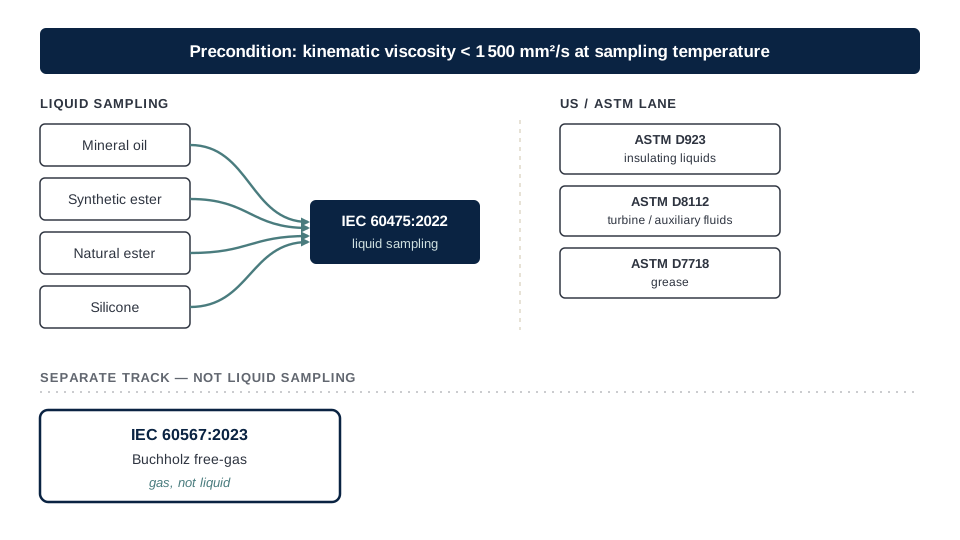
The map has honest edges. Grease is governed worldwide by a single standard, ASTM D7718 — the fourth shift. One area sits in a genuine gap: no IEC, ISO, ASTM, or CIGRE standard is written specifically for in-service oil sampling on wind turbines. For wind-turbine oil — gear and hydraulic fluids in the nacelle — ASTM D8112 is the pragmatic anchor, with the wind-specific deviations documented in the sampling plan. We name the gap rather than pretend a standard exists; that is part of the advice. On-line hydraulic line sampling for particle counting is not a gap: it is governed by ISO 4021, which TriboTech now holds — the upstream extraction method that draws a representative sample from an operating hydraulic system (the dynamic line method preferred, the static reservoir method only where no line sampler can be fitted) and feeds it downstream to the cleanliness count. Extraction sits upstream of the count, and a poorly drawn sample makes even a perfectly calibrated count meaningless.
Shift one — IEC 60567 now points at IEC 60475 for liquid sampling
This is the single most consequential change since 2023, and it is widely under-recognised in laboratory procedures still in circulation. Since the 2023 fifth edition, IEC 60567 no longer covers liquid sampling at all. Its scope is now explicit: the techniques for sampling oil from oil-filled equipment are no longer covered by IEC 60567 and are instead described in IEC 60475:2022 §4.2. The clause that used to house liquid sampling is now a single forwarding sentence.
What survives in IEC 60567, for the act of sampling, is Buchholz free-gas sampling — the act of drawing the collected gas from a gas-relay after an alarm. That role is real and unchanged. But the act of drawing a transformer oil sample for routine quality or for DGA has moved house.
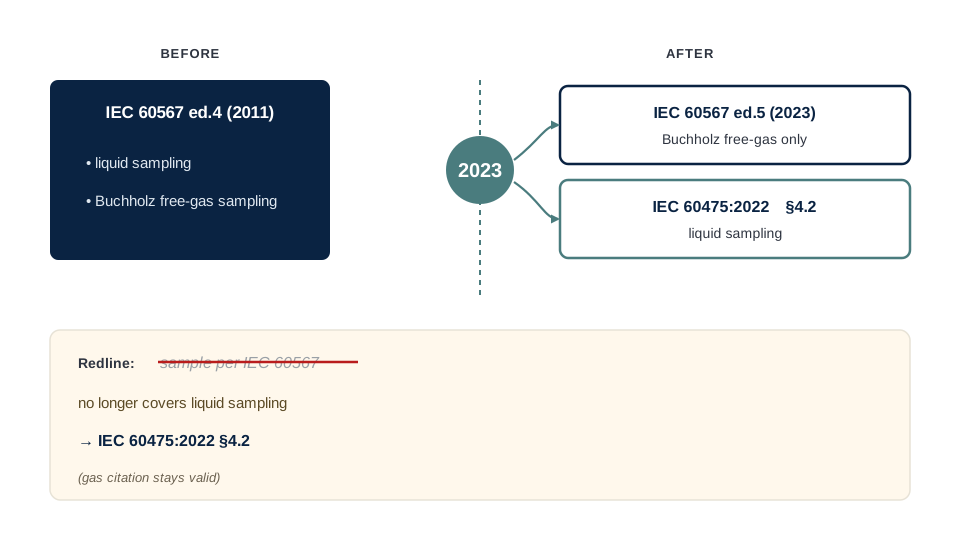
A procedure that still cites "IEC 60567" for the act of drawing a transformer oil sample has been pointing at the wrong document since 2023. Why it matters in practice: a sharp asset owner or auditor will catch a stale IEC 60567 sampling anchor in an offer or SOP, and it reads as a lab that has not kept current. When field judgment refines it: the physical operation is unchanged by the re-pointer. A gas-tight syringe or a drawn-aluminium bottle filled to zero headspace draws exactly the same sample it did before 2023. The discipline that protects a DGA result is headspace elimination, not which clause-house you cite. Fix the citation; the technique was never the problem.
Shift two — ASTM D3613 was absorbed, and D6871 was withdrawn and reinstated in the same year
Two ASTM reference points that US-spec buyers may still have in their procurement language have moved since those clauses were written — and the right response to each is different. This is the section most worth getting precisely right.
ASTM D3613, the old DGA-sampling practice, was withdrawn. The operational DGA-sampling capability is now carried by ASTM D923-15(R2023) §8 (glass syringes) and §9 (stainless-steel cylinders) — the two sections the standard's index designates "(DGA and Water Analysis)" — the current ASTM authority for the act of DGA sampling. There is no longer a standalone ASTM document dedicated solely to DGA sampling, but the capability has not been lost. This distinction matters: describing D3613 as "withdrawn with no replacement" implies a capability gap that the current ASTM catalogue does not show, and would misadvise a US-spec client.
ASTM D6871, the natural-ester fluid specification, is the sharper case: a specification withdrawn and reinstated inside the same year. The 2017 edition was withdrawn in January 2026 and reinstated in July 2026 as ASTM D6871-26, approved 1 June 2026; §5.1 requires fluid as received to conform to the property table in Table 1, and §1.4 limits its reach to new insulating fluid as received prior to any processing. Acceptance of new natural ester therefore runs on two parallel new-fluid specifications — IEC 62770:2024 internationally and ASTM D6871-26 on the US track — with IEEE C57.166-2026, which supersedes IEEE C57.147-2018, as the acceptance-and-maintenance guide. The guide does not replace the specification: its §7.1 requires unused natural ester as delivered to conform to ASTM D6871, and its Table 2 adds suggested test limits for shipments as received from the liquid supplier.
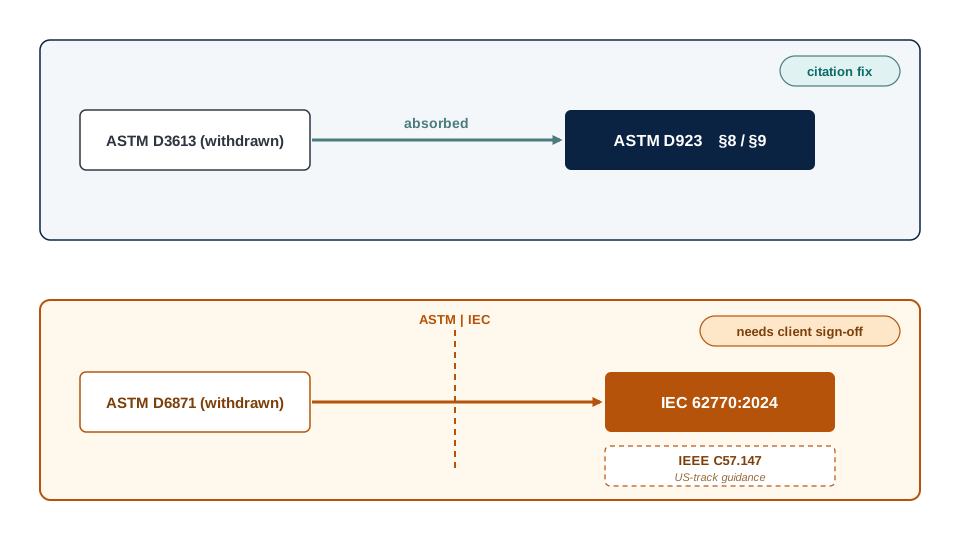
Why it matters in practice: a spec that still demands "sample per D3613" is unbuildable as written, and the right advisory move is to propose the live equivalent rather than substitute it silently. "Accept per D6871" is buildable again — against D6871-26 Table 1 — but a clause naming D6871-17 points at a superseded edition and should be re-cut. When field judgment refines it: the two defects are not the same kind. For D3613 the content was absorbed into ASTM D923 §8/§9, so it is a citation fix; for D6871 it is an edition fix. One case is worth checking separately: a spec moved off D6871 to IEC 62770 during the January-to-July window, on advice that D6871 was dead, can be re-anchored to D6871-26 if the client is on the US track. Treating an edition defect as a family switch is the error to avoid.
Shift three — one IEC standard, four fluid families
The 2022 third edition of IEC 60475 put four fluid families — mineral oil, synthetic ester, natural ester, and silicone — under one sampling standard, as long as the fluid sits below 1 500 mm²/s at sampling temperature. The scope is explicit, naming mineral oils and non-mineral oils such as synthetic esters, natural esters, vegetable oils, and silicones. Family-level specifications now converge on it: IEC 62770:2024 §5.3 defers sampling to IEC 60475, and IEC 61099 carries it in its normative references.
The old argument that "esters and silicones are different, so the mineral-oil sampling rules don't apply" no longer holds. One standard across four fluid families removes the excuse for ester or silicone sampling drift, so a fleet running mixed fluids can finally hold a single consistent sampling SOP instead of a patchwork. But IEC 60475 sets the floor, not the ceiling. Esters are hygroscopic and still need tightened moisture discipline at the point of sampling; silicones still need dedicated, hydrocarbon-free kit and a viscosity check at sampling temperature against the 1 500 mm²/s ceiling. The standard's scope is generous; the operator's care must stay fluid-specific.
Shift four — grease still answers to a single standard
For insulating liquids, IEC 60475 and ASTM D923 co-exist and largely converge, with one difference that matters for DGA: D923 recommends only syringes or stainless-steel cylinders for DGA and water (Note 2), while IEC 60475 also lists bottles. Grease is different: in-service grease sampling is governed in practice by a single standard worldwide — ASTM D7718-11(2019), with no ISO equivalent and no IEC analogue.
A practical detail is worth surfacing, because it looks like a compliance problem and is not. A plastic syringe with the plunger removed — the barrel acting as a funnel into a clean bottle below — is a §9.2-compliant open catch container when used passively during a regreasing purge: the method constrains the catch container only to "a clean sample container". Driven actively into a sealed fitting, the same syringe does not meet the §8 active-device geometry — the honest label there is "active-method intent, executed with a non-conforming tool". The discriminating fact is the operation, not the tool: whether a regreasing purge was driving the sample.
Which makes the close the same as for oil. Recording which method track was actually used — the execution record, not the tool — is what makes the result defensible across operators and bearings.
Pick your fluid, get your standard
The practical pay-off of all four shifts is a single question: for this fluid, in this component, for this purpose, which standard applies — and how should it be cited? The interactive decision-tree below walks from fluid and component to the authoritative standard, the full clause chain, and an example citation in three forms: what an offer you receive should cite, what a report you receive should cite, and what your sampling plan should specify.
Three contrasting cases make the point, same tool, three different leaves: a transmission asset owner sampling a 400 kV autotransformer for routine DGA lands on IEC 60475:2022 §4.2.4; a small fleet owner pulling pitch-bearing grease on a 10-turbine site lands on ASTM D7718 §9.2; and a hyperscale data-centre operator commissioning a synthetic-ester GSU lands on IEC 60475 with tightened moisture discipline. The right standard for your fluid and your component is rarely obvious from the catalogue, which is what the decision-tree is for.
For the field execution that turns a citation into a representative sample, our oil sampling guide walks through the procedure, steps 0 to 6, with illustrations. The guidance below is about the paperwork on either side of that operation: where the citation chain belongs, and what the field record confirms.
Where the citation chain lives — and what the field record confirms
The single most common mistake is to treat the sample note as the place where the citation chain is born. It is not. The chain — standard, edition, clause, container spec, acceptance criteria — belongs in two documents that are written and agreed before anyone goes to site: the sampling plan, the scope of work, or the purchase order. That is where the parties decide which standard governs, which container is required, and what the acceptance criterion is. Get it right there, and the field operation has a target to hit.
The field record — the note the crew fills in at the valve — then confirms execution only; the facts it carries are listed in the table below. Two of them earn the weight: the zero-headspace note decides whether a DGA gas profile is real or an artefact, and a deviation flagged on the record is auditable where an unrecorded one is a trap.
So the same DGA operation lives in three documents that cross your desk, and each carries a different weight:
| Document | What it carries |
|---|---|
| The Sampling Plan / SoW / PO (agreed up front) | The full chain. For mineral transformer DGA: IEC 60475:2022 §4.2.4 drawn-aluminium bottle, or §4.2.2 glass syringe, the bottle gas-tight to §4.2.4.1's <2.5 % H₂/week loss criterion, filled to zero headspace; Table 2 lists both containers as usable for DGA. Where a Buchholz relay is sampled, free gas per IEC 60567:2023. This is the document that does the citing. |
| An offer or report you receive | Family-level citation is sufficient: "DGA sampling per IEC 60475 (oil), IEC 60567 (gas-from-relay where applicable)." Clause numbers here are over-specification, not rigour — their absence is not a red flag. A stale citation is: "sample per D3613", or IEC 60567 named for the act of drawing oil, both date the document to before 2023. |
| The field execution record | Container actually used, zero-headspace confirmed at sealing, sampling point, timestamp, operator, and any deviation from the plan. It references the agreed plan; it does not re-derive the clause chain. |
A field recommendation on the container choice, since it is the line the plan should specify: for transport robustness, default to the drawn-aluminium bottle. A gas-tight glass syringe is not standard kit: TriboTech supplies one only when the client's protocol calls for it, or by arrangement with the client. IEC 60475:2022 Table 2 lists both containers as usable for DGA, provided the bottle meets the <2.5 % H₂/week gas-tightness criterion of §4.2.4.1. On the IEC track the choice is then logistics, provided the fill procedure is followed strictly, which IEC calls critical for bottles (§4.2.1.5).
The asymmetry runs the opposite way to what most people fear. The field record should be short and factual — it confirms what was done, nothing more. The citation weight sits in the plan, agreed before site. The trap is not an over-long note; it is a plan that left the container or the acceptance criterion unspecified, so the crew improvised at the valve and the record has nothing to confirm against.
Where to go next
If your sampling clauses predate 2023, the four shifts above are the checklist. Three engagement shapes cover most of the work TriboTech is asked to do here:
- Transmission, large GSU, HVDC converter, or hydropower step-up. Your existing sampling clauses likely cite IEC 60475 §4.2 already, but the IEC 60567 → 60475 redirect needs to be reflected in the SOPs that reference the standard, and reactors plus bushings under IEC 60475:2022 §1 scope are often missing from older procurement templates. TriboTech reviews the clause-level chain against the current edition. Review my clauses.
- Distribution fleet, solar-park MV step-up, or natural-ester pilot. Edition drift on ASTM D6871 — clauses still naming D6871-17, and clauses re-pointed to IEC 62770 during the 2026 withdrawal window — and the IEC 60475:2022 ester scope expansion are where most distribution-grade clauses break first. We audit purchase-order templates against IEC 60475:2022 and confirm laboratory acceptance forms reference the surviving standards. Audit our PO templates.
- New programme — wind site commissioning, data-centre GSU acceptance, retrofit project. When the programme is being written from scratch, TriboTech writes the SOP, specifies the sampling kit, and delivers an advisory training session for the field crew, with the asset owner retaining responsibility for operational execution. The interactive decision-tree above is the pre-screen for the citations that will go into the formal procedure. Scope a new programme.
All engagements are scoped under TriboTech's framework agreement (ABR Abridged 2019, Bilag C ad-hoc order).
Standards editions and scopes change. The citations in this article reflect the published editions current as of 2026-09; verify against the current edition before incorporating any clause into a procurement specification, SOP, or laboratory acceptance form.
For the practical fundamentals of drawing a representative sample, see our oil sampling guide and the companion piece on the physics of oil sampling.
Standards referenced in this article
These are the official product or abstract pages for each standard named above; most are paywalled — that is where you buy or verify the exact edition, and editions move, which is the point of this article.
IEC
- IEC 60475:2022 — liquid sampling from oil-filled equipment
- IEC 60567:2023 — extraction and analysis of dissolved and free gases
- IEC 62770:2024 — natural ester fluid specification
- IEC 61099:2010 — synthetic ester fluid specification
ASTM
- ASTM D923-15(R2023) — sampling of insulating liquids (§8 glass syringes, §9 stainless-steel cylinders)
- ASTM D3613 (withdrawn) — former DGA-sampling practice, content absorbed into D923
- ASTM D6871-26 (current) — natural-ester (vegetable oil) fluid specification
- ASTM D7718-11(2019) — sampling in-service grease
- ASTM D8112-26 — sampling of in-service lubricating oils and hydraulic fluids in industrial applications, turbines included
ISO
- ISO 4021:1992 — line sampling of hydraulic fluid for particle counting
IEEE
- IEEE C57.166-2026 — guide for acceptance and maintenance of insulating liquids in transformers; supersedes IEEE C57.147-2018
Dansk Standard
- DS 3077 — Theory of Sampling (this article discusses the 2013 edition; DS 3077:2024 has since superseded it)
Put Theory into Practice
Try our interactive Duval diagnostic tools or use our new unified workflow to analyze your transformer oil data.