
Audio player docked to bottom
Listen to this article
Why the dissipation factor on a liquid specimen and the tan delta on the whole transformer are two different numbers — and what a rising DDF actually tells you about the unit
❗ Important
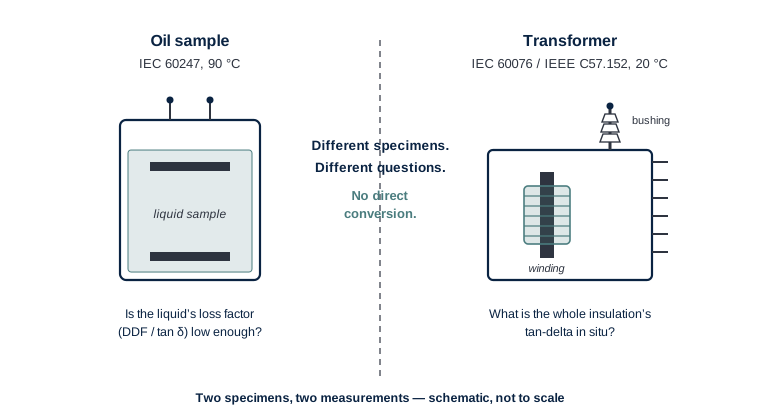
The oil sample's dissipation factor (DDF, tan δ) is measured on a small liquid specimen at 90 °C. The transformer's own tan delta is measured out at the unit, on the whole installed insulation, corrected to 20 °C. They are two different specimens answering two different questions — and there is no standardised conversion between them. A rising oil DDF is a cleanliness and ageing indicator for the oil, not a verdict on the winding. Read it as a trend, and hold it up against breakdown voltage and water content before you act.
The mix-up that costs misreadings
The same concept appears in two places — on an oil sample in the laboratory and on the transformer in the field — and that is exactly where the confusion arises: the oil sample's dissipation factor gets read as if it said something about the condition of the winding or the bushing. It does not. They are two different specimens, each answering its own question, measured at its own reference temperature.
The dissipation factor — internationally dissipation factor (DDF), tan delta or power factor — is one of the most sensitive parameters we measure on an insulating liquid. It catches ionic and polar contamination that no other single parameter sees as early. But it is precisely that sensitivity that makes it important to know which dissipation factor you have in front of you.
This article separates the two, explains what drives oil DDF up, and gives a severity ladder you can use when the number rises.
What the oil sample's dissipation factor actually is
When an insulating liquid is exposed to an alternating field, it both stores energy capacitively and dissipates some of that energy as heat. In an ideal, loss-free liquid the current runs exactly 90° ahead of the voltage; real loss tips it back a little, and the difference is the loss angle δ (the Greek letter delta). The dissipation factor is the tangent of that angle — "tan δ", read "tan delta" — that is, the ratio of the resistive (loss-bearing) to the capacitive (storing) current (IEC 60247:2004).
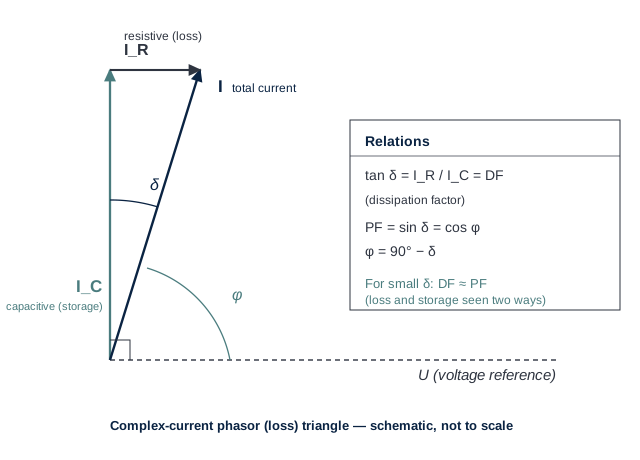
Two concepts are often confused: dissipation factor (DF = tan δ) and power factor (PF = sin δ). They are not the same number. But in the normal operating range, where the loss angle is small, they are approximately equal — it is only at large loss angles that they diverge.
The laboratory methods: IEC 60247, IEC 61620 and ASTM D924
IEC 60247 is broader than tan δ alone: in the same measuring cell it determines relative permittivity, dissipation factor (tan δ) and DC resistivity. The dissipation factor is measured directly on an AC capacitance bridge from the loss angle δ — the deviation from the ideal 90° between applied sinusoidal voltage and current — at a field strength of 0.03–1 kV/mm and 40–62 Hz (IEC 60247:2004, §12.1). At 90 °C the loss is dominated by the liquid's ionic conduction, and that is precisely why tan δ here is a sensitive cleanliness indicator (IEC 60247:2004, §4.1).
IEC 60247 is the reference method for oil DDF. IEC 61620 is not merely a check on it, but a self-contained measurement method: it measures conductance and capacitance with a square-wave alternating voltage at low, near-equilibrium field strength and computes tan δ from them. That is exactly why it is particularly suited to highly insulating liquids with very low dissipation factors — where 60247's AC bridge loses resolution — and can determine tan δ reliably down to 10⁻⁶. 61620 does not replace 60247, but complements it in the low-DDF regime (IEC 60247:2004, §1; IEC 61620:1998, §1; cf. IEC 60422:2024, §7.7). The American counterpart is ASTM D924.
All three methods report the same quantity — tan δ at mains frequency — so a number is comparable with its own history when method, temperature and frequency are held fixed (IEC 60247:2004, §12.1; ASTM D924-23, §1.2). The caution between 60247 and 61620 applies to the resistivity, not the dissipation factor: 60247's DC resistivity is measured at high voltage over a long time and differs from 61620's conductance-derived figure (IEC 60247:2004, §4.2), while tan δ is measured the same way. Across methods, however, absolute single numbers should be interpreted with care — especially in the very low DDF range, where 60247's bridge loses resolution.
For the same reason, 61620 cannot simply replace 60247: it measures only tan δ (via conductance and capacitance), whereas 60247 in the same cell also determines relative permittivity and DC resistivity (IEC 60247:2004, §1; IEC 61620:1998, §1). 60247 is moreover the reference method for liquids generally — including high-loss and contaminated oil — where 61620's low-DDF optimisation is not needed.
What drives oil DDF up
The dissipation factor rises when mobile charge carriers enter the liquid. Physically this is the same as increased conductivity: the more ions and polar molecules that can move in the field, the more energy is dissipated per cycle (IEC 60247:2004; CIGRE TB 414:2010). The typical sources:
- Dissolved water. Water increases the ionic dissociation and raises both DDF and conductivity.
- Acids and polar ageing products. When the oil's hydrocarbon chains oxidise under heat, dissolved oxygen and catalytic metals, peroxides give rise to carboxylic acids, ketones and aldehydes that add both mobile charge and polar molecules. Acidity and dissipation factor are, at bottom, measuring the same oxidation process from different angles (IEC 60422:2024, §7.7).
- Metal soaps and particles. Metal soaps form when carboxylic acids from the oil oxidation react with metal from windings, core and tank (copper, iron) into soluble metal carboxylates — polar, charge-bearing organometallic compounds that, together with charged particles, add further mobile charge (IEC 60247:2004, §4.1; IEC 60422:2024, §7.7).
Both DDF and resistivity are very sensitive to dissolved polar contaminants, ageing products and colloids — changes can be tracked even when the contamination is so small that it is near the limit of chemical detection (IEC 60422:2024, §7.7).
The dissipation factor is strongly temperature-dependent — it rises approximately exponentially with temperature, while DC resistivity falls correspondingly (IEC 60247:2004). The two are mirror images of the same ionic conduction mechanism: tan δ up, resistivity down — a general relationship in which resistivity falls as DDF rises (IEC 60422:2024, §7.7, Figure 3). That is also why the reference temperature is part of the measurement — a dissipation-factor number without its temperature is not a diagnostic number.
For esters the dissipation factor sits higher from new, because the ester bond is itself polar. That makes DDF a weak stand-alone diagnostic for esters — here acidity and breakdown voltage lead instead.
Two specimens, two questions
Here is the core. The same physical quantity — the tangent of the loss angle — is measured in two entirely different setups, and confusing them is the most common error in transformer diagnostics.
| The oil sample's dissipation factor | The transformer's tan delta | |
|---|---|---|
| Specimen | A liquid specimen alone, in a test cell | The whole installed insulation: solid (paper/pressboard) plus liquid, in the unit |
| Standard | IEC 60247, IEC 61620 (low-DDF), ASTM D924 | IEC 60076-1/-3 (on the unit); IEEE C57.152 (in the field) |
| Reference temperature | 90 °C (IEC 60247:2004) | corrected to 20 °C (IEEE C57.152-2013) |
| What it diagnoses | Ionic/polar contamination and ageing of the liquid | The state of the whole installed insulation — moisture in the paper, bushing condition, winding deformation |
An oil sample cannot "see" moisture in the paper or the condition of a bushing — that requires a field measurement of the installed system (IEEE C57.152-2013). And the two reference temperatures cannot be crossed: there is no standardised conversion between the oil sample's 90 °C and the field's 20 °C. With an exponential temperature dependence and a 70 K jump, the two numbers are simply not comparable as values. Only trends — each number held up against its own history at its own reference temperature — can be compared.
What a rising oil DDF means for the transformer
A rising oil DDF is, as described above, a cleanliness and ageing indicator for the oil. It is not in itself a fault symptom on the winding or the solid insulation.
It is tempting to couple dielectric loss directly to thermal risk: more loss means more heat per cycle in the dielectric. But at operating field strength in the oil itself the measurable heat contribution is in practice small. The classic thermal runaway is associated with confined insulation and bushings, not with free oil (IEEE C57.152-2013). IEC 60422 emphasises precisely that at very high and ultra-high voltages — in instrument transformers and oil-filled bushings — DDF must be followed especially closely, because a high DDF here can, according to reports, lead to thermal runaway and failure (IEC 60422:2024, §7.7). Oil DDF is therefore first and foremost an indicator parameter — not a significant heat source in the liquid.
The practical payoff lies in how the number aligns with — or diverges from — the field measurement. If both the oil sample's DDF and the field tan delta are elevated and rising together, the contamination sits in the oil phase. If the oil sample's DDF is low while the field measurement is high, that points rather to moisture or ageing in the solid cellulose — which an oil sample can never see. That is exactly where separating the two measurements pays off.
Severity ladder for oil DDF
When oil DDF rises, the question is when it is an occasion to investigate and when it calls for action. The table below gives the limits for the oil sample's dissipation factor measured at 90 °C:
| Liquid | Good | Monitor (Fair) | Act (Poor) | Source |
|---|---|---|---|---|
| Mineral oil, Cat. A (>170 kV) | <0.10 | 0.10–0.20 | >0.20 | IEC 60422:2024, Table 5 |
| Mineral oil, Cat. B/C (≤170 kV) | <0.10 | 0.10–0.50 | >0.50 | IEC 60422:2024, Table 5 |
| Synthetic ester, Cat. A (>170 kV) | <0.15 | 0.15–0.3 | >0.3 | IEC 61203:2025, Table 5 |
| Synthetic ester, Cat. B–C (≤170 kV) | <0.15 | 0.15–0.5 | >0.5 | IEC 61203:2025, Table 5 |
Note that the ester's "Good" band sits higher than the mineral oil's. That is not a relaxation, but the polar baseline: esters start higher from new, and small rises above the new-fluid value have many benign causes.
How to read a dissipation-factor result
- Always keep the method and temperature together with the number. An oil DDF without its 90 °C reference cannot be interpreted — and it cannot be held up against a field measurement corrected to 20 °C.
- Never convert between the oil sample and the field measurement. There is no standardised conversion between the two reference temperatures. Track each number on its own, each against its own history.
- Read DDF as a trend, not as a single verdict. One high value is an occasion to investigate — water? contamination? ageing? — not a verdict on the transformer.
- Always hold DDF up against breakdown voltage and water content. If breakdown voltage falls or water rises in parallel, DDF confirms a real deterioration. If they stay stable, an isolated DDF rise more often points to benign polar contamination — especially in esters, where DDF is already a weak stand-alone diagnostic.
- No action on one result and one property. The combination makes the diagnosis, not the single number.
The short version: the oil sample's dissipation factor tells you about the oil's cleanliness — the transformer's own tan delta tells you about the whole insulation. They are two questions, and it is worth keeping them apart.
💡 Tip
Getting dissipation-factor numbers from both the oil laboratory and a field measurement on the same unit? They cannot be added on top of one another or converted — they are two different specimens. That is exactly the kind of separation we make in an independent review of your analysis history, so a rising DDF is read for what it is. Get in touch if you want a second eye on what your DDF series are actually telling you.
Frequently asked questions
Is the oil sample's tan delta the same as the transformer's tan delta?
What is a good tan delta value for transformer oil?
At what temperature is tan delta (DDF) measured on transformer oil?
What is the difference between tan delta and power factor?
What makes the oil sample's tan delta rise?
IEC 60247 or IEC 61620 — which is used to measure DDF?
Does a high oil DDF mean the transformer is about to fail?
Standards referenced
The methods on this page are anchored in these standards — follow each into our standards library.
Put Theory into Practice
Try our interactive Duval diagnostic tools or use our new unified workflow to analyze your transformer oil data.