Audio player docked to bottom
Listen to this article
Why IFT deserves routine status — and what the 2024/2025 IEC updates change for mineral oil, ester, and GTL diagnostics
What happens at the oil-water interface — and why it matters
Of all the parameters we measure on transformer insulating fluids, interfacial tension (IFT) is arguably the one that delivers the most diagnostic value per millinewton. It responds earlier than acidity, integrates more degradation chemistry than any single chemical test, and has been validated against sludge formation in a landmark AIEE-era field dataset spanning 500 transformers over 11 years (1946–1957). Yet for decades, the dominant international standard — IEC 60422 — classified it as a "complementary" test rather than a routine one.
That is now changing.
IFT is measured in millinewtons per metre (mN/m) and quantifies the energy required to expand the boundary between two immiscible liquids — in our case, transformer oil and distilled water. For new, healthy mineral oil, this value typically lies between 40 and 50 mN/m.
The physics behind it is elegant. Water molecules at the interface have fewer hydrogen-bonding partners than in the bulk, creating a strong inward cohesive pull. Mineral oil molecules interact only through weak van der Waals forces. The large dissimilarity between these two phases produces a high-energy boundary — and that energy is what the tensiometer measures.
As oil degrades through oxidation, it generates polar by-products: carboxylic acids, aldehydes, ketones, hydroperoxides, and eventually high-molecular-weight sludge precursors. These degradation products are amphiphilic — they have a nonpolar hydrocarbon tail and a polar headgroup. Thermodynamically, they are driven to the oil-water interface where both affinities can be satisfied simultaneously. The polar head orients toward water; the hydrocarbon tail extends into the oil phase. Each molecule that adsorbs at the interface displaces water-water interactions and lowers the measured IFT.
This behaviour is described rigorously by the Gibbs adsorption isotherm:
Gibbs Adsorption Isotherm
The equation tells us that if increasing the concentration of a solute (polar degradation products) decreases interfacial tension, then the surface excess concentration must be positive — meaning those molecules are accumulating at the interface in excess of their bulk concentration.
This provides the theoretical foundation for why IFT is such a sensitive early-warning parameter: even trace levels of polar contaminants concentrate at the measurement interface, producing a detectable signal long before bulk-phase tests like titration can register the change.
❗ Important
Why oil-water and not oil-air? Surface tension (oil-air) changes only modestly with degradation because all oil molecules — degraded or not — have similar van der Waals interactions with air. The oil-water interface, by contrast, provides a polar phase that specifically attracts and concentrates amphiphilic contaminants. This is why IFT is diagnostically powerful while surface tension is not — and why the test specifically requires high-purity water.
Seven decades of field validation
IFT was integrated into transformer diagnostics in the 1940s, championed by Frank Doble and his special oil committee established in 1936 at Doble Engineering Company. Early work demonstrated that IFT could detect chemical degradation well before measurable sludge formation — and critically, before acidity showed an alarming increase.
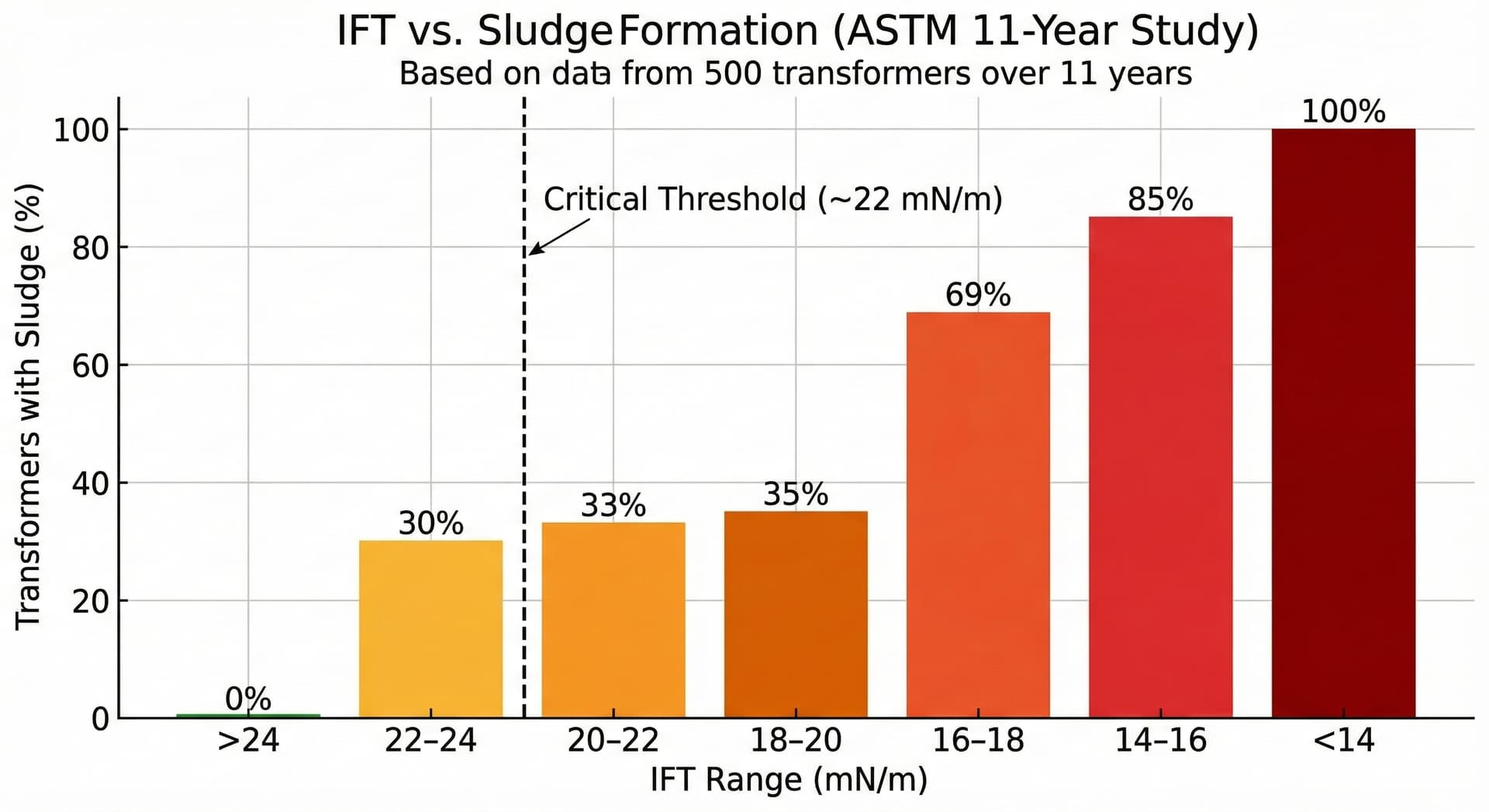
The definitive validation came from an 11-year field study (1946–1957) covering 500 transformers reported in AIEE Transactions (1955) and subsequently propagated through Doble and SDMyers literature, which quantified the relationship between IFT and sludge formation:
| IFT (mN/m) | Transformers with sludge |
|---|---|
| >24 | 0% |
| 22–24 | 30% |
| 20–22 | 33% |
| 18–20 | 35% |
| 16–18 | 69% |
| 14–16 | 85% |
| <14 | 100% |
This study established the ~22 mN/m threshold as the boundary where sludge risk becomes significant — a value that remains central to diagnostic practice today.
SDMyers subsequently developed the Oil Quality Index Number (OQIN) — the ratio of IFT to Neutralisation Number — which compresses both parameters into a single metric. TriboTech uses the direct form OQIN = IFT / NN with reference thresholds at new oil ≈ 1,500, Watch ≈ 300, Fair ≈ 100, and sludge onset ≈ 55. The canonical treatment, including conversions to the inverse convention 1000 × NN / IFT sometimes seen in the literature, is maintained in TriboTech's IFT condition metrics reference.
How IFT is measured: methods old and new
The Du Noüy ring — the workhorse
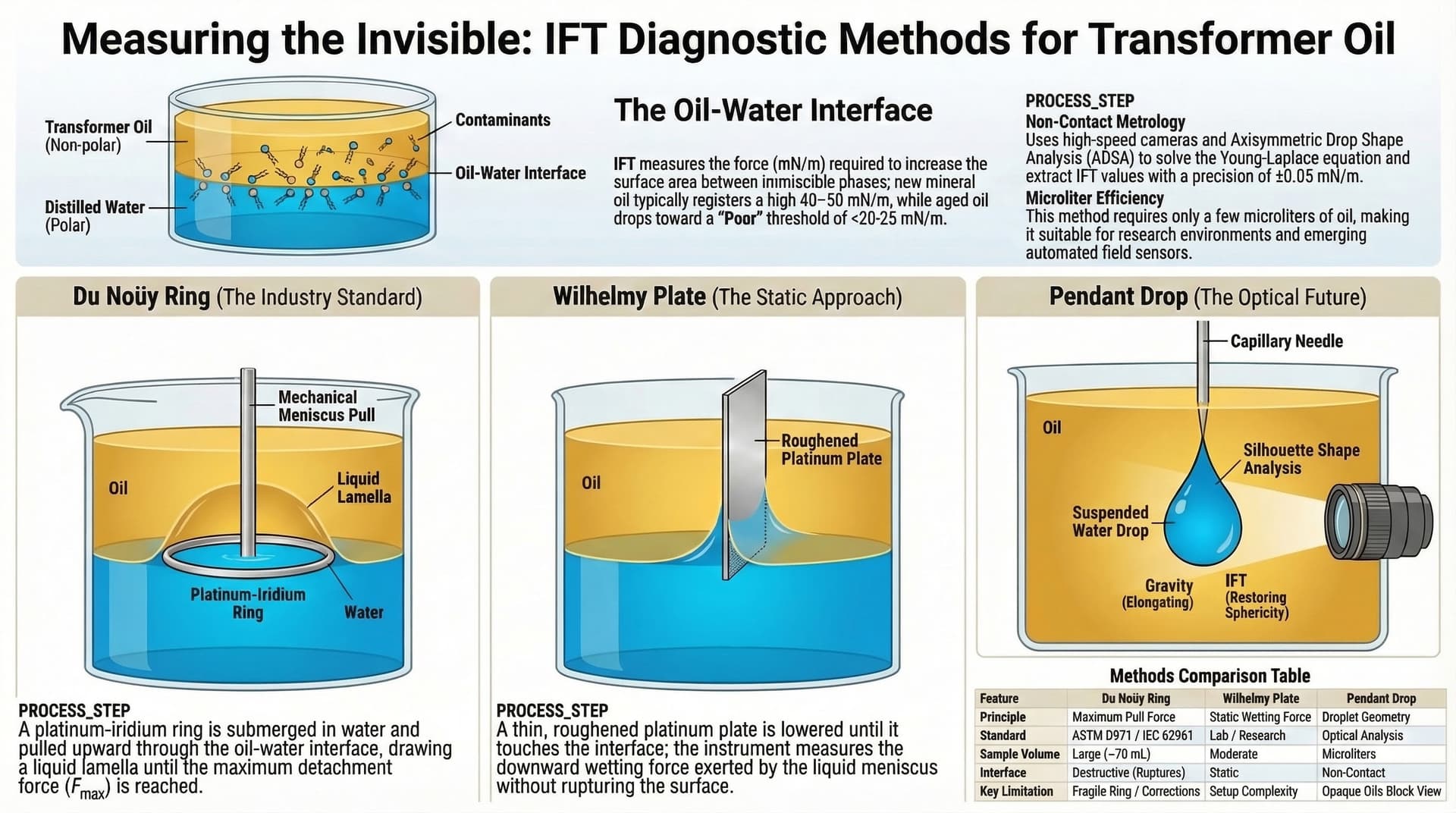
The platinum-iridium ring method (ASTM D971 / IEC 62961) remains the dominant laboratory technique. A ring is submerged through the oil into water, then drawn upward through the interface. The maximum force before the liquid lamella detaches gives the IFT, corrected by the Harkins-Jordan factor for meniscus geometry.
Modern automated tensiometers — the Krüss K100 series, DataPhysics DCAT, and the Biolin Scientific Sigma 702ET (purpose-built for transformer oil) — handle these corrections automatically and achieve precision of ±0.01 mN/m. The critical practical requirements are: flame-annealing the ring before each measurement, using water of verified purity (surface tension 70–74 mN/m), and maintaining the measurement temperature at 25 °C.
ℹ️ Note
IEC 62961 (2018) extends the equilibration time to 180 ± 30 seconds, compared to ASTM D971's 60-second window. The longer equilibration allows more polar species to diffuse to the interface, which is particularly relevant for ester fluids. IEC 62961 is expected to progressively replace ASTM D971 as the international reference.
The Wilhelmy plate — static and non-destructive
The plate method measures the wetting force directly without tearing the interface. With complete wetting on clean platinum, no correction factors are needed. Its main advantage is continuous, time-resolved monitoring — useful for research into adsorption dynamics — but it is not specified in the major transformer oil standards.
The pendant drop — optical, miniaturised, and AI-ready
This technique captures the silhouette of a droplet hanging from a needle and fits its profile to the Young-Laplace equation using Axisymmetric Drop Shape Analysis (ADSA). Accuracy reaches ±0.05 mN/m with microlitre sample volumes and no physical contact with the interface.
What makes pendant drop particularly exciting is the recent integration of deep learning. Kratz and Kierfeld (2020, J. Chem. Phys. 153, 094102, DOI 10.1063/5.0018814) demonstrated deep neural networks that solve the inverse Young-Laplace problem orders of magnitude faster than traditional ADSA fitting, at surface-tension precision competitive with conventional methods. This opens the door to real-time, field-deployable pendant drop systems — though heavily aged, opaque oils can obstruct the optical path.
Emerging: microfluidics and QCM-D
Microfluidic lab-on-a-chip platforms generate uniform water droplets in a continuous oil stream within sub-millimetre channels. Coupled with machine vision and edge computing, these devices could provide autonomous field measurements — though no transformer oil application has been published yet.
The Quartz Crystal Microbalance with Dissipation (QCM-D) offers a different angle entirely: it monitors the real-time adsorption and mass uptake of polar contaminants onto a sensor surface at the nanoscale. Contactless wireless deployment concepts have been developed for high-voltage environments — potentially enabling in-situ monitoring inside sealed transformer tanks.
What drives IFT decline — and what it tells you
The oxidation arc
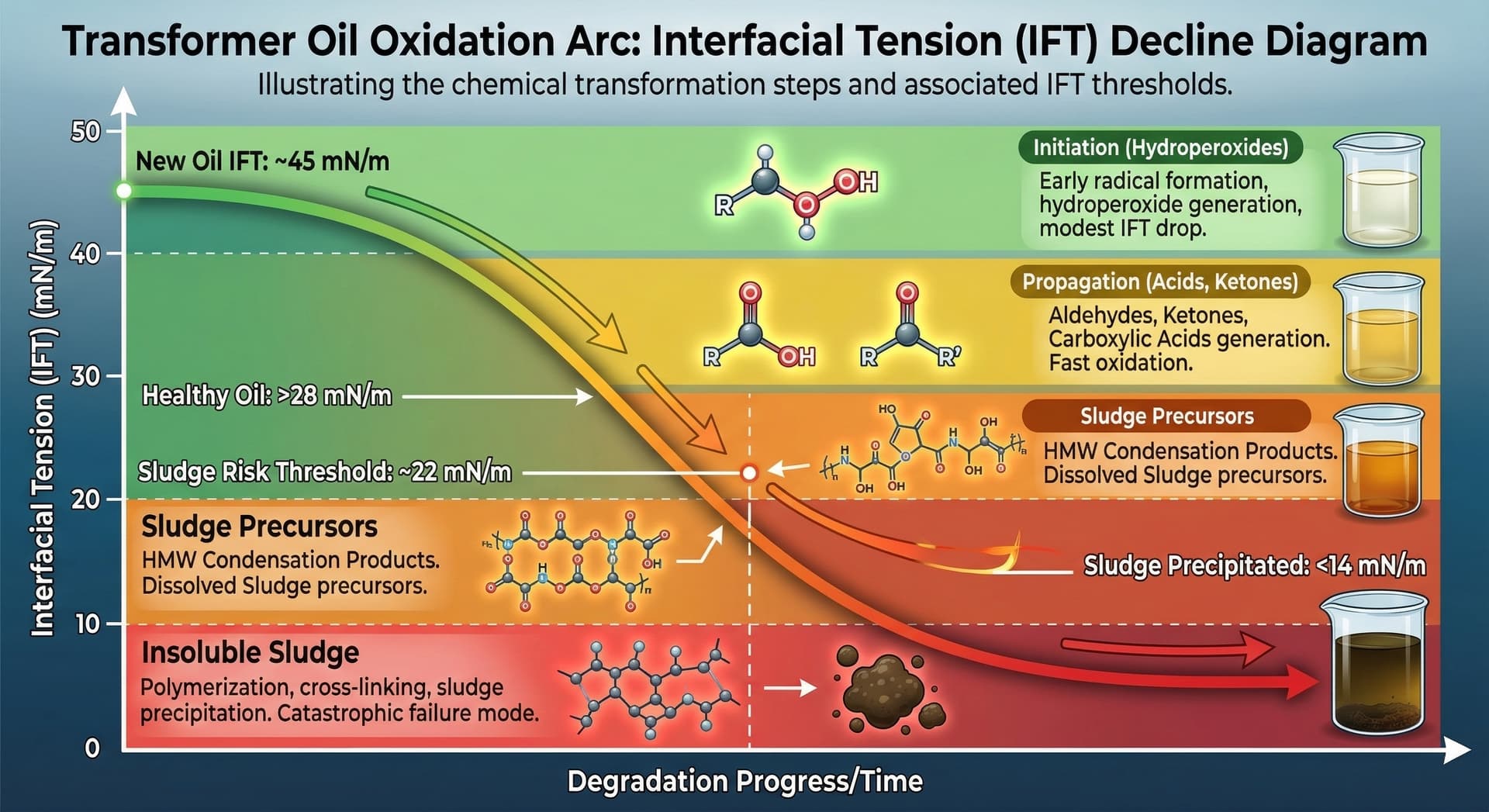
IFT decline traces the full arc of oil oxidation chemistry. In the initiation phase, hydroperoxides cause modest IFT reduction. As oxidation propagates, aldehydes, ketones, and carboxylic acids accumulate — each more amphiphilic than the last — driving IFT steadily downward. In the final stages, high-molecular-weight condensation products form as dissolved sludge precursors before precipitating as insoluble sludge.
IFT decline on the order of 0.5–1.5 mN/m per year is commonly observed for in-service uninhibited mineral oil, varying with loading, temperature, oxygen access, and copper content. CIGRE TB 526:2013 (WG D1.30, "Oxidation Stability of Insulating Fluids") provides the underlying framework relating oxidation chemistry to oil parameter decline; the absolute IFT-decline rate is fleet- and design-dependent and is not tabulated in the standard.
Inhibitors slow the decline — but re-inhibition doesn't reverse it
Antioxidant inhibitors (DBPC/BHT, 0.08–0.40% total inhibitor per IEC 60296:2020) dramatically slow IFT decline by scavenging radicals before they produce polar products. Below approximately 0.08% residual inhibitor content — the boundary below which IEC 60296 no longer classes the oil as inhibited — protection is effectively lost and oxidation accelerates.
⚠️ Warning
Re-inhibition alone does not restore IFT — it only slows further decline. If IFT has already dropped below ~32 mN/m, reclamation is typically necessary before re-inhibiting.
Fuller's earth: proof that IFT tracks polar compounds
Oil reclamation through Fuller's earth (activated clay) provides the most compelling mechanistic validation of IFT. The clay selectively adsorbs polar compounds — acids, sludge precursors, colour bodies — and post-treatment, IFT routinely returns to ≥40 mN/m. This dramatic restoration from sometimes <20 mN/m confirms that IFT depression is caused specifically by dissolved polar species, and that removing them restores original interfacial characteristics.
ℹ️ Note
Fuller's earth also strips polar additives (DBPC, Irgamet 39), requiring re-inhibition after treatment.
Paper degradation leaves an IFT signature too
A 2022 regression study by Saeid, Zeinoddini-Meymand, Kamel & Khan, "Interaction of Transformer Oil Parameters on Each Other and on Transformer Health Index Using Curve Estimation Regression Method" (International Transactions on Electrical Energy Systems, 2022, DOI 10.1155/2022/7548533) found that furfural (2-FAL) — the primary marker of cellulose paper degradation — has the single largest impact on IFT among the measured parameters: a 1 ppm increase in furfural corresponds to a 0.644 mN/m decrease in IFT in the power-regression fit. This means IFT captures not only oil oxidation but also the chemical consequences of solid insulation aging.
The 2024/2025 standards revolution: fluid-specific IFT limits
This is where the landscape has shifted decisively. For the first time, we now have internationally standardised IFT condition limits for all major transformer fluid types.
IEC 60422:2024 — mineral oil limits tightened, IFT moves toward routine
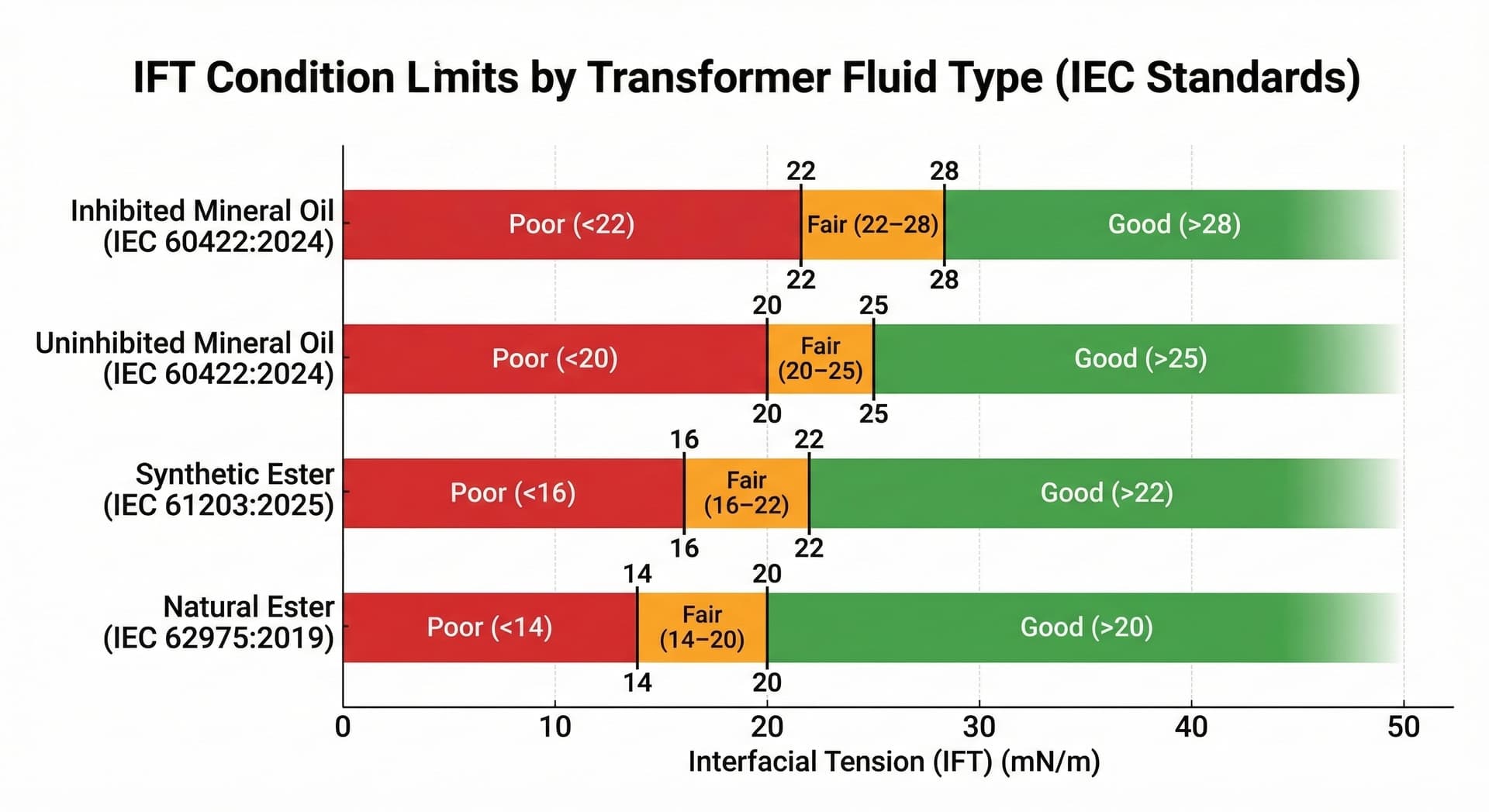
The 2024 edition brings two major changes. First, it now differentiates between inhibited and uninhibited mineral oils, with tighter limits for inhibited oils (where higher initial IFT is expected):
| Condition | Inhibited oil | Uninhibited oil |
|---|---|---|
| Good | >28 mN/m | >25 mN/m |
| Fair | 22–28 mN/m | 20–25 mN/m |
| Poor | <22 mN/m | <20 mN/m |
Second, the standard now states that IFT "can be a routine test for inhibited oil" and is "most useful during the early life as it can indicate early stage of oxidation or contamination." This is a notable shift: earlier editions treated IFT purely as a complementary test. The 2024 edition still classes IFT as a Group 2 test by default, but a new note allows it to count as a Group 1 (routine) test for inhibited oil.
IEC 61203:2025 — synthetic ester limits now exist
This standard establishes IFT condition limits for synthetic ester fluids such as MIDEL 7131:
| Condition | Limit |
|---|---|
| Good | >22 mN/m |
| Fair | 16–22 mN/m |
| Poor | <16 mN/m |
This is particularly significant because the manufacturer of the most widely used synthetic ester had previously questioned whether IFT was even a meaningful diagnostic parameter for their products. IEC's publication of explicit limits settles the question at the standards level.
IEC 62975:2021 — natural ester limits
For natural ester fluids (FR3, MIDEL eN, BioTemp), IEC 62975:2021 sets the following IFT classification limits:
| Condition | Limit |
|---|---|
| Good | >20 mN/m |
| Fair | 14–20 mN/m |
| Poor | <14 mN/m |
The complete framework at a glance
| Condition | Mineral oil (inhibited) | Mineral oil (uninhibited) | Synthetic ester | Natural ester |
|---|---|---|---|---|
| Good | >28 | >25 | >22 | >20 |
| Fair | 22–28 | 20–25 | 16–22 | 14–20 |
| Poor | <22 | <20 | <16 | <14 |
| Standard | IEC 60422:2024 | IEC 60422:2024 | IEC 61203:2025 | IEC 62975:2021 |
The progressively lower thresholds across fluid types directly reflect the increasing inherent polarity of the base fluid chemistry. Natural esters, with triglyceride ester bonds, are the most polar and start at the lowest IFT baseline (~24–27 mN/m for new FR3).
🔴 Caution
Mineral oil alarm limits applied to esters will trigger false alarms on brand-new fluid — a dangerous error that the fluid-specific framework now prevents.
A practical note on dynamic range: mineral oil spans roughly 28 mN/m from new-oil to Poor condition (45 → 22 for inhibited). Natural esters span only about 13 mN/m (27 → 14). Each millinewton of decline in an ester carries proportionally more diagnostic weight than in mineral oil.
GTL oils: the knowledge gap
Gas-to-liquid transformer oils such as Shell Diala S4 ZX-I — synthesised from natural gas via the Fischer-Tropsch process — are ultra-pure isoparaffinic hydrocarbons with virtually no aromatics or sulphur (<1 ppm). Their initial IFT is expected to be very high (likely >50 mN/m), and accelerated aging studies show remarkably flat IFT decay curves compared to conventional naphthenic oils.
However, a significant knowledge gap exists: the Diala S4 ZX-I technical datasheet does not report IFT — a notable omission compared to Nynas product datasheets. No published IFT aging trajectory data exists for GTL products in actual transformer service.
The removal of natural antioxidant species (aromatic and sulphur compounds) raises a question: once synthetic inhibitor is depleted, does oxidation proceed more abruptly than in naphthenic oils?
GTL fluids fall under IEC 60422:2024 mineral oil limits, but whether those limits are optimally calibrated for this fundamentally different chemistry is unresolved. If a sudden IFT drop occurs in a GTL system, it may be more likely to indicate external contamination (varnish, seal degradation) than the gradual internal oxidation typical of naphthenic oils — a diagnostically important distinction.
How IFT relates to other diagnostic parameters
IFT vs. acidity: the early-warning advantage
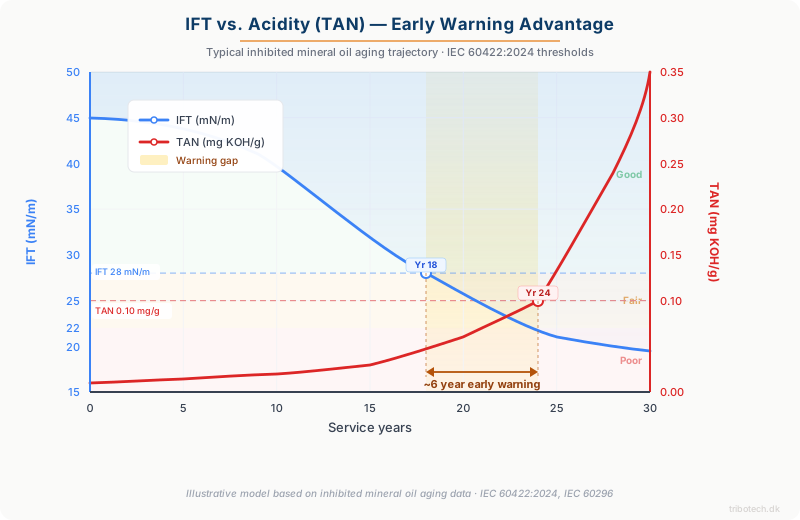
The classic inverse correlation between IFT and Total Acid Number (TAN) is the most documented relationship in transformer oil analysis. At very low acidity levels, the curve is nearly vertical — IFT declines measurably well before TAN reaches detectable alarm levels, giving IFT an early-warning advantage of potentially years.
Discordance between the two parameters is itself diagnostic: low IFT combined with low acidity points to external polar contamination (solvents, gasket materials, leachates) rather than normal oxidation aging.
The SDMyers OQIN combines both: IFT ÷ Neutralisation Number. New oil ≈ 1,500; the Watch band sits at ≈ 300, Fair at ≈ 100, and sludge onset at ≈ 55 (IFT ~22, NN ~0.40). Full threshold table and ester-fluid caveats are in the IFT condition metrics reference.
IFT vs. dissipation factor (tan δ): complementary, not redundant
Both parameters respond to polar degradation products, but through fundamentally different physical mechanisms — IFT via surface chemistry, tan δ via electrical conductivity and dielectric loss. Tan δ is more sensitive to ionic and conductive contamination (moisture, dissolved metal soaps), while IFT better captures dissolved molecular polar species.
A high tan δ that normalises at elevated temperature typically indicates moisture; persistent elevation across temperatures points to oxidation. IFT cannot make this distinction alone — which is precisely why the IEC standards recommend checking DDF alongside IFT when Fair or Poor conditions are observed.
The rate of decline matters more than any single value
A sudden acceleration in IFT decline — even when absolute values remain above 28 mN/m — signals changing oxidation kinetics (possibly inhibitor depletion or new contamination) and warrants investigation. This aligns with IEC 60422:2024's observation that IFT is most useful during early life.
The automation challenge: why online IFT monitoring doesn't exist yet
No commercially available real-time online IFT sensor exists for transformers. The obstacles are formidable: the Du Noüy ring requires flame-annealing before each measurement, every test needs high-purity water maintained to exacting standards, the interface must be scrupulously clean, and measurement is performed at 25 °C — requiring active cooling from typical operating temperatures of 60–80 °C.
The most promising near-term path is spectroscopic proxy measurement. Abu Bakar et al. (IEEE TDEI, 2015, DOI 10.1109/TDEI.2015.7076831) demonstrated that UV-Vis spectral features correlate with IFT strongly enough for neural networks to predict IFT at the high-accuracy level reported in the paper's regression analysis. The approach requires only inexpensive optics and no water phase, making it far more amenable to fibre-optic integration into transformer cooling circuits.
This suggests a realistic near-term future where IFT — or its spectroscopic equivalent — transitions from a periodic laboratory measurement to a continuous condition signal feeding real-time health algorithms. For now, however, laboratory tensiometry remains the only standardised approach.
What this means for your maintenance programme
For asset managers and owners
IFT should be in your standard oil analysis package, not reserved for special investigations. The cost is negligible relative to transformer replacement value, and its early-warning capability for sludge formation — a catastrophic but preventable failure mode — justifies routine inclusion. The IEC 60422:2024 revision now supports this position.
For laboratory specialists
Ensure your IFT measurement protocol aligns with IEC 62961 (180-second equilibration) rather than ASTM D971 alone, particularly when analysing ester fluids. Water quality is everything — verify surface tension of your distilled/deionised water regularly. If you are analysing mixed fleets of mineral oil and ester transformers, apply the correct fluid-specific limits from the relevant standard.
For OEMs and fluid suppliers
The absence of published IFT data for GTL and highly hydroprocessed transformer oils is a gap the market will increasingly demand be filled. As these fluids gain market share, asset owners will need aging trajectory data and validated alarm limits specific to these chemistries.
For anyone evaluating ester-filled transformers
⚠️ Warning
Do not apply mineral oil IFT limits to esters — this will produce false alarms on new fluid. Use the IEC 62975:2021 limits for natural esters (Good >20) and IEC 61203:2025 limits for synthetic esters (Good >22). The compressed dynamic range means trending is even more important than for mineral oil — track the rate of decline, not just the absolute value.
Conclusion: an old test with new relevance
IFT is one of the oldest tests in the transformer diagnostics toolkit, grounded in thermodynamic principles established by Gibbs over a century ago and validated by decades of field data. What makes it newly relevant is the convergence of three developments:
- Tightened and modernised international standards that finally provide fluid-specific limits
- Growing recognition of its early-warning value as transformers age and replacement costs escalate
- Emerging spectroscopic and machine-learning techniques that may eventually bring IFT monitoring online
At TriboTech, we include IFT in our standard analysis packages for transformer oils and actively promote it for ester-filled transformers. We consider it one of the most cost-effective diagnostic investments an asset owner can make — a single measurement that integrates the entire polar degradation history of the fluid into one number.
The quiet powerhouse of oil diagnostics deserves a louder voice.
TriboTech ApS specialises in transformer oil analysis, dissolved gas analysis (DGA), and tribology services for the energy sector. For questions about IFT diagnostics or our transformer oil analysis programmes, contact us at info@tribotech.dk.
Key references and standards
| Standard | Title | Edition |
|---|---|---|
| IEC 60422 | Mineral insulating oils — Supervision and maintenance guidance | 2024 |
| IEC 60296 | Fluids for electrotechnical applications — Mineral insulating oils | Ed. 5, 2020 |
| IEC 62961 | Insulating liquids — IFT of insulating liquids — Ring method | 2018 |
| IEC 62975 | Natural esters — Guidance for maintenance and use | 2021 |
| IEC 61203 | Synthetic esters — Guidance for maintenance and use | 2025 |
| ASTM D971 | Standard test method for IFT against water by the ring method | D971-20 |
| IEEE C57.106 | Guide for acceptance and maintenance of insulating mineral oil | 2015 |
| IEEE C57.147 | Guide for acceptance and maintenance of natural ester insulating liquid | 2018 |
Standards referenced
The methods on this page are anchored in these standards — follow each into our standards library.
Put Theory into Practice
Try our interactive Duval diagnostic tools or use our new unified workflow to analyze your transformer oil data.